Lecanora subsinuosa Arup, Malíček & Holien
in Arup & al., Lichenologist 57: 249, 2025.
Synonyms:
Distribution:
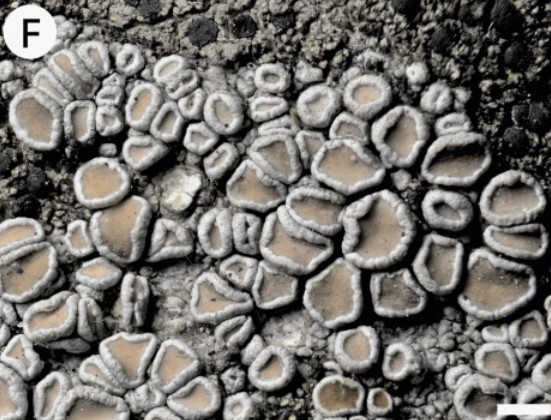
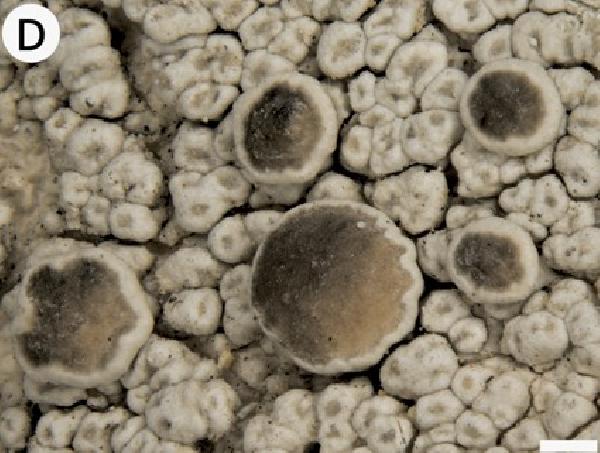
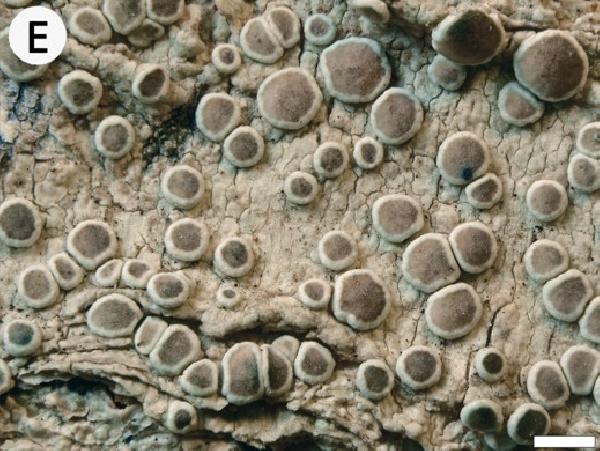
Description: Thallus crustose, episubstratic, 0.05-0.2 mm thick, whitish to medium grey, often with a yellowish tinge, continuous, smooth to finely rimose, rarely areolate, the areoles 0.2-1 mm wide, irregular in outline, finely to strongly verruculose, sometimes delimited by a thin black prothallus. Apothecia lecanorine, 0.4-1.5(-2.5) mm across, adnate to sessile, round to irregular, scattered or crowded and then angular from mutual compression, with a pale beige to greyish brown, frequently mottled, sometimes initially pruinose disc and a prominent and persistent, smooth to uneven thalline margin. Thalline exciple corticate, (25-)50-150(-300) μm thick, with large crystals soluble in K but not in N, pulicaris-type, the cortex 20-50(-60) μm thick; proper exciple colourless, lacking crystals; epithecium colourless to pale orange-brown, pulicaris-type, i.e. with small (0.5-1 μm) crystals visible under polarized light, distributed mainly along the upper part of the paraphyses, soluble rapidly in K, slowly in N, penetrating into the hymenium for c. 20 μm; hymenium colourless, 70-100(-115) μm high, not inspersed with oil droplets; paraphyses 1.5-2 μm thick, slightly thickened apically; hypothecium colourless, 125-250(-300) μm high. Asci 8-spored, clavate, very thin-walled, with a K/I+ blue, tall tholus penetrated by a faintly amyloid apical cushion, the wall K/I-, surrounded by a blue outer layer, Lecanora-type. Ascospores 1-celled, hyaline, broadly ellipsoid, 12.3-14.4(-17) x (6-)6.7-8.8(-11) μm. Pycnidia rare. Conidia thread-like, almost straight to curved 12-18 x c. 0.8 μm. Photobiont chlorococcoid. Spot tests: thallus and apothecial margin K+ yellow, C-, KC+ pale yellow, P- or P+ pale yellow, UV-. Chemistry: atranorin and roccellic acid, sometimes with an additional unknown fatty acid, possibly nephrosteranic acid.Note: a recently-described, semi-cryptic species in the L. hybocarpa complex. It seems to be widespread and common in Central Europe, mostly on isolated deciduous trees, and its presence in Italy is very likely, but the species was likely confused with L. chlarotera in the past. For further details see Arup & al. (2025).
Growth form: Crustose
Substrata: bark
Photobiont: green algae other than Trentepohlia
Reproductive strategy: mainly sexual
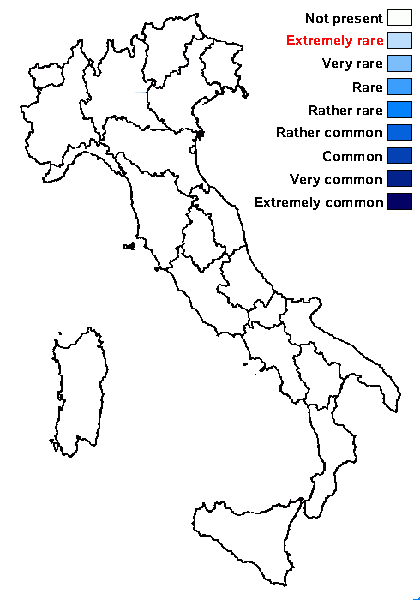
Predictive model
CC BY 4.0 - Source: Arup U, Malíček J, Schiefelbein U, Holien H. Lecanora hybocarpa and similar European species. The Lichenologist. 2025;57(6):239-255. doi:10.1017/S0024282925101291
L. subsinuosa (Malíček 6928). - Scale bar: 0.5 mm
CC BY 4.0 - Source: Arup U, Malíček J, Schiefelbein U, Holien H. Lecanora hybocarpa and similar European species. The Lichenologist. 2025;57(6):239-255. doi:10.1017/S0024282925101291
L. subsinuosa, holotype (TRH L-33654). - Scale bar: 0.5 mm
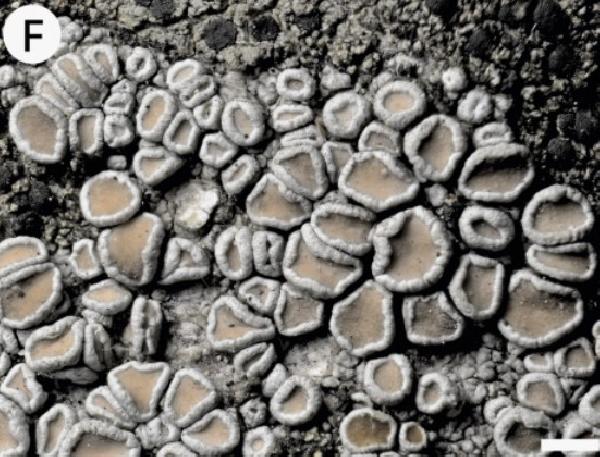
CC BY 4.0 - Source: Arup U, Malíček J, Schiefelbein U, Holien H. Lecanora hybocarpa and similar European species. The Lichenologist. 2025;57(6):239-255. doi:10.1017/S0024282925101291
L. subsinuosa (TRH L-13230). - Scale bar: 0.5 mm
Growth form: Crustose
Substrata: bark
Photobiont: green algae other than Trentepohlia
Reproductive strategy: mainly sexual
Predictive model

CC BY 4.0 - Source: Arup U, Malíček J, Schiefelbein U, Holien H. Lecanora hybocarpa and similar European species. The Lichenologist. 2025;57(6):239-255. doi:10.1017/S0024282925101291
L. subsinuosa (Malíček 6928). - Scale bar: 0.5 mm

CC BY 4.0 - Source: Arup U, Malíček J, Schiefelbein U, Holien H. Lecanora hybocarpa and similar European species. The Lichenologist. 2025;57(6):239-255. doi:10.1017/S0024282925101291
L. subsinuosa, holotype (TRH L-33654). - Scale bar: 0.5 mm