Anaptychia mereschkowskii (Tomin) Kulakov
Bot. Zh. SSSR, 88, 9: 100, 2003, comb. inval.. Basionym: Physcia mereschkowskii Tomin - Neue Flecht. Süd- Russl.: 7, 1926.
Synonyms: Kurokawia mereschkowskii (Tomin) S.Y. Kondr., Lőkös & Hur
Distribution: N - Ven (Nascimbene & Nimis in prep.).
Description: Thallus foliose, heteromerous, dorsiventral, forming regular to rarely irregular, up to 3-4(-6) cm wide rosettes, the lobed closely appressed, flat to slightly convex, 0.5-1(2) mm wide, deeply divided, densely white-pruinose except usually at the very tips which are dark brown or reddish-brown. Soralia laminal, circular to crater-shaped, rarely spreading over the entire surface, originating from swollen pustules which burst open revealing the granular, blackish, isidia-like soredia. Lower surface pale, attached by simple or weakly branched, pale (except sometimes at margins) rhizines. Upper cortex prosoplectenchymatous; medulla white, more or less dense; lower cortex poorly developed, prosoplectenchymatous. Apothecia very rare (never observed in the mature state), lecanorine, with a dark disc and thick, incurved thalline margin. Ascospores not known. Pycnidia immersed. Conidia bacilliform. Photobiont chlorococcoid. Spot tests: cortex and medulla K-, C-, KC-, P-. Chemistry: unknown, but probably devoid of lichen substances.Note: a species of the eurasiatic steppes growing on sunny, calciferous substrata, mostly on rain-sheltered surfaces, surprisingly found in the Italian Alps by J. Nascimbene. The species has been frequently confused with the esorediate A. desertorum. For further details see Kulakov (2003) and Urbanavichus (2022).
Growth form: Foliose, narrow lobed
Substrata: rocks
Photobiont: green algae other than Trentepohlia
Reproductive strategy: mainly asexual, by soredia, or soredia-like structures (e.g. blastidia)
Subcontinental: restricted to areas with a dry-subcontinental climate (e.g. dry Alpine valleys, parts of Mediterranean Italy)
In underhangs rarely wetted by rain
Commonnes-rarity: (info)
Alpine belt: absent
Subalpine belt: extremely rare
Oromediterranean belt: absent
Montane belt: extremely rare
Submediterranean belt: absent
Padanian area: absent
Humid submediterranean belt: absent
Humid mediterranean belt: absent
Dry mediterranean belt: absent
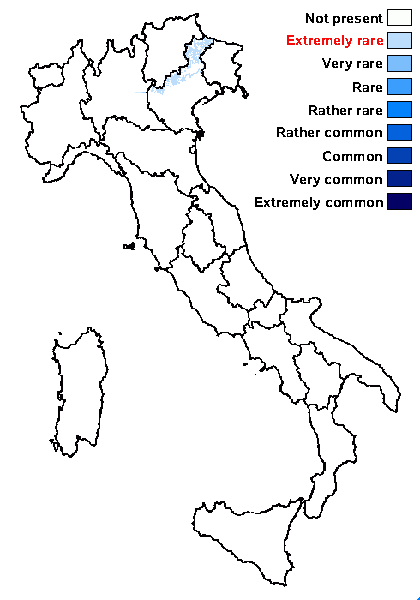
Predictive model


Juri Nascimbene - CC BY 4.0
Italy, Veneto, BL, Parco Nazionale Dolomiti Bellunesi

Juri Nascimbene - CC BY 4.0
Italy, Veneto, BL, Parco Nazionale Dolomiti Bellunesi

Juri Nascimbene - CC BY 4.0
Italy, Veneto, BL, Parco Nazionale Dolomiti Bellunesi

Juri Nascimbene - CC BY 4.0
Italy, Veneto, BL, Parco Nazionale Dolomiti Bellunesi

Juri Nascimbene - CC BY 4.0
Italy, Veneto, BL, Parco Nazionale Dolomiti Bellunesi
Growth form: Foliose, narrow lobed
Substrata: rocks
Photobiont: green algae other than Trentepohlia
Reproductive strategy: mainly asexual, by soredia, or soredia-like structures (e.g. blastidia)
Subcontinental: restricted to areas with a dry-subcontinental climate (e.g. dry Alpine valleys, parts of Mediterranean Italy)
In underhangs rarely wetted by rain
Commonnes-rarity: (info)
Alpine belt: absent
Subalpine belt: extremely rare
Oromediterranean belt: absent
Montane belt: extremely rare
Submediterranean belt: absent
Padanian area: absent
Humid submediterranean belt: absent
Humid mediterranean belt: absent
Dry mediterranean belt: absent
Predictive model
 DOLICHENS

Juri Nascimbene - CC BY 4.0
Italy, Veneto, BL, Parco Nazionale Dolomiti Bellunesi

Juri Nascimbene - CC BY 4.0
Italy, Veneto, BL, Parco Nazionale Dolomiti Bellunesi

Juri Nascimbene - CC BY 4.0
Italy, Veneto, BL, Parco Nazionale Dolomiti Bellunesi

Juri Nascimbene - CC BY 4.0
Italy, Veneto, BL, Parco Nazionale Dolomiti Bellunesi