Myriospora hilitzeri K. Knudsen, Pušová & Kocourk.
in Knudsen & al., MycoKeys, 139: 77, 2026.
Synonyms:
Distribution: N- Piem (Knudsen & al. 2026). S - Cal (Knudsen & al. 2026).
Description: Thallus crustose, episubstratic, areolate, the areoles (1-)1.5-2(-3) mm wide, 0.5-0.6 mm thick, pale brown, irregular in shape, rarely convex, broadly attached, usually starting to replicate by division when c. 1 mm wide, sometimes forming up to 4 mm wide clusters with up to c. 10 apothecia; lower surface white to brown. Epicortex absent or indistinct, to 10 µm thick; cortex 45-70 µm thick, with mostly round, 3-5 µm wide cells; algal layer 100-110 µm thick, partially interrupted by 30-40 µm wide hyphal bands; medulla up to 350 µm thick. Apothecia (0.1-)0.2-0.5 mm across, immersed or slightly elevated, with a reddish brown to almost black disc and sometimes a thin parathecial ring. Proper exciple to 15-30 µm wide; epithecium 15-30 µm high, pale brown; hymenium colourless, 130-170 µm high, the hymenial gel I+ red or hemiamyloid; paraphyses c. 1 µm thick at mid-level, the apical cells up to 2 µm wide; subhymenium 50-60 µm high, inspersed with oil droplets, euamyloid; hypothecium indistinct, to 20 µm high. Asci >100-spored, narrowly clavate, the apical dome K/I-, 70-80 x 7-13 µm. Ascospores 1-celled, hyaline, narrowly to broadly ellipsoid, 2-3(-4) x 1-3 µm.. Pycnidia black, c. 40 x 95 µm, the conidiogenous cells 10-14 x c. 2 µm. Conidia globose or ellipsoid, 2(-3) x c. 1 µm. Photobiont chlorococcoid. Spot tests: cortex and medulla K-, C-, KC-, P-, UV-. Chemistry: without lichen substances.Note: a recently described species, hitherto known from the Czech Republic, Germany and Italy, growing on more or less base-rich siliceous rocks, often in rain-sheltered situations under overhangs. Probably more widespread in Italy. For further details see Knudsen & al. (2026).
Growth form: Crustose
Substrata: rocks
Photobiont: green algae other than Trentepohlia
Reproductive strategy: mainly sexual
In underhangs rarely wetted by rain
Commonnes-rarity: (info)
Alpine belt: very rare
Subalpine belt: very rare
Oromediterranean belt: very rare
Montane belt: extremely rare
Submediterranean belt: absent
Padanian area: absent
Humid submediterranean belt: absent
Humid mediterranean belt: absent
Dry mediterranean belt: absent
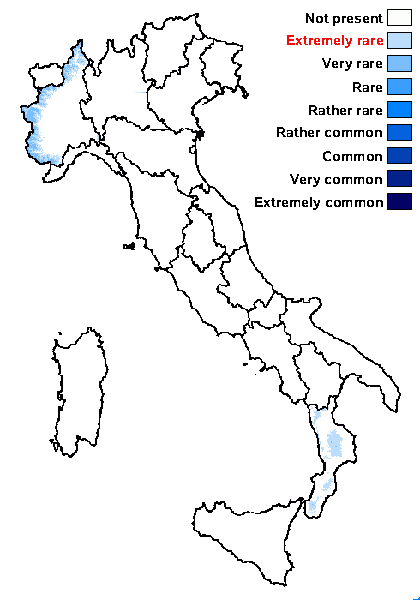
Predictive model
Herbarium samples

CC BY 4.0 – Source: Knudsen K, Pušová T, Kocourková J, Kondrysová E (2026) Two new species of Myriospora (Lecanoromycetes, Acarosporomycetidae, Acarosporales, Acarosporaceae) from Europe, one last observed in 1925. MycoKeys 139: 73-87. https://doi.org/10.3897/mycokeys.139.200273
Myriospora hilitzeri - Palice 27581, holotype (A), Malíček 8554 (B), Malíček et al. 1303 (C), Bouda, PRM 953588 (D). A. Habit of the areolate thallus with apothecia; B. Thallus areoles on process of replicating areoles with up to 10 young apothecia; C. Areoles with apothecia without conspicuous parathecium; D. Convex areoles with apothecia showing distinct parathecium. Scale bars: 1 mm (A, B); 500 μm (C, D).

CC BY 4.0 – Source: Knudsen K, Pušová T, Kocourková J, Kondrysová E (2026) Two new species of Myriospora (Lecanoromycetes, Acarosporomycetidae, Acarosporales, Acarosporaceae) from Europe, one last observed in 1925. MycoKeys 139: 73-87. https://doi.org/10.3897/mycokeys.139.200273
Myriospora hilitzeri - Palice 27581, holotype (A), Malíček 8554 (B), Malíček et al. 1303 (C), Bouda, PRM 953588 (D). A. Habit of the areolate thallus with apothecia; B. Thallus areoles on process of replicating areoles with up to 10 young apothecia; C. Areoles with apothecia without conspicuous parathecium; D. Convex areoles with apothecia showing distinct parathecium. Scale bars: 1 mm (A, B); 500 μm (C, D).
Growth form: Crustose
Substrata: rocks
Photobiont: green algae other than Trentepohlia
Reproductive strategy: mainly sexual
In underhangs rarely wetted by rain
Commonnes-rarity: (info)
Alpine belt: very rare
Subalpine belt: very rare
Oromediterranean belt: very rare
Montane belt: extremely rare
Submediterranean belt: absent
Padanian area: absent
Humid submediterranean belt: absent
Humid mediterranean belt: absent
Dry mediterranean belt: absent
Predictive model
| Herbarium samples |

CC BY 4.0 – Source: Knudsen K, Pušová T, Kocourková J, Kondrysová E (2026) Two new species of Myriospora (Lecanoromycetes, Acarosporomycetidae, Acarosporales, Acarosporaceae) from Europe, one last observed in 1925. MycoKeys 139: 73-87. https://doi.org/10.3897/mycokeys.139.200273
Myriospora hilitzeri - Palice 27581, holotype (A), Malíček 8554 (B), Malíček et al. 1303 (C), Bouda, PRM 953588 (D). A. Habit of the areolate thallus with apothecia; B. Thallus areoles on process of replicating areoles with up to 10 young apothecia; C. Areoles with apothecia without conspicuous parathecium; D. Convex areoles with apothecia showing distinct parathecium. Scale bars: 1 mm (A, B); 500 μm (C, D).