Caloplaca cravensis (Clauzade & Wunder) Cl. Roux
in Roux et al., Catal. Lich. Champ. Lich. France Métrop.: 1314, 2014. Basionym: Caloplaca conversa var. cravensis Clauzade & Wunder - in Wunder, Bibl. Lichenol. 3: 126, 1974.
Synonyms:
Distribution:
Description: Thallus crustose, thinly episubstratic, rimose-areolate, at first ash-grey but soon turning dark brown to brown-black. Apothecia lecanorine, 0.1-0.5 mm across, with a flat to slightly convex, dark brown to black disc, a thin, concolour proper margin, and an initially thick, finally often excluded thalline margin. Epithecium brown, K+ pale violet; hymenium colourless, without oil droplets and without crystals; paraphyses mostly simple o few sparingly branched in upper part, 1.5-2 µm thick at mid-level, the apical cells 3.5-5 µm wide. Asci 8-spored, clavate, functionally unitunicate, apically thickened with a broad internal beak, the inner part of apex and external cap I+ blue, Teloschistes-type. Ascospores 2-celled, polarilocular, hyaline, ellipsoid, 8-13 x 4-8 µm, the septum 5-7(-7.5) µm, up to 1/2 of spore length. Photobiont chlorococcoid. Spot tests: thallus surface K-, C-, KC- P-, UV-; upper part of medulla (especially below the apothecia) intensively but fleeting C+ carmine-red. Chemistry: medulla with gyrophoric acid.Note: a species of more less basic siliceous rocks found in rain-exposed, sunny sites, sometimes on pebbles, known from the French Alps at low elevations. To be looked for in Italy. The species does not belong to Caloplaca s.str. but the precise generic attribution is still pending.
Growth form: Crustose
Substrata: rocks
Photobiont: green algae other than Trentepohlia
Reproductive strategy: mainly sexual
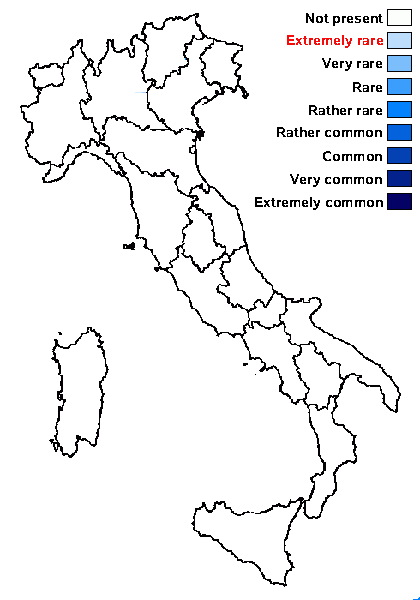
Predictive model

Courtesy Serge Poumarat
France, 10/10/2020 - Rustrel, alt. 420 m - Vaucluse
Growth form: Crustose
Substrata: rocks
Photobiont: green algae other than Trentepohlia
Reproductive strategy: mainly sexual
Predictive model