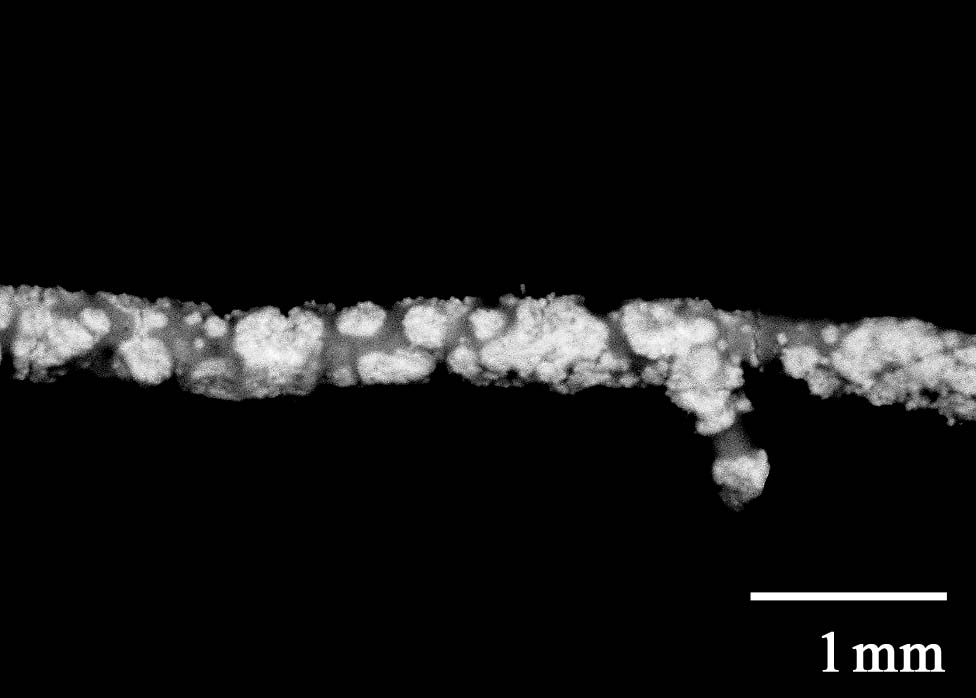
Usnea praetervisa (Asahina) P. Clerc
Bibl. Lichenol., 88: 85, 2004. Basionym: Usnea comosa subsp. praetervisa Asahina - Lich. Japan, 3. Genus Usnea: 95, 1956
Synonyms: Usnea subfloridana subsp. praetervisa (Asahina) P. Clerc
Distribution:
Description: Thallus fruticose-filamentous, greenish, shrubby, 2-6(-8) cm long, with anisotomic- to isotomic-dichotomous branches. Main branches tapering, the basal part jet black to brownish black; lateral branches not narrowed at attachment point. Papillae few to numerous, verrucose-cylindrical, mainly on the main branches; tubercles few, irregularly distributed; fibercles numerous on terminal branches, looking like pseudocyphellae, coalescing together, frequently evolving into soralia; fibrils few to numerous, more or less regularly distributed, short (< 3 mm) and slender. Soralia minute, irregular, without a reflexed edge, smaller than half of the diameter of the branch, arising mainly on fibercles, even and plane, frequently coalescing and looking like a large soralium, generally numerous, sometimes entirely covering the terminal branches; isidiomorphs spinulose, developing inside the soralia, 0.1-0.2 mm long, numerous especially on young soralia, but present on mature soralia as well. Cortex thin to moderately thick (5-11% of total branch thickness), dull to shiny in longitudinal section; medulla usually thin (12-22%), dense to compact, sometimes orange-pigmented peripherally; central axis thick (41-62%), white. Apothecia not known. Photobiont chlorococcoid. Spot tests: cortex K-, C- KC-, P-; medulla and soralia K+ dull yellow slowly turning orange-red, C-, KC-, P+ deep yellow. Chemistry: cortex with usnic acid; medulla with norstictic acid (major) and substances of the stictic acid complex.Note: a species with a broad world distribution extending to Asia and North America, mainly western and southern in Europe, being known from Corsica, Portugal and Spain. To be looked for in Tyrrhenian Italy.
Growth form: Fruticose filamentous
Substrata: bark
Photobiont: green algae other than Trentepohlia
Reproductive strategy: mainly asexual, by soredia, or soredia-like structures (e.g. blastidia)
Most common in areas with a humid-warm climate (e.g. most of Tyrrenian Italy)
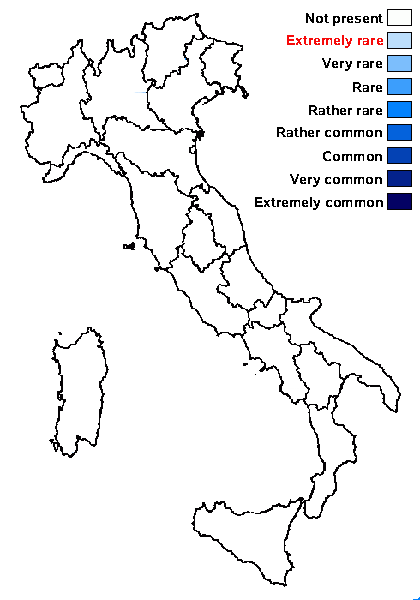
Predictive model
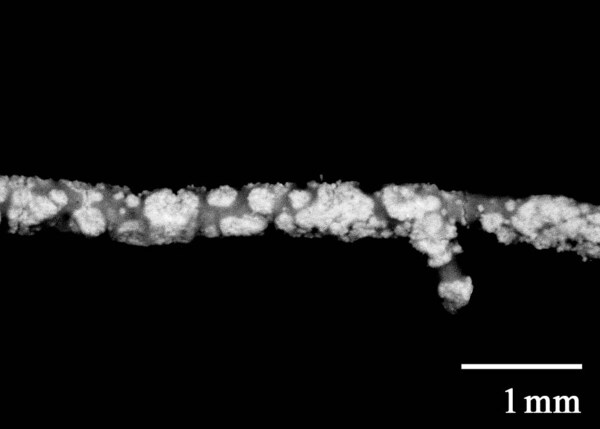
Philippe Clerc - CC BY-SA 3.0 - Source: https://lichenportal.org/portal/taxa/index.php?taxon=125928&clid=1187
Growth form: Fruticose filamentous
Substrata: bark
Photobiont: green algae other than Trentepohlia
Reproductive strategy: mainly asexual, by soredia, or soredia-like structures (e.g. blastidia)
Most common in areas with a humid-warm climate (e.g. most of Tyrrenian Italy)
Predictive model
 Index Fungorum
 GBIF
GBIF