Toniniopsis fusispora (Hepp ex Körb.) Cl. Roux
Catal. Lich. France Métr., 3rd ed., 1: 1290, 2020. Basionym: Raphiospora fusispora Hepp ex Körb. - Parerga Lichenol., 3: 237, 1861
Synonyms:
Distribution:
Description: Thallus small-squamulose to subcrustose, whitish to pale grey, often green-spotted, appearing maculate when wet, dull, epruinose or completely covered with a white pruina. Squamules up to 1.5 mm in diam., flat to slightly convex, with flexuose margins, scattered to aggregated (often on a black cyanobacterial mat). Upper cortex c. 50 μm thick, lacking crystals and epinecral later; algal layer discontinuous; medulla white, without crystals. Apothecia frequent, lecideine, strongly constricted at base, up to 1 mm across, with a black, epruinose, flat disc and a distinct, smooth, brown-black (paler than disc), shining proper margin. Proper exciple dark reddish brown, K-, N-; epithecium brown-green, dark olivaceous green to green, K-, N+ violet; hymenium colourless to straw-coloured, 60-65 μm high; paraphyses not conglutinated, simple or sparingly branched and anastomosing in upper part, thin-walled, the apical cell distinctly swollen and covered by a gelatinous pigment cap; hypothecium dark reddish brown. Asci 8-spored, clavate, surrounded by a gelatinous I+ blue coat, with a well-developed I+ blue tholus, an I+ darker blue tube and a well-developed ocular chamber, Bacidia-type. Ascospores (1-)3-septate, hyaline, cylindrical with pointed ends, (14-)16-29(-35) x 3.5-5 μm. Pycnidia dark, immersed. Conidia filiform, sickle-shaped, 10-12.5 x c. 1 μm. Photobiont chlorococcoid. Spot tests: thallus K-, C-, KC-, P-, UV-. Chemistry: thallus without lichen substances.Note: for a long time considered as a synonym of T. aromatica, this seems to be a good species, characterized by the larger ascospores with pointed ends. It grows on more or less calciferous rocks in upland areas and is known from the British Isles (Cannon & al. 2021) and the French Alps (see Roux 2020). To be looked for in the Italian Alps.
Growth form: Crustose
Substrata: rocks
Photobiont: green algae other than Trentepohlia
Reproductive strategy: mainly sexual
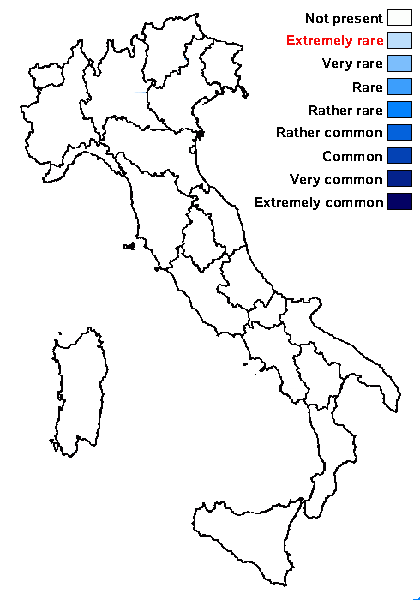
Predictive model
Growth form: Crustose
Substrata: rocks
Photobiont: green algae other than Trentepohlia
Reproductive strategy: mainly sexual
Predictive model
 Index Fungorum
 GBIF
GBIF