Gomphillus calycioides (Duby) Nyl.
Mém. Soc. Sc. Nat. Cherbourg, 2: 15, 1853. Basionym: Baeomyces calycioides Delise ex Duby - Bot. Gallic., 2: 636, 1830.
Synonyms: Berengeria calicioides (Duby) A. Massal.; Mycetodium calicioides (Duby) A. Massal.
Description: Thallus crustose, thin, membranous, translucent when moist, pale grey to greenish, often poorly evident, the hyphae penetrating the cells of moss and liverwort leaflets. Apothecia borne on short stalks which are black in upper part, paler in lower part, solitary or clustered, 0.2-0.7 mm across, with a convex, dark brown to black disc. Exciple well-developed, extending below into the stalk, pale brown in upper and outer part, almost colourless within; epithecium reddish brown; hymenium colourless, 280-360 µm high; paraphyses thin, anastomosing, the apices not swollen. Asci 8-spored, narrowly cylindrical, with a K/I- apical tholus, fissitunicate, Gomphillus-type. Ascospores many-septate (with up to 100 septa), with almost square cells, hyaline, thread-like, 160-210 x 1.5-2(-3) µm, with rounded apices. Pycnidial wall black in upper part, pale below. Conidia minutely ellipsoid, 2-4 x 0.5-0.7 µm. Photobiont chlorococcoid. Spot tests: thallus and apothecia K-, C-, KC-, P-. Chemistry: without lichen substances.
Growth form: Crustose
Substrata: bark
Photobiont: green algae other than Trentepohlia
Reproductive strategy: mainly sexual
Restricted to humid-warm, oceanic areas
Commonnes-rarity: (info)
Alpine belt: absent
Subalpine belt: absent
Montane belt: absent
Dry submediterranean belt: extremely rare
Humid submediterranean belt: absent
Padanian area: absent
pH of the substrata:
1 2 3 4 5

Solar irradiation:
1 2 3 4 5
Aridity:
1 2 3 4 5
Eutrophication:
1 2 3 4 5
Poleotolerance:
0 1 2 3
Altitudinal distribution:
1 2 3 4 5 6
Rarity
absent
extremely rare
very rare
rare
rather rare
rather common
common
very common
extremely common
Loading data...
Occurrence data
Predictive map

P.L. Nimis CC BY-SA 4.0
TSB 9291

P.L. Nimis; Owner: Department of Life Sciences, University of Trieste
Herbarium: TSB (17119)
2001/11/24

Photo by Maria Zardini, Museo di Storia Naturale di Venezia CC BY-SA 4.0
Supra muscos in sylva Montello prov. Tarvisinae.
Trevisan Lichenotheca Veneta 96

Photo by Maria Zardini, Museo di Storia Naturale di Venezia CC BY-SA 4.0
Supra muscos in sylva Montello prov. Tarvisinae.
Trevisan Lichenotheca Veneta 96

Photo by Maria Zardini, Museo di Storia Naturale di Venezia CC BY-SA 4.0
Supra muscos in sylva Montello prov. Tarvisinae.
Trevisan Lichenotheca Veneta 96

Photo by Maria Zardini, Museo di Storia Naturale di Venezia CC BY-SA 4.0
Supra muscos in sylva Montello prov. Tarvisinae.
Trevisan Lichenotheca Veneta 96

Photo by Maria Zardini, Museo di Storia Naturale di Venezia CC BY-SA 4.0
Supra muscos in sylva Montello prov. Tarvisinae.
Trevisan Lichenotheca Veneta 96

P.L. Nimis; Owner: Department of Life Sciences, University of Trieste
Herbarium: TSB (9291)
2001/11/24
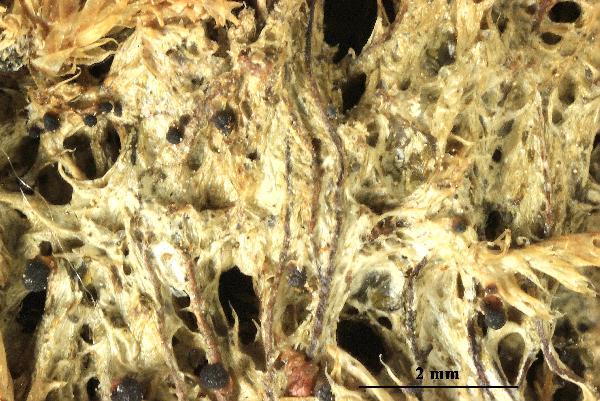
Felix Schumm - CC BY 4.0
[VZ1167], Gallia. Pyrenaei montes occident. Haute-Saule: Assurrucq,
Arbailles, 600 m. Ad truncum muscorum Fagi sivaticae. Leg. J. Vivant,
28.12.1972. EX A. VEZDA LICHENES SELECTI EXSICCATIU NR. 1167.
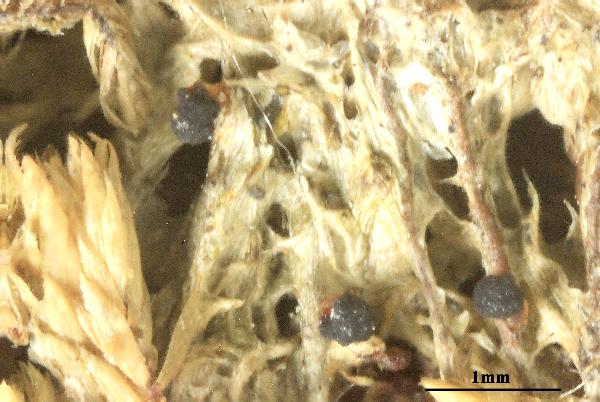
Felix Schumm - CC BY 4.0
[VZ1167], Gallia. Pyrenaei montes occident. Haute-Saule: Assurrucq,
Arbailles, 600 m. Ad truncum muscorum Fagi sivaticae. Leg. J. Vivant,
28.12.1972. EX A. VEZDA LICHENES SELECTI EXSICCATIU NR. 1167.
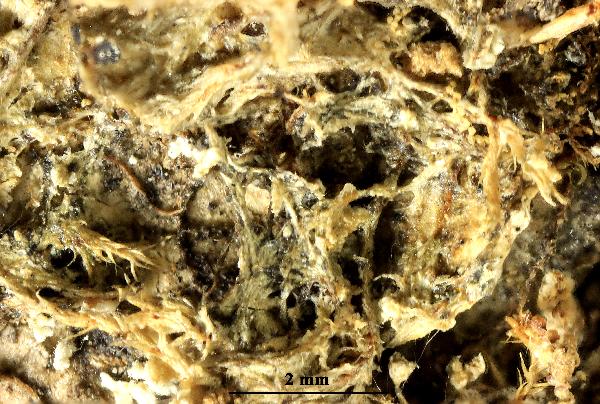
Felix Schumm - CC BY 4.0
[VZ1715], Magna Britannia. Caledonia, Argyll. Inver, Glasdrum, Loch
Creran. Supra muscos ad truncum arboris. Leg. P. W. James. EX A.
VEZDA LICHENES SELECTI EXSICCATI NR. 1715.
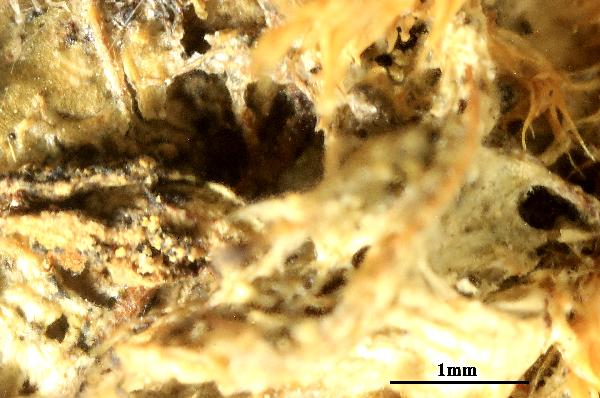
Felix Schumm - CC BY 4.0
[VZ1715], Magna Britannia. Caledonia, Argyll. Inver, Glasdrum, Loch
Creran. Supra muscos ad truncum arboris. Leg. P. W. James. EX A.
VEZDA LICHENES SELECTI EXSICCATI NR. 1715.
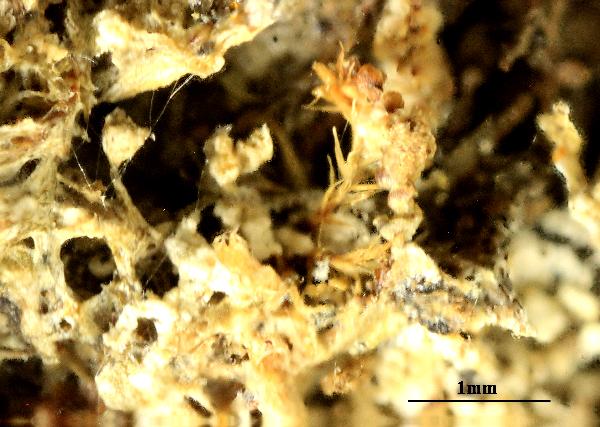
Felix Schumm - CC BY 4.0
[VZ1715], Magna Britannia. Caledonia, Argyll. Inver, Glasdrum, Loch
Creran. Supra muscos ad truncum arboris. Leg. P. W. James. EX A.
VEZDA LICHENES SELECTI EXSICCATI NR. 1715.

Frey E. 1933. Cladoniaceae (unter Ausschluß ded Gattung Cladonia) und Umbilicariaceae. In: Rabenhrst’s Kryptogamenflora von Deutschland, Österreich und der Schweiz. 15: 1-208.

Source: Vězda A. (1979) Folia Geobot. Phytotax. 14: 43-94 Flechtensystematische Studien IX. Beiträge zur Kenntnis der Familie Asterothyriaceae (Discolichens).
Gomphillus calycioide8 (DEL. ex DUBY) NYL. (Frankreich: Pyrenees, Haut-Saule,
Arbailles, 1972 J. VZVANT). -- ap Vertikalschnitt durch ein }unges Apothecium, aa unreifer Ascus
und Paraphysen, b Habitus, ep Sporen.
Growth form: Crustose
Substrata: bark
Photobiont: green algae other than Trentepohlia
Reproductive strategy: mainly sexual
Restricted to humid-warm, oceanic areas
Commonnes-rarity: (info)
Alpine belt: absent
Subalpine belt: absent
Montane belt: absent
Dry submediterranean belt: extremely rare
Humid submediterranean belt: absent
Padanian area: absent
pH of the substrata:
| 1 | 2 | 3 | 4 | 5 |
Solar irradiation:
| 1 | 2 | 3 | 4 | 5 |
Aridity:
| 1 | 2 | 3 | 4 | 5 |
Eutrophication:
| 1 | 2 | 3 | 4 | 5 |
Poleotolerance:
| 0 | 1 | 2 | 3 |
Altitudinal distribution:
| 1 | 2 | 3 | 4 | 5 | 6 |
Rarity
absent
extremely rare
very rare
rare
rather rare
rather common
common
very common
extremely common
Loading data...
Occurrence data
Predictive map

P.L. Nimis CC BY-SA 4.0
TSB 9291

P.L. Nimis; Owner: Department of Life Sciences, University of Trieste
Herbarium: TSB (17119)
2001/11/24

Photo by Maria Zardini, Museo di Storia Naturale di Venezia CC BY-SA 4.0
Supra muscos in sylva Montello prov. Tarvisinae.
Trevisan Lichenotheca Veneta 96

Photo by Maria Zardini, Museo di Storia Naturale di Venezia CC BY-SA 4.0
Supra muscos in sylva Montello prov. Tarvisinae.
Trevisan Lichenotheca Veneta 96

Photo by Maria Zardini, Museo di Storia Naturale di Venezia CC BY-SA 4.0
Supra muscos in sylva Montello prov. Tarvisinae.
Trevisan Lichenotheca Veneta 96

Photo by Maria Zardini, Museo di Storia Naturale di Venezia CC BY-SA 4.0
Supra muscos in sylva Montello prov. Tarvisinae.
Trevisan Lichenotheca Veneta 96

Photo by Maria Zardini, Museo di Storia Naturale di Venezia CC BY-SA 4.0
Supra muscos in sylva Montello prov. Tarvisinae.
Trevisan Lichenotheca Veneta 96

P.L. Nimis; Owner: Department of Life Sciences, University of Trieste
Herbarium: TSB (9291)
2001/11/24

Felix Schumm - CC BY 4.0
[VZ1167], Gallia. Pyrenaei montes occident. Haute-Saule: Assurrucq, Arbailles, 600 m. Ad truncum muscorum Fagi sivaticae. Leg. J. Vivant, 28.12.1972. EX A. VEZDA LICHENES SELECTI EXSICCATIU NR. 1167.

Felix Schumm - CC BY 4.0
[VZ1167], Gallia. Pyrenaei montes occident. Haute-Saule: Assurrucq, Arbailles, 600 m. Ad truncum muscorum Fagi sivaticae. Leg. J. Vivant, 28.12.1972. EX A. VEZDA LICHENES SELECTI EXSICCATIU NR. 1167.

Felix Schumm - CC BY 4.0
[VZ1715], Magna Britannia. Caledonia, Argyll. Inver, Glasdrum, Loch Creran. Supra muscos ad truncum arboris. Leg. P. W. James. EX A. VEZDA LICHENES SELECTI EXSICCATI NR. 1715.

Felix Schumm - CC BY 4.0
[VZ1715], Magna Britannia. Caledonia, Argyll. Inver, Glasdrum, Loch Creran. Supra muscos ad truncum arboris. Leg. P. W. James. EX A. VEZDA LICHENES SELECTI EXSICCATI NR. 1715.

Felix Schumm - CC BY 4.0
[VZ1715], Magna Britannia. Caledonia, Argyll. Inver, Glasdrum, Loch Creran. Supra muscos ad truncum arboris. Leg. P. W. James. EX A. VEZDA LICHENES SELECTI EXSICCATI NR. 1715.

Frey E. 1933. Cladoniaceae (unter Ausschluß ded Gattung Cladonia) und Umbilicariaceae. In: Rabenhrst’s Kryptogamenflora von Deutschland, Österreich und der Schweiz. 15: 1-208.