Hymenelia melanocarpa (Kremp.) Arnold
Flora, 52: 255, 1869. Basionym: Hymenelia prevostii var. melanocarpa Kremp. - Flora, 35: 25, 1852.
Synonyms: Ionaspis cyrtaspis auct. non (Wahlenb.) Arnold; Ionaspis melanocarpa (Kremp.) Arnold; Lecanora prevostii f. melanocarpa (Kremp.) Stizenb.
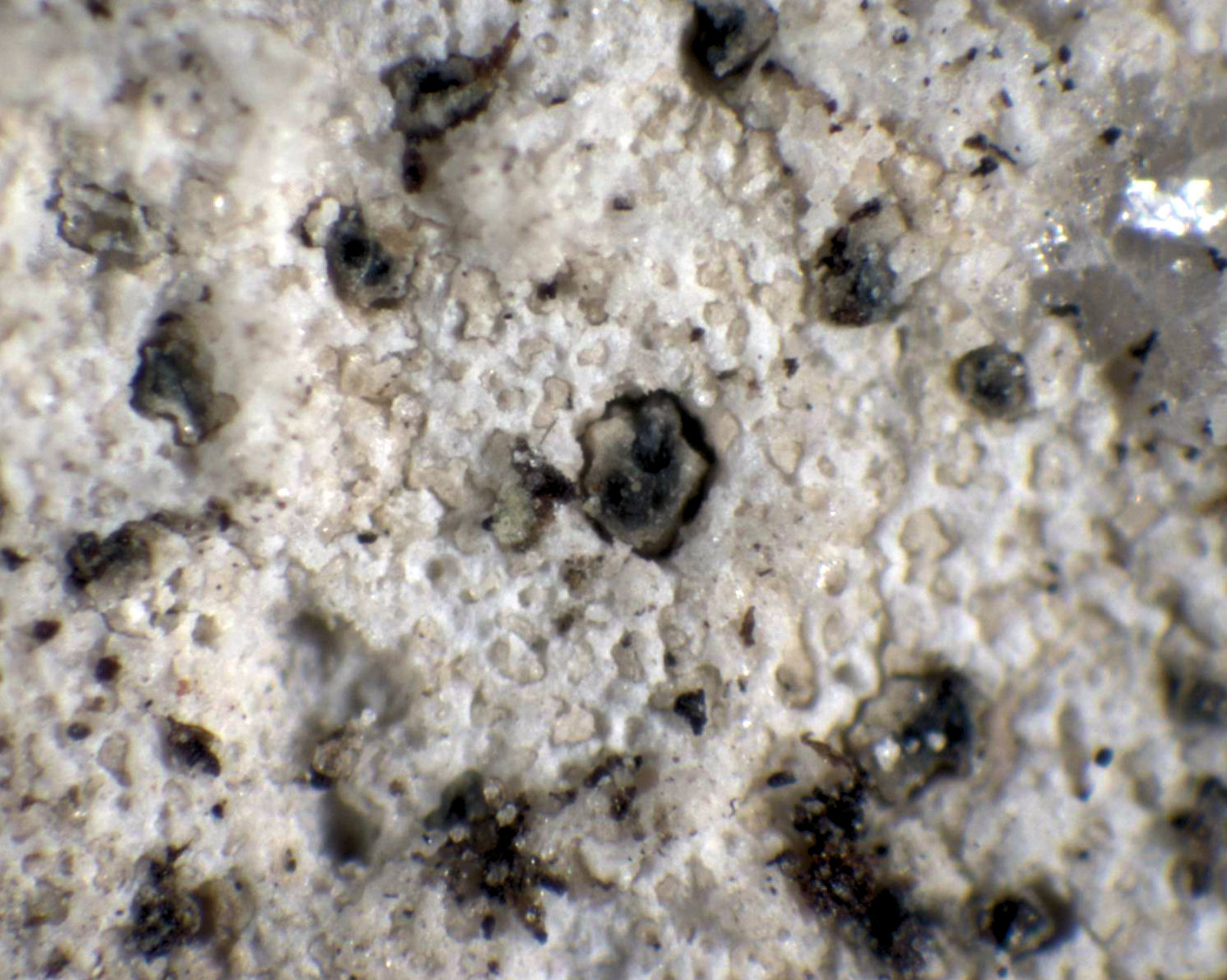
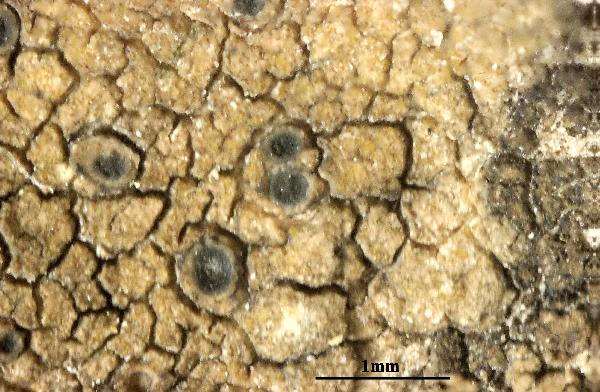
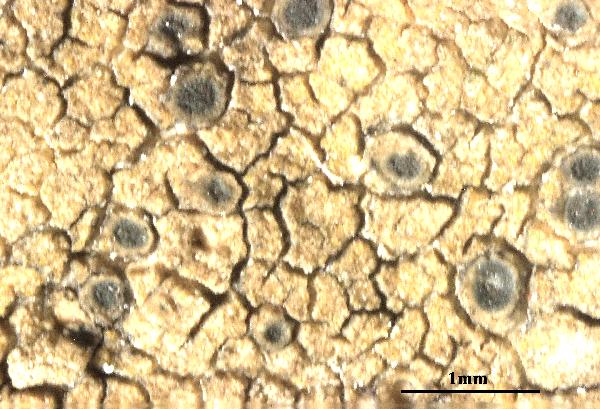
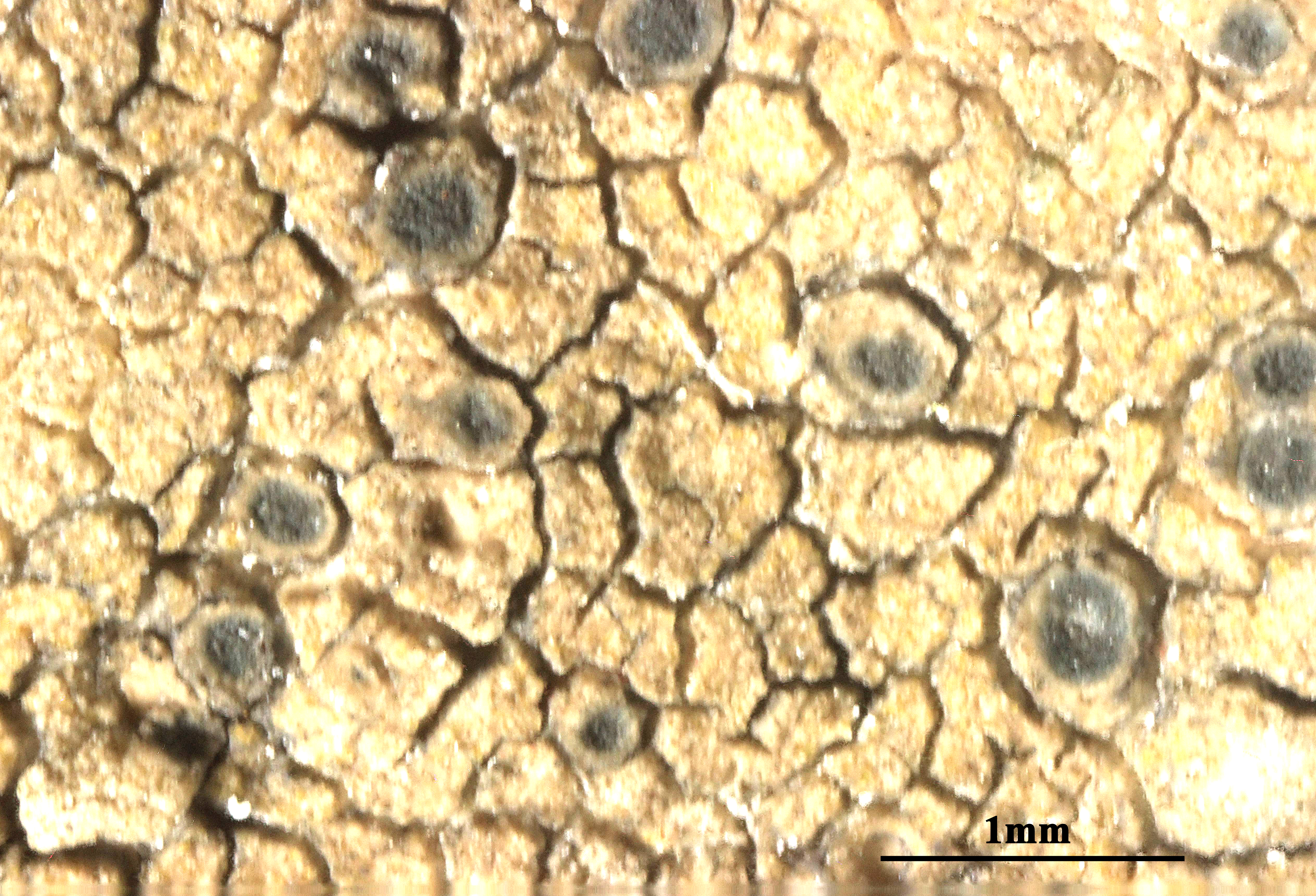
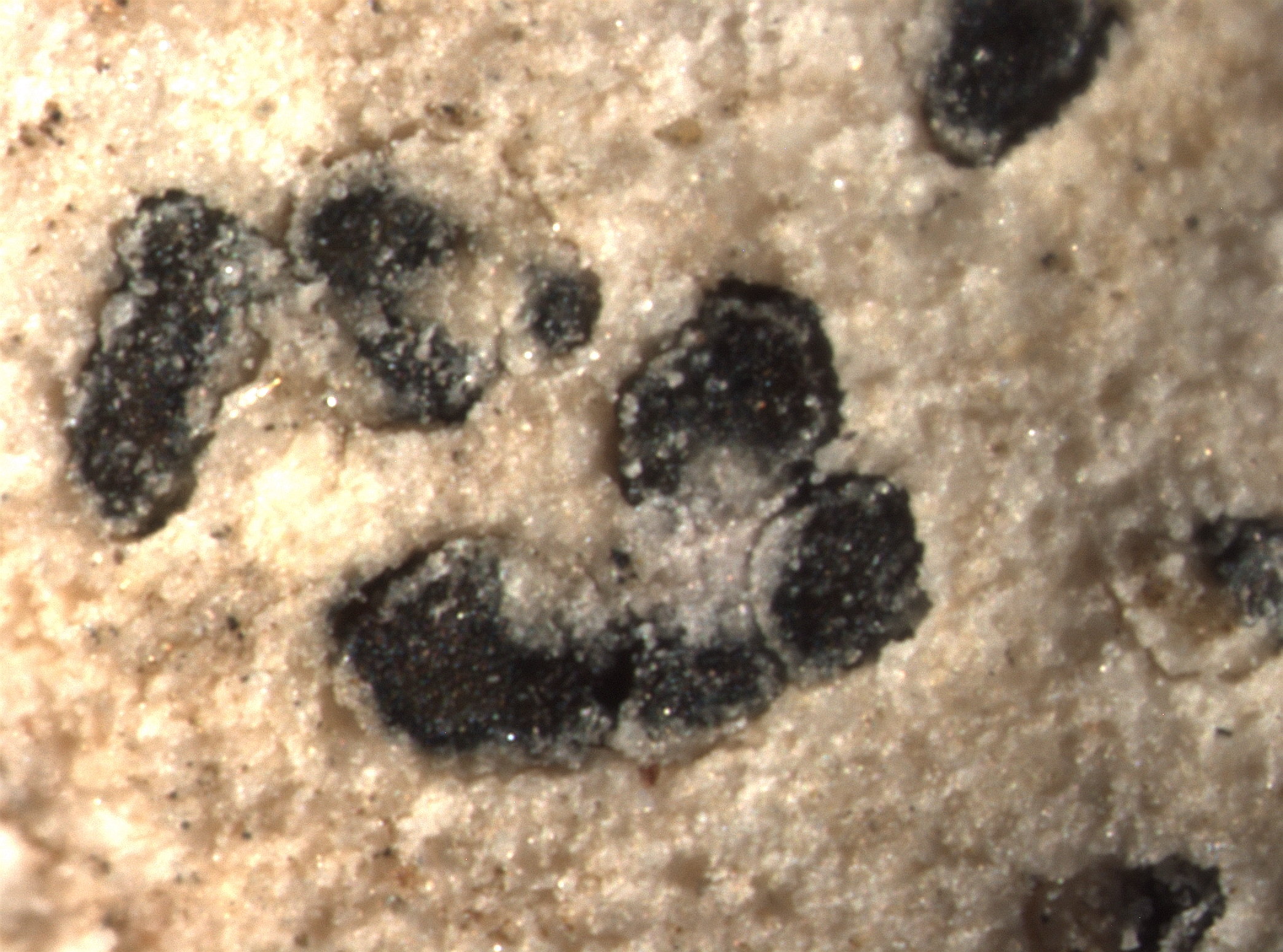
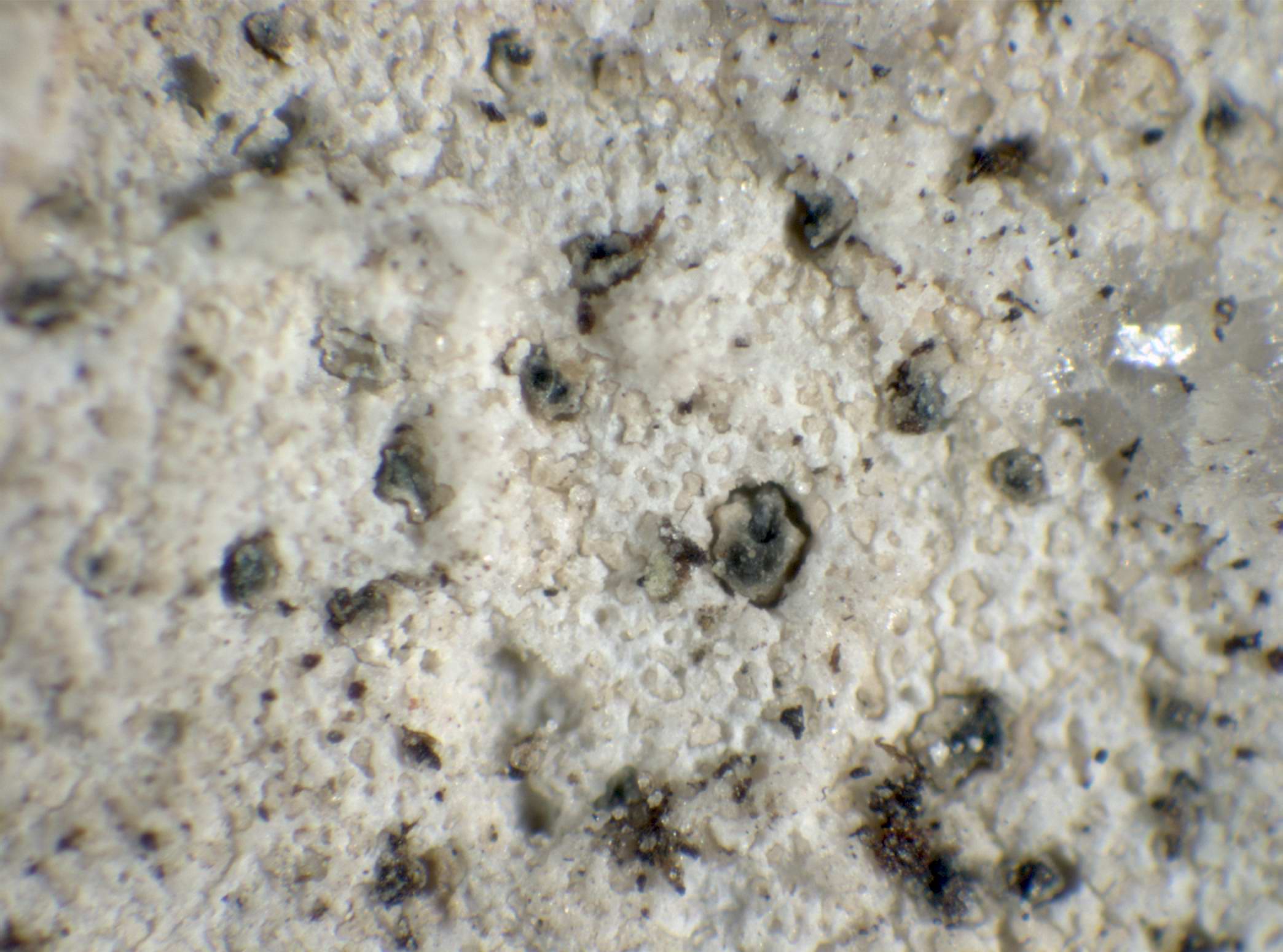
Description: Thallus crustose, endosubstratic or thinly episubstratic, continuous or very finely rimose, pinkish white to yellowish grey. Apothecia (0.2-)0.5-1 mm across, immersed in thalline warts and often separated from the thallus by a circular crack, with a black, at first pore-like and concave, then expanded and flat disc, and a more or less prominent, black proper margin. Proper exciple brown-black; epithecium greenish brown to blue-green, K-, N+ red; hymenium 120-150(-240) µm high, blue-green in upper part, colourless in lower part, the pigmented parts K-, N+ red; paraphyses simple or sparingly branched, submoniliform in upper part, the apical cells slightly swollen; hypothecium colourless. Asci 8-spored, cylindrical-clavate, the outer wall K/I+ blue, but the inner walls and apical dome K/I-. Ascospores 1-celled, hyaline, broadly ellipsoid, (10-)14-20(-24) x 8-13 µm. Pycnidia immersed, with a green wall reacting N+ red. Conidia short-bacilliform. Photobiont trentepohlioid, the cells 10-18 µm wide. Spot tests: thallus K-, C-, KC-, P-, UV-. Chemistry: without lichen substances.
Growth form: Crustose
Substrata: rocks
Photobiont: Trentepohlia
Reproductive strategy: mainly sexual
Commonnes-rarity: (info)
Alpine belt: rather common
Subalpine belt: rather rare
Montane belt: very rare
Dry submediterranean belt: absent
Humid submediterranean belt: absent
Padanian area: absent
pH of the substrata:
1 2 3 4 5

Solar irradiation:
1 2 3 4 5
Aridity:
1 2 3 4 5
Eutrophication:
1 2 3 4 5
Poleotolerance:
0 1 2 3
Altitudinal distribution:
1 2 3 4 5 6
Rarity
absent
extremely rare
very rare
rare
rather rare
rather common
common
very common
extremely common
Loading data...
Occurrence data
Predictive map
Felix Schumm - CC BY 4.0
[VZ1140], Bohemoslovacia. Slovacia. Montes Velká Fatra, in latere
montis Velký Rozsutec, loco Poludñové skály dicto, 1100 m. Ad lapidem
magnam calcaream. Leg. A. Vezda, 6.9.1972. EX A. VEZDA LICHENES
SELECTI EXSICCATI NR. 1140. - As Ionaspis melanocarpa var. crustosa
Felix Schumm - CC BY 4.0
[VZ1140], Bohemoslovacia. Slovacia. Montes Velká Fatra, in latere
montis Velký Rozsutec, loco Poludñové skály dicto, 1100 m. Ad lapidem
magnam calcaream. Leg. A. Vezda, 6.9.1972. EX A. VEZDA LICHENES
SELECTI EXSICCATI NR. 1140. - As Ionaspis melanocarpa var. crustosa

Pier Luigi Nimis - CC BY-SA 4.0
TSB 4024

P.L. Nimis; Owner: Department of Life Sciences, University of Trieste
Herbarium: TSB (19713)
2001/12/18

Pier Luigi Nimis - CC BY-SA 4.0
TSB 4024

Pier Luigi Nimis - CC BY-SA 4.0
TSB 4024

P.L. Nimis CC BY-SA 4.0
TSB 19713
Growth form: Crustose
Substrata: rocks
Photobiont: Trentepohlia
Reproductive strategy: mainly sexual
Commonnes-rarity: (info)
Alpine belt: rather common
Subalpine belt: rather rare
Montane belt: very rare
Dry submediterranean belt: absent
Humid submediterranean belt: absent
Padanian area: absent
pH of the substrata:
| 1 | 2 | 3 | 4 | 5 |
Solar irradiation:
| 1 | 2 | 3 | 4 | 5 |
Aridity:
| 1 | 2 | 3 | 4 | 5 |
Eutrophication:
| 1 | 2 | 3 | 4 | 5 |
Poleotolerance:
| 0 | 1 | 2 | 3 |
Altitudinal distribution:
| 1 | 2 | 3 | 4 | 5 | 6 |
Rarity
absent
extremely rare
very rare
rare
rather rare
rather common
common
very common
extremely common
Loading data...
Occurrence data
Predictive map

Felix Schumm - CC BY 4.0
[VZ1140], Bohemoslovacia. Slovacia. Montes Velká Fatra, in latere montis Velký Rozsutec, loco Poludñové skály dicto, 1100 m. Ad lapidem magnam calcaream. Leg. A. Vezda, 6.9.1972. EX A. VEZDA LICHENES SELECTI EXSICCATI NR. 1140. - As Ionaspis melanocarpa var. crustosa
Felix Schumm - CC BY 4.0
[VZ1140], Bohemoslovacia. Slovacia. Montes Velká Fatra, in latere montis Velký Rozsutec, loco Poludñové skály dicto, 1100 m. Ad lapidem magnam calcaream. Leg. A. Vezda, 6.9.1972. EX A. VEZDA LICHENES SELECTI EXSICCATI NR. 1140. - As Ionaspis melanocarpa var. crustosa
Pier Luigi Nimis - CC BY-SA 4.0
TSB 4024
P.L. Nimis; Owner: Department of Life Sciences, University of Trieste
Herbarium: TSB (19713)
2001/12/18
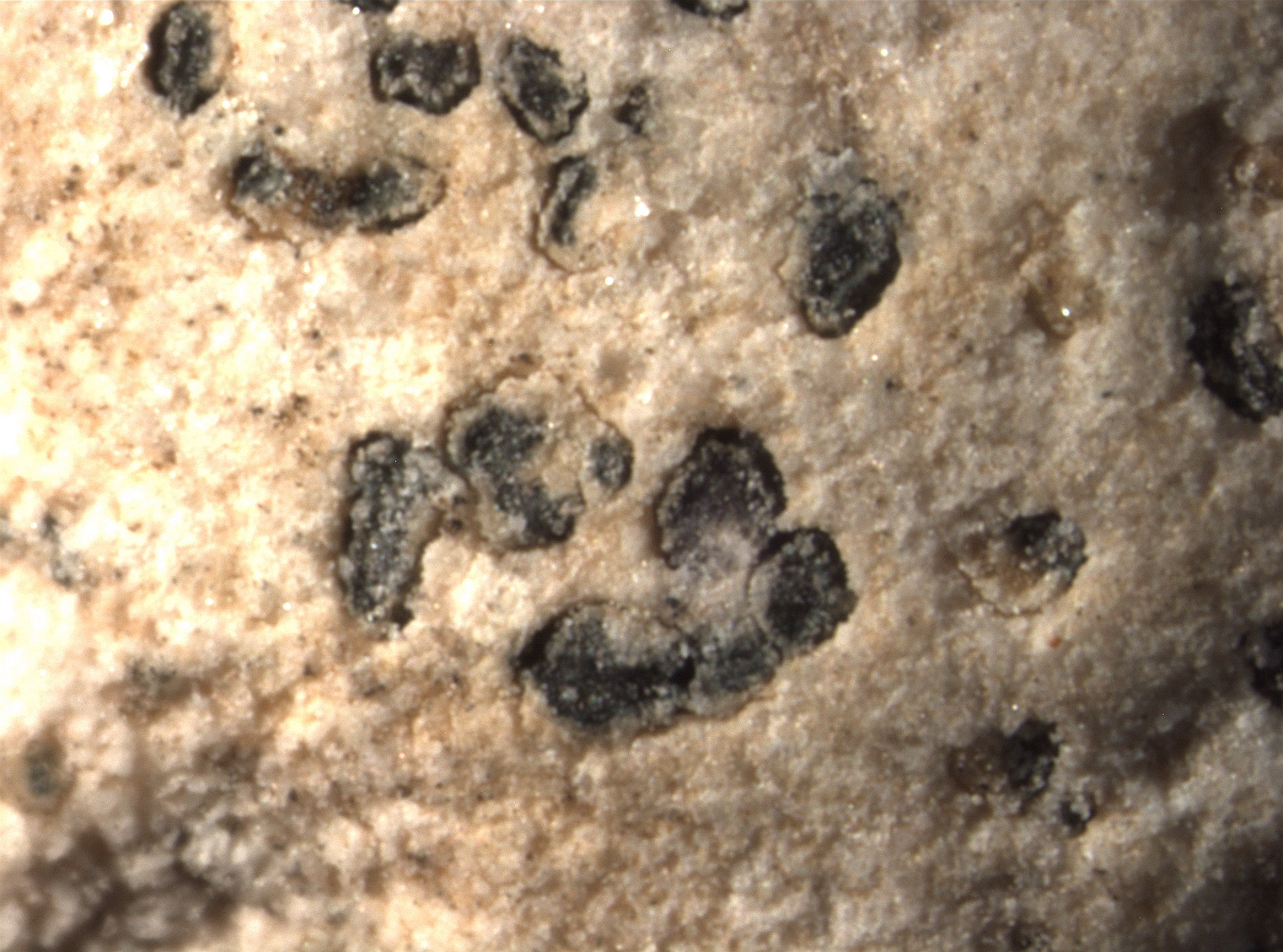
Pier Luigi Nimis - CC BY-SA 4.0
TSB 4024
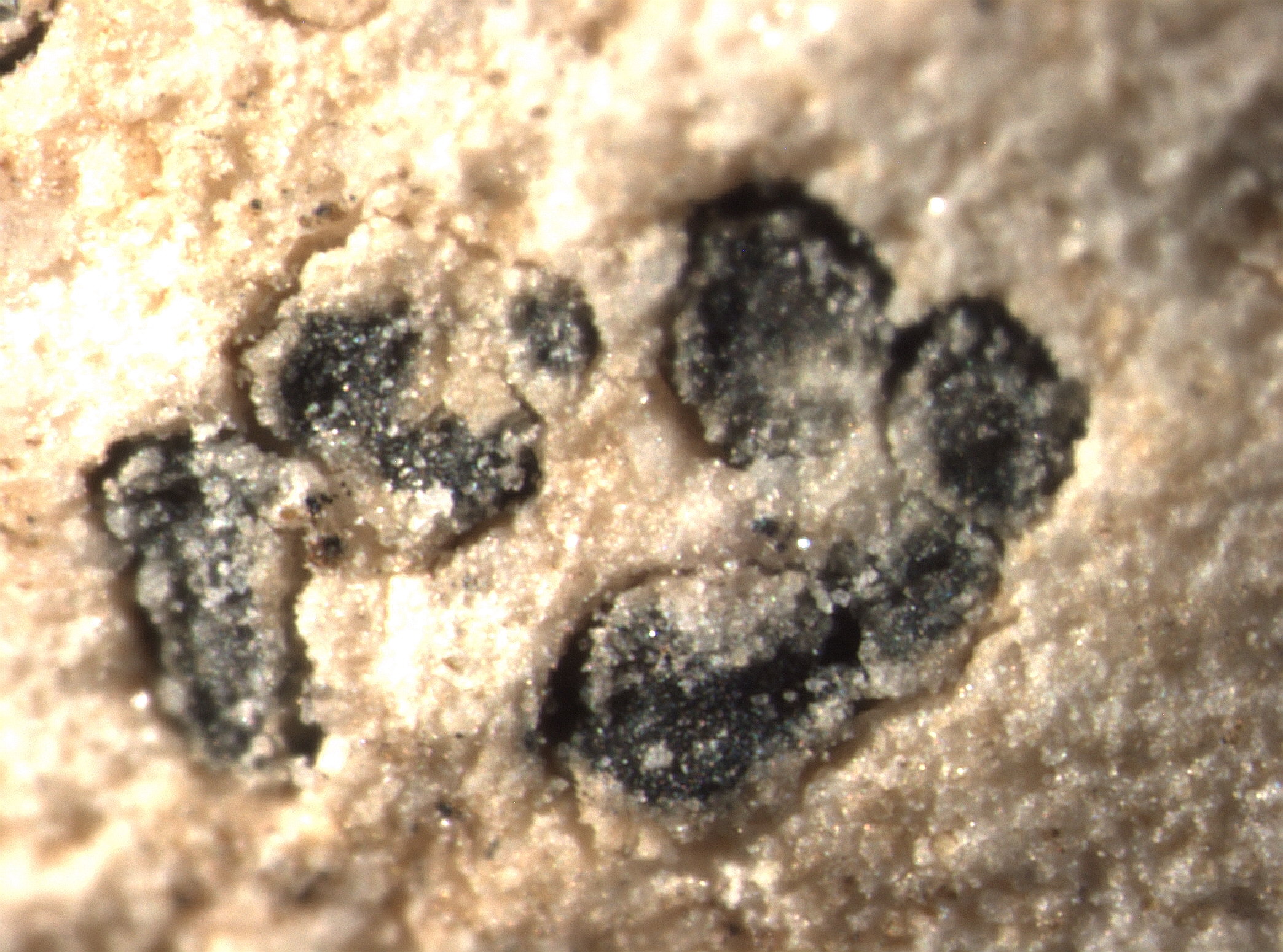
Pier Luigi Nimis - CC BY-SA 4.0
TSB 4024