Lecaimmeria cupreoatra (Nyl.) C.M. Xie
in Xie & al., MycoKeys, 87: 119, 2022. Basionym: Lecanora cupreoatra Nyl. - Not. Sällsk. Fauna Fl. Fenn. Förh., 8: 181, 1866.
Synonyms: Aspicilia cupreoatra (Nyl.) Arnold; Aspicilia olivacea Bagl. & Carestia; Bellemerea cupreoatra (Nyl.) Clauzade & Cl. Roux; Immersaria cupreoatra (Nyl.) Calat. & Rambold
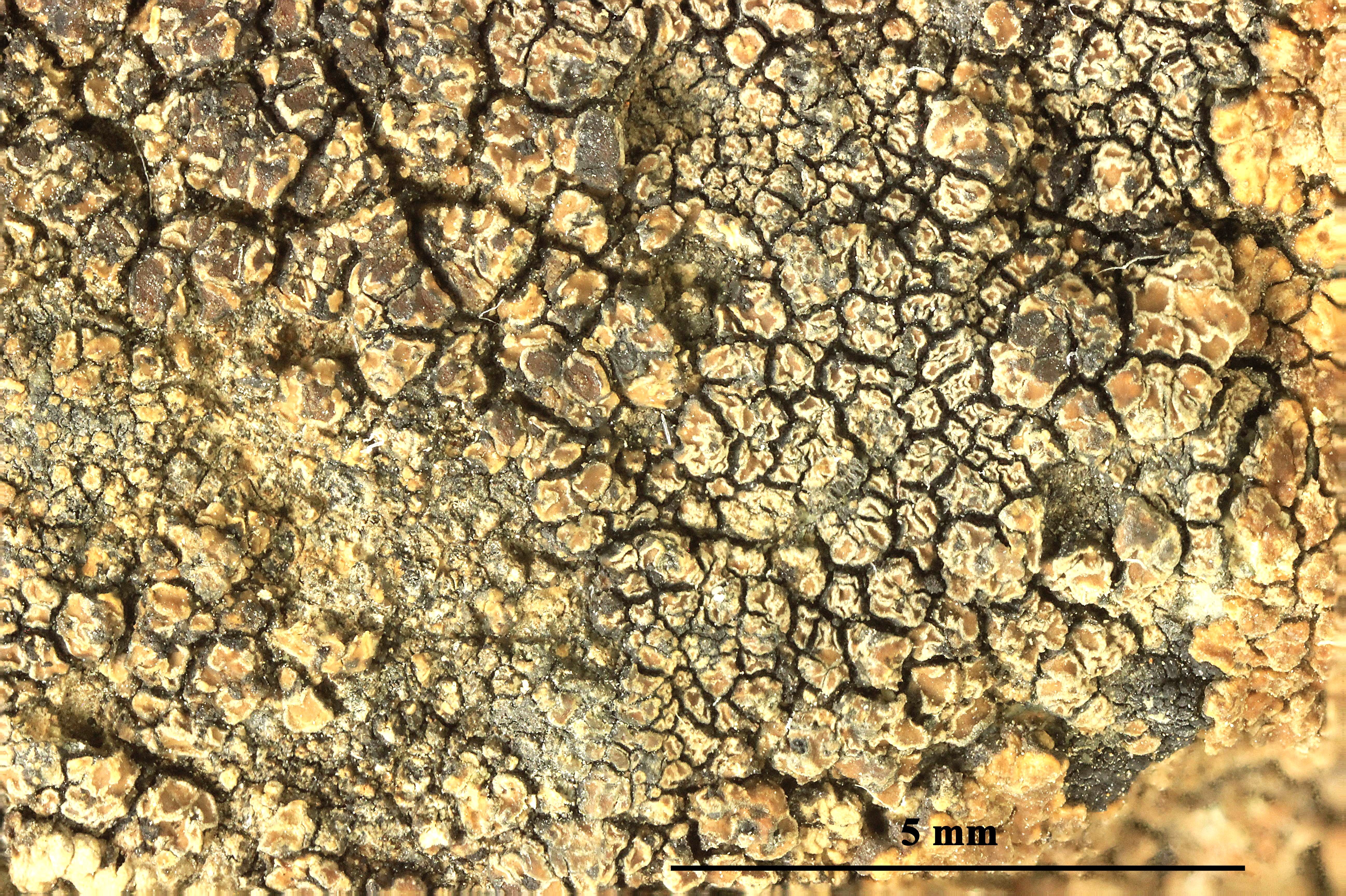
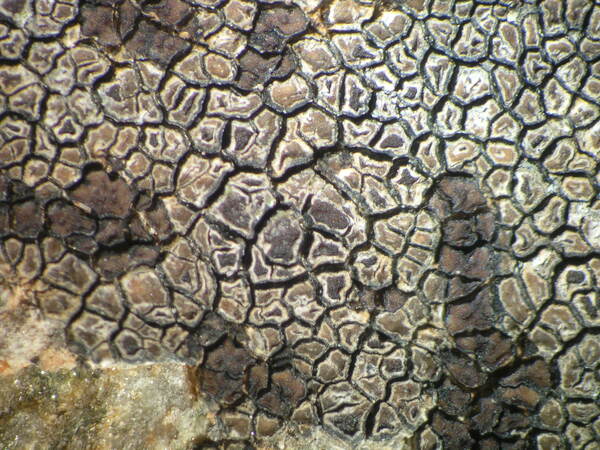
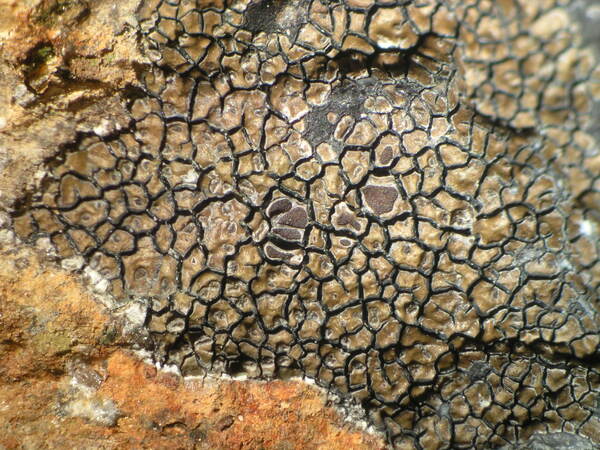
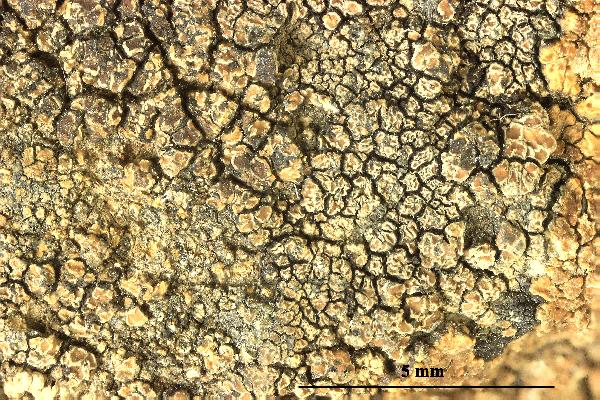
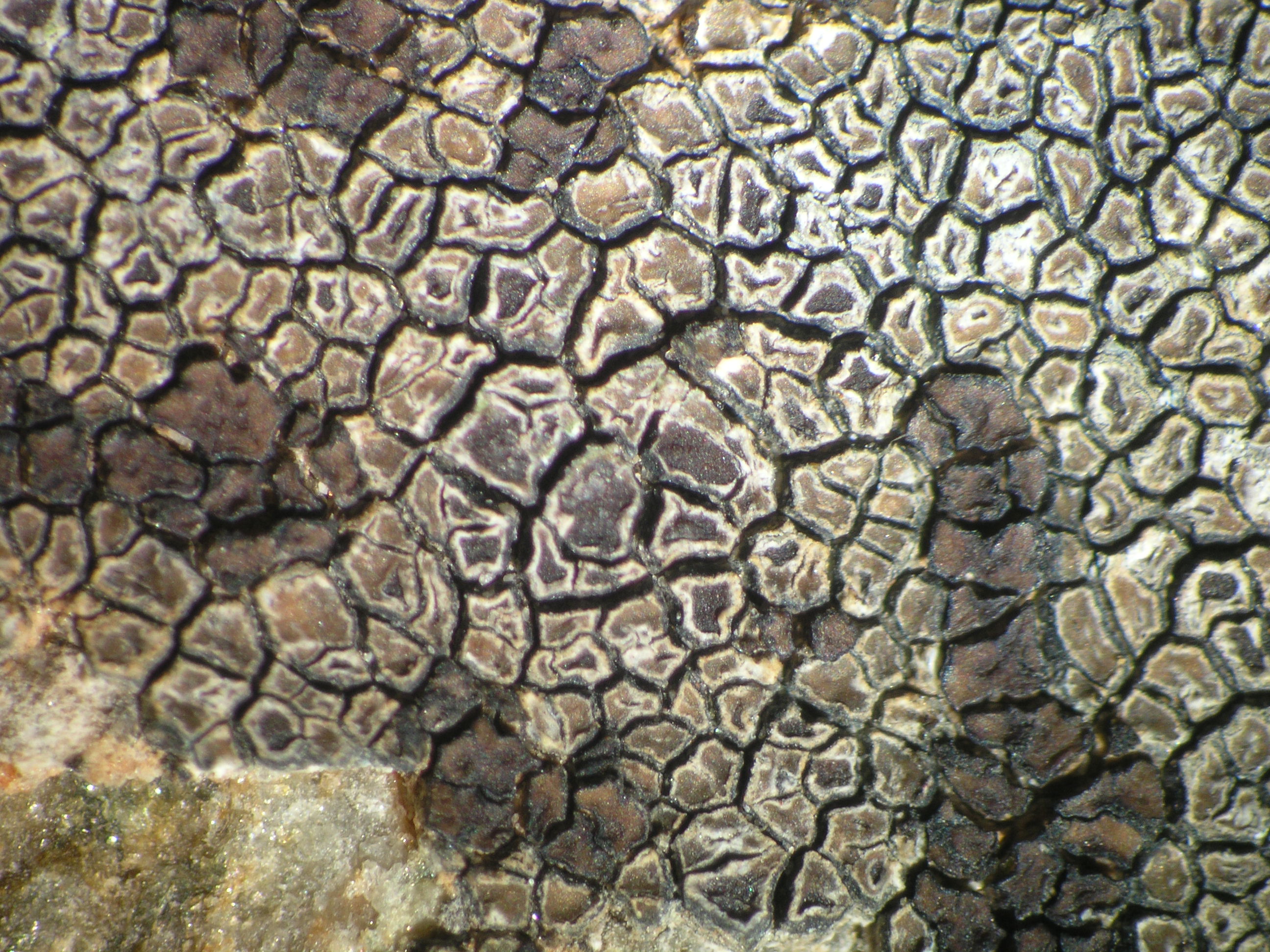
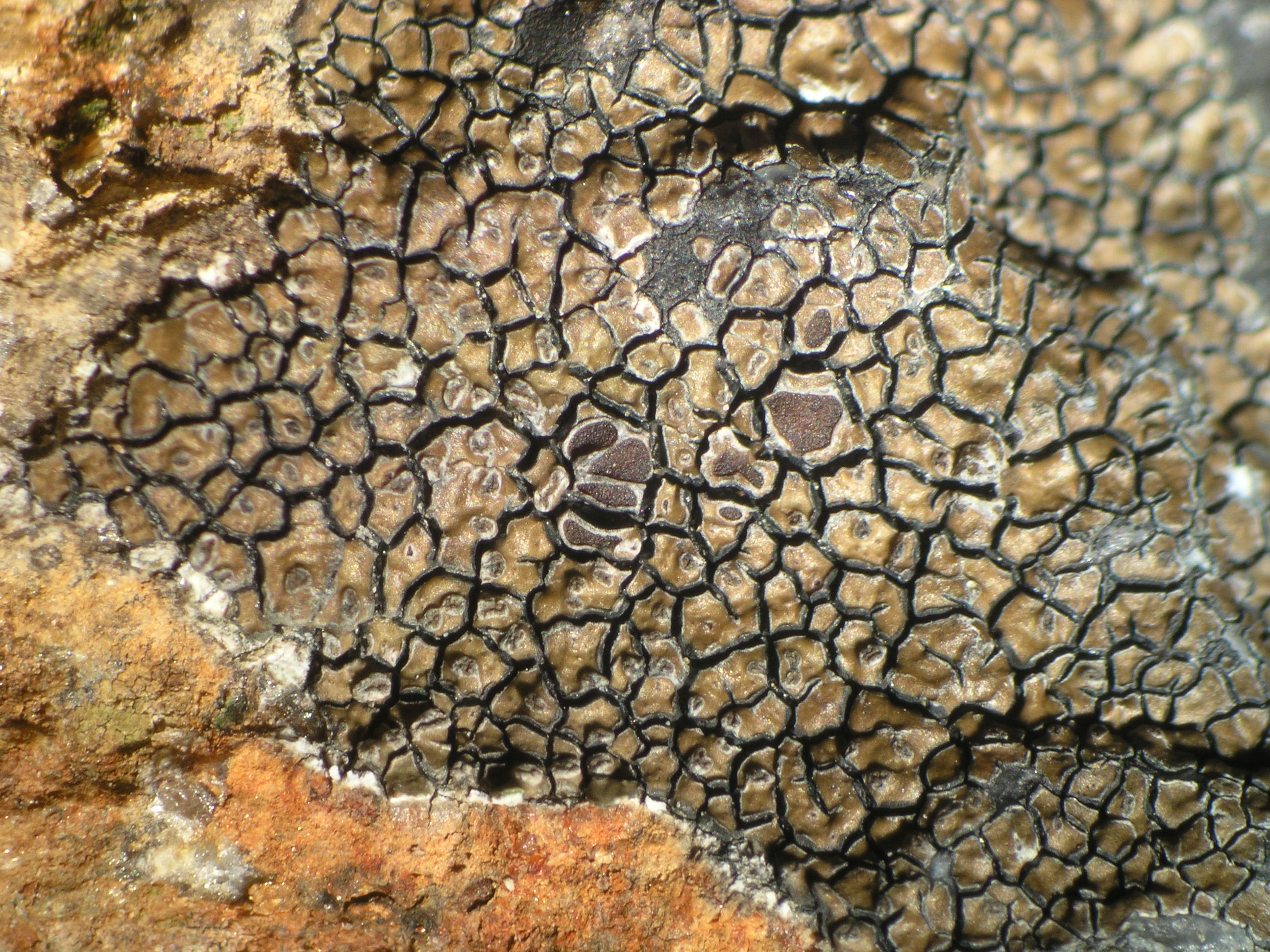
Description: Thallus crustose, episubstratic, areolate, 0.2-0.3 mm thick, brown, somewhat shiny, often delimited by a pale prothallus, forming up to several cm wide patches, the areoles contiguous, slightly concave to flat, angular, very irregular in outline, 0.3-0.8 mm wide, with a slightly raised, whitish-grey margin. Cortex 10-25 µm thick, brown in upper part, with an up to 20 µm thick epinecral layer; medulla white, I+ blue. Apothecia cryptolecanorine-aspicilioid, immersed, 1 per areole, 0.2-0.3(-0.4) mm across, round to very irregular in outline, with a brownish black, epruinose, flat disc and a whitish-grey thalline margin, the proper margin corresponding to the phenocortex and algal layer of the areoles. Proper exciple very thin, poorly developed; epithecium brown to greenish brown, c. 10 µm high, N+ purple; hymenium colourless, 100-110 µm high, I+ blue; paraphyses branched and anastomosing, 1.5-2 µm thick at base, the apical cells 3-5 µm wide; hypothecium colourless, c. 50 µm high, underlain by an algal layer. Asci 8-spored, narrowly cylindrical-clavate, with a I+ blue tholus and an internal, darker I+ tubular structure, the external gel I+ faintly blue, Porpidia-type. Ascospores 1-celled, hyaline, ellipsoid, 8-18 x 5-9 µm, halonate, non-amyloid. Pycnidia dark, immersed in the areoles, sometimes with a prominent ostiole. Conidia bacilliform. Photobiont chlorococcoid. Spot tests: K-, C+ faintly red, KC+ faintly red, P-. Chemistry: gyrophoric acid.
Growth form: Crustose
Substrata: rocks
Photobiont: green algae other than Trentepohlia
Reproductive strategy: mainly sexual
paras Buellia spp.
Commonnes-rarity: (info)
Alpine belt: rather rare
Subalpine belt: very rare
Montane belt: extremely rare
Dry submediterranean belt: absent
Humid submediterranean belt: absent
Padanian area: absent
pH of the substrata:
1 2 3 4 5

Solar irradiation:
1 2 3 4 5
Aridity:
1 2 3 4 5
Eutrophication:
1 2 3 4 5
Poleotolerance:
0 1 2 3
Altitudinal distribution:
1 2 3 4 5 6
Rarity
absent
extremely rare
very rare
rare
rather rare
rather common
common
very common
extremely common
Loading data...
Occurrence data
Predictive map
Harrie Sipman
Source: https://archive.bgbm.org/sipman/Zschackia/AegeanLichens/Immersaria.htm
Harrie Sipman
Source: https://archive.bgbm.org/sipman/Zschackia/AegeanLichens/Immersaria.htm

Felix Schumm - CC BY-SA 4.0
[VZ1482], Bulgaria. Pontus, distr. Burgas: in litore inter pagos Mi urin
et Varvara, 3 m. Ad scopulos siliceos. Leg. A. Kiszely & A. Vezda,
18.8.1975. Ex A. Vezda: Lichenes Selecti Exsiccati Nr. 1482.
Felix Schumm - CC BY-SA 4.0
[VZ1482], Bulgaria. Pontus, distr. Burgas: in litore inter pagos Mi urin
et Varvara, 3 m. Ad scopulos siliceos. Leg. A. Kiszely & A. Vezda,
18.8.1975. Ex A. Vezda: Lichenes Selecti Exsiccati Nr. 1482.
Growth form: Crustose
Substrata: rocks
Photobiont: green algae other than Trentepohlia
Reproductive strategy: mainly sexual
paras Buellia spp.
Commonnes-rarity: (info)
Alpine belt: rather rare
Subalpine belt: very rare
Montane belt: extremely rare
Dry submediterranean belt: absent
Humid submediterranean belt: absent
Padanian area: absent
pH of the substrata:
| 1 | 2 | 3 | 4 | 5 |
Solar irradiation:
| 1 | 2 | 3 | 4 | 5 |
Aridity:
| 1 | 2 | 3 | 4 | 5 |
Eutrophication:
| 1 | 2 | 3 | 4 | 5 |
Poleotolerance:
| 0 | 1 | 2 | 3 |
Altitudinal distribution:
| 1 | 2 | 3 | 4 | 5 | 6 |
Rarity
absent
extremely rare
very rare
rare
rather rare
rather common
common
very common
extremely common
Loading data...
Occurrence data
Predictive map
Harrie Sipman
Source: https://archive.bgbm.org/sipman/Zschackia/AegeanLichens/Immersaria.htm
Harrie Sipman
Source: https://archive.bgbm.org/sipman/Zschackia/AegeanLichens/Immersaria.htm

Felix Schumm - CC BY-SA 4.0
[VZ1482], Bulgaria. Pontus, distr. Burgas: in litore inter pagos Mi urin et Varvara, 3 m. Ad scopulos siliceos. Leg. A. Kiszely & A. Vezda, 18.8.1975. Ex A. Vezda: Lichenes Selecti Exsiccati Nr. 1482.