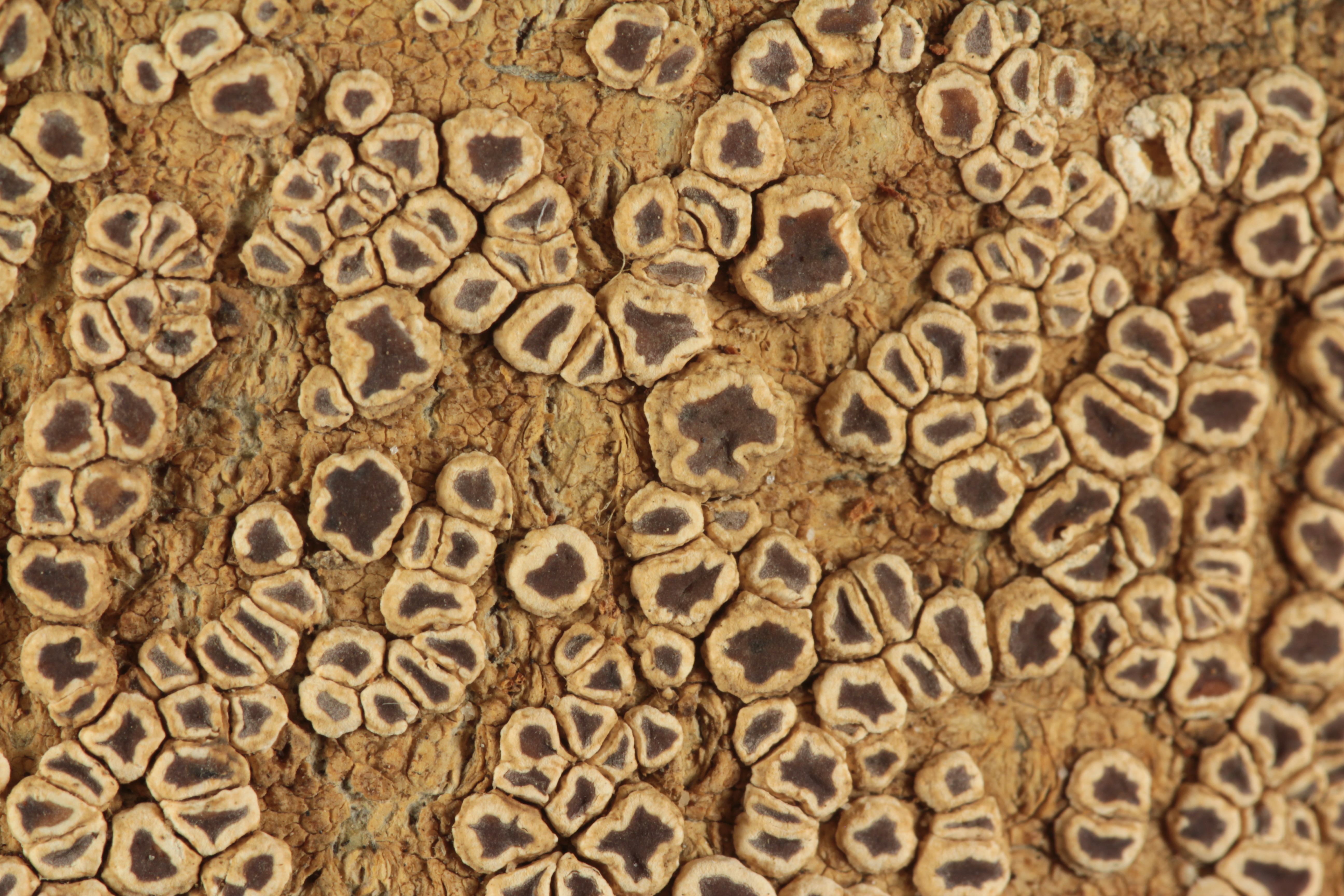
Lecanora cateilea (Ach.) A. Massal.
Ric. Auton. Lich. Crost.: 9, 1852. Basionym: Lecanora subfusca var. cateilea Ach. - Lichenogr. Univ.: 394, 1810.
Synonyms:
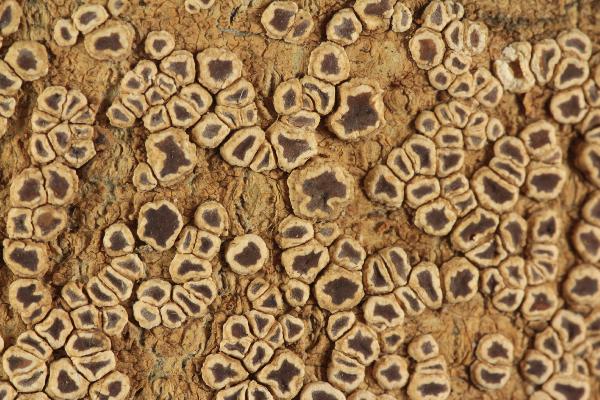
Description: Thallus crustose, endosubstratic or thinly episubstratic, continuous to rimose, grey or yellowish grey, epruinose, without a distinct prothallus. Apothecia lecanorine, 0.2-1.2 mm across, with a flat, orange-brown or yellowish brown, strongly to weakly pruinose disc and a thin, finally usually excluded thalline margin. Thalline exciple ecorticate, with many small crystals soluble in K; epithecium grey-brown, with many small crystals soluble in K; hymenium colourless, 60-75 µm high; paraphyses simple to sparingly branched in upper part, 1.5–2 µm thick at mid-level, the apical cells up to 4 µm wide; hypothecium colourless. Asci (8-)12-spored, clavate, very thin-walled, with a K/I+ blue, tall tholus penetrated by a faintly amyloid apical cushion, the wall K/I-, surrounded by a blue outer layer, Lecanora-type. Ascospores 1-celled, hyaline, ellipsoid, 10-13 x 5-7.5 µm. Photobiont chlorococcoid. Spot tests: thallus and apothecial margin K+ yellow, C-, KC-, P+ yellow (apothecial margin only). Chemistry: thallus and apothecial margin with atranorin, chloratranorin and zeorin; apothecial margin with additional psoromic and 2'-0-demethylpsoromic acids.
Growth form: Crustose
Substrata: bark
Photobiont: green algae other than Trentepohlia
Reproductive strategy: mainly sexual
Commonnes-rarity: (info)
Alpine belt: absent
Subalpine belt: absent
Montane belt: very rare
Dry submediterranean belt: very rare
Humid submediterranean belt: very rare
Padanian area: absent
pH of the substrata:
1 2 3 4 5

Solar irradiation:
1 2 3 4 5
Aridity:
1 2 3 4 5
Eutrophication:
1 2 3 4 5
Poleotolerance:
0 1 2 3
Altitudinal distribution:
1 2 3 4 5 6
Rarity
absent
extremely rare
very rare
rare
rather rare
rather common
common
very common
extremely common
Loading data...
Occurrence data
Predictive map
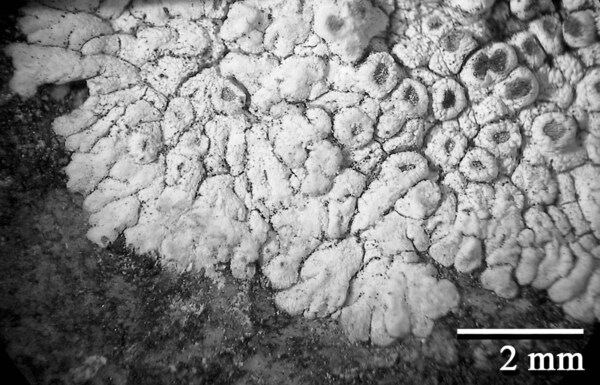
Thorsten Lumbsch - Source: https://lichenportal.org/imglib/lichens/Lecanoraceae/photos/Lecanora_catalinae_with_r.jpg
Collezione lichenologica Abramo Massalongo del Museo di Storia Naturale G. Ligabue di Venezia - Autori: Seggi, Linda; Trabucco, Raffaella Proprietà: Fondazione Musei Civici di Venezia - CC BY-NC
Italy, Veneto, In M. Alba ad truncos fagorum 1855
Growth form: Crustose
Substrata: bark
Photobiont: green algae other than Trentepohlia
Reproductive strategy: mainly sexual
Commonnes-rarity: (info)
Alpine belt: absent
Subalpine belt: absent
Montane belt: very rare
Dry submediterranean belt: very rare
Humid submediterranean belt: very rare
Padanian area: absent
pH of the substrata:
| 1 | 2 | 3 | 4 | 5 |
Solar irradiation:
| 1 | 2 | 3 | 4 | 5 |
Aridity:
| 1 | 2 | 3 | 4 | 5 |
Eutrophication:
| 1 | 2 | 3 | 4 | 5 |
Poleotolerance:
| 0 | 1 | 2 | 3 |
Altitudinal distribution:
| 1 | 2 | 3 | 4 | 5 | 6 |
Rarity
absent
extremely rare
very rare
rare
rather rare
rather common
common
very common
extremely common
Loading data...
Occurrence data
Predictive map

Thorsten Lumbsch - Source: https://lichenportal.org/imglib/lichens/Lecanoraceae/photos/Lecanora_catalinae_with_r.jpg