Pulvinora cavicola (Creveld) Mazur & Śliwa
MycoKeys, 122: 6, 2025. Basionym: Lecanora cavicola Creveld - Bibl. Lichenol., 17: 273, 1981.
Synonyms:
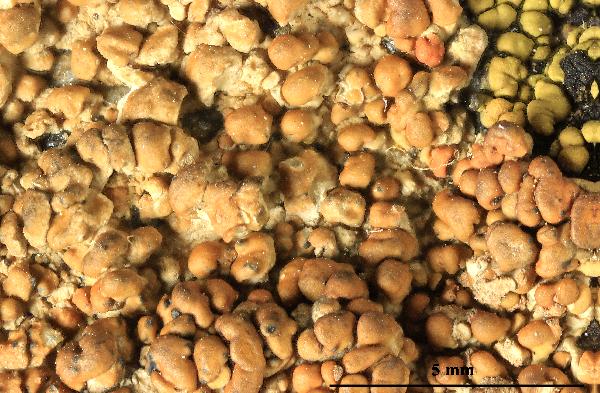
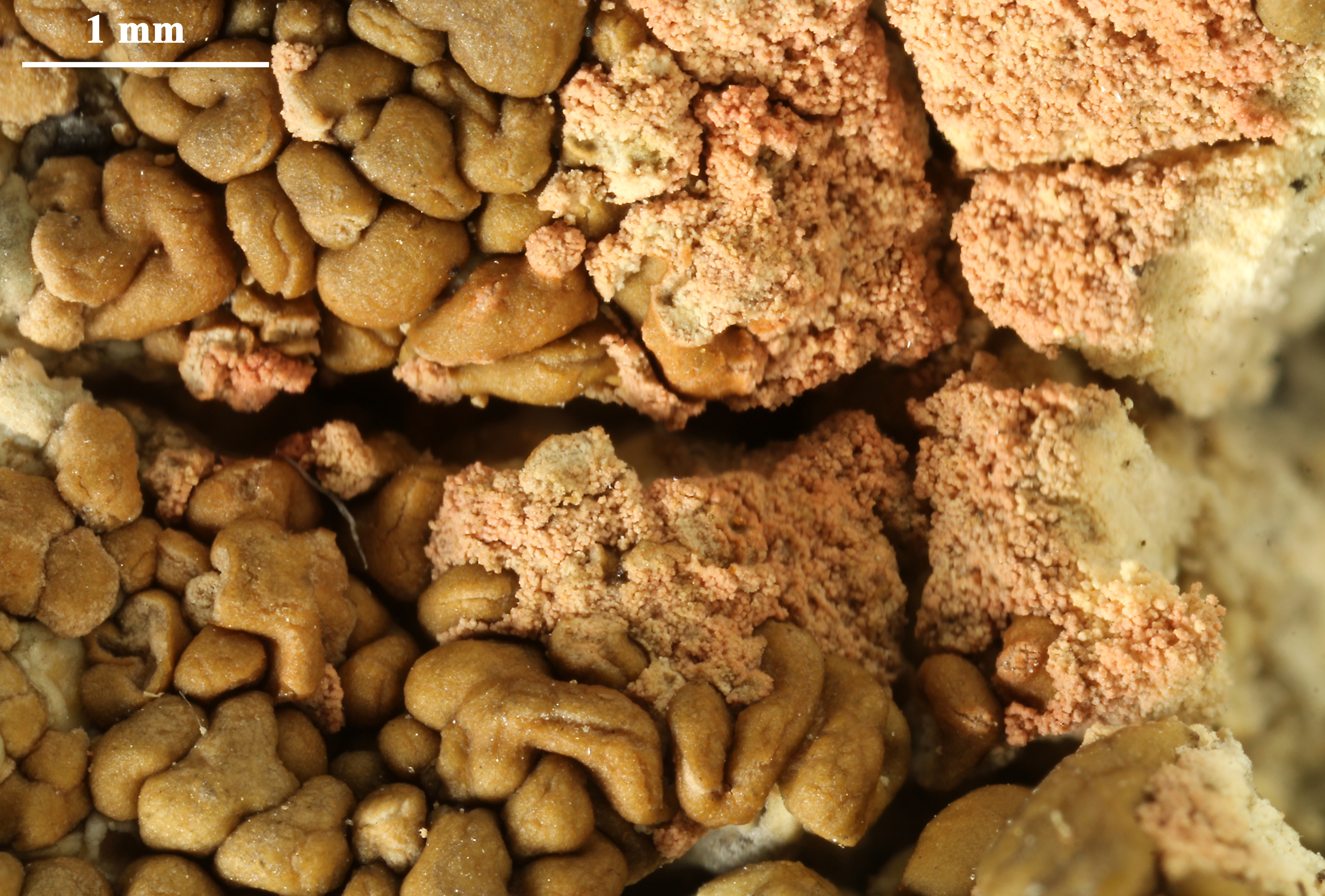
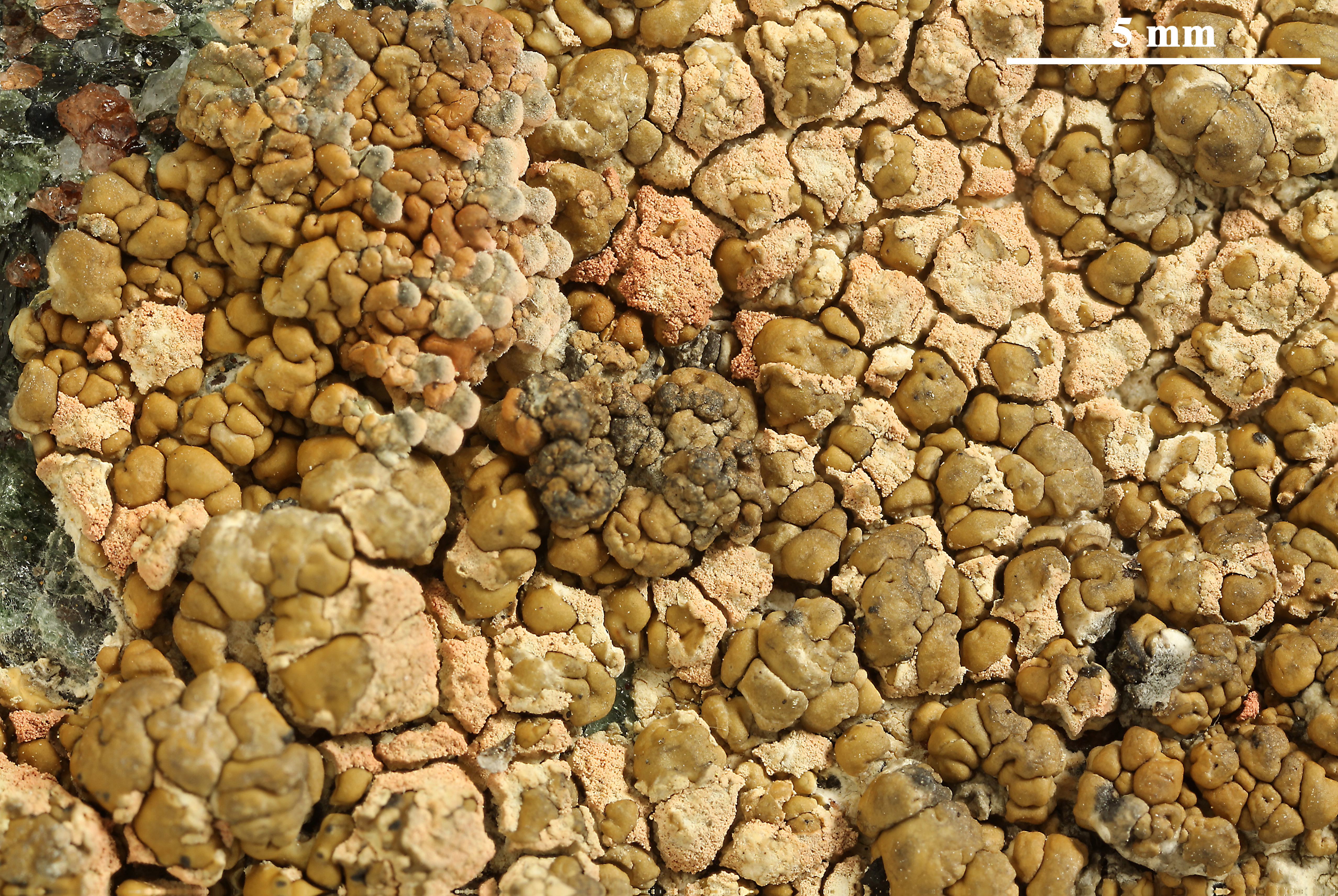
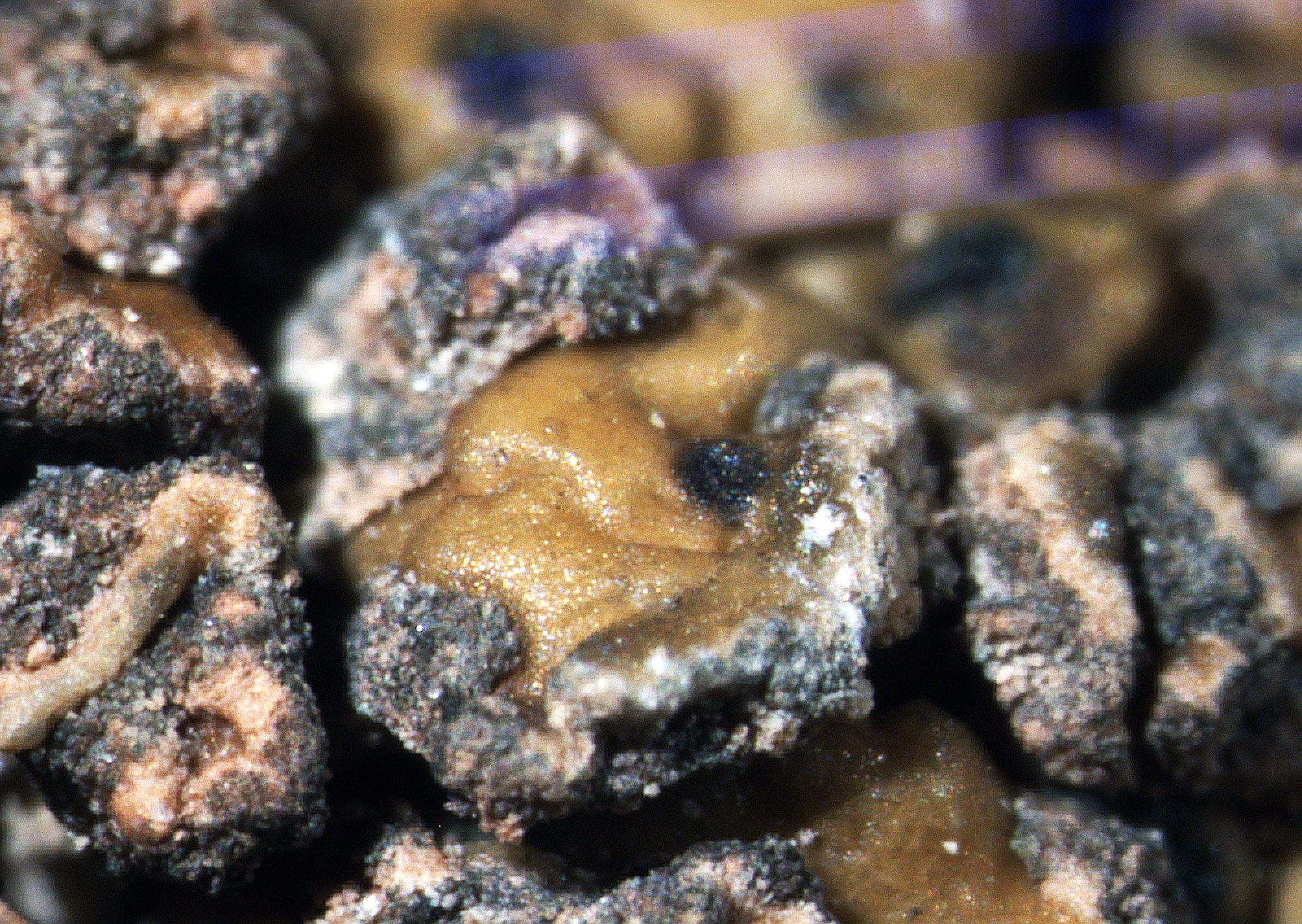
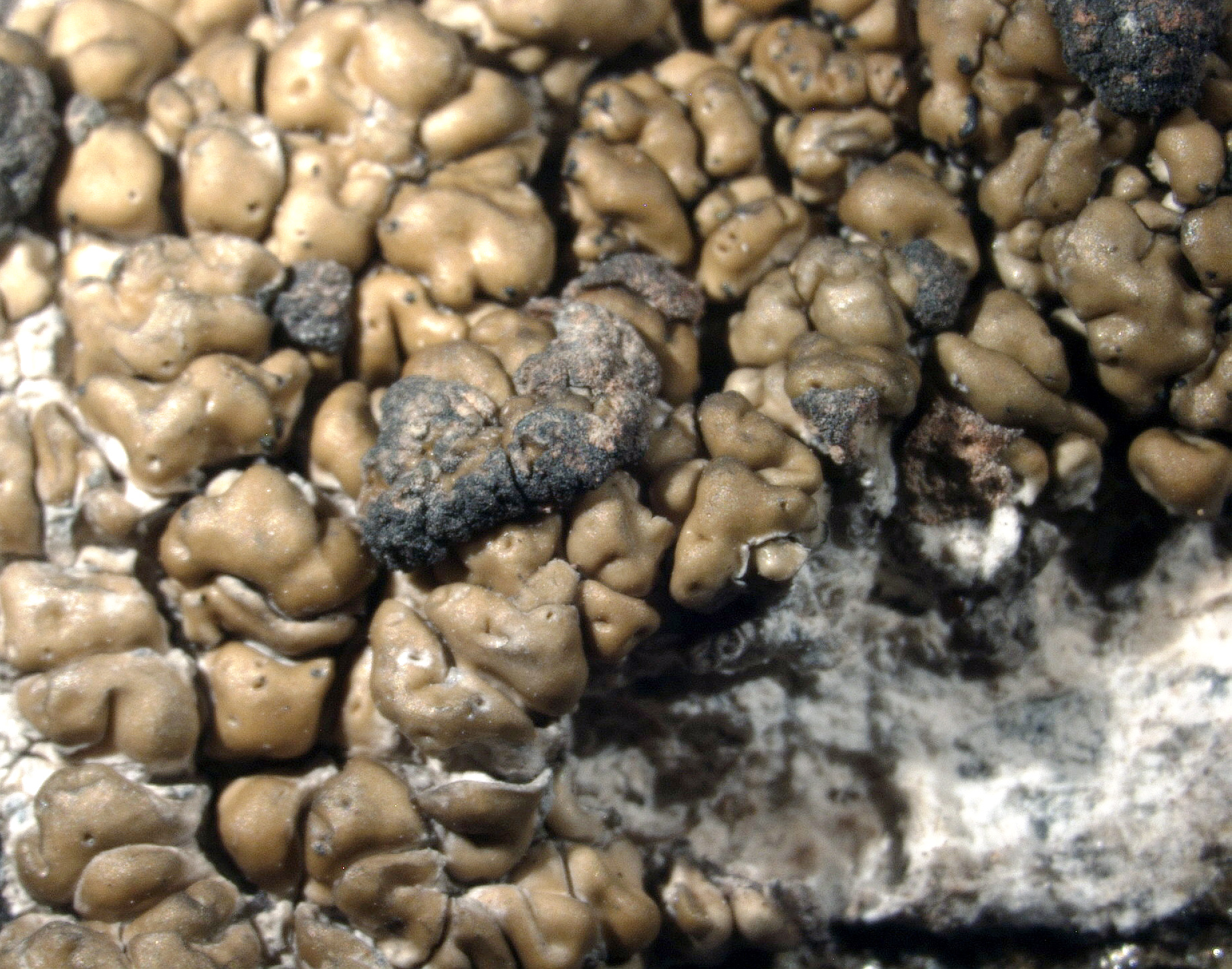
Description: Thallus crustose-subsquamulose, episubstratic, 3-5 mm thick, forming 2-4(-5) cm wide, orbicular or irregular patches often delimited by a pale prothallus, the areoles constricted at base, convex-bullate, becoming subcerebriform, scattered to contiguous, 1-3 mm wide, pale grey-brown to brown, sorediate. Soredia finely granular, arising at the margins and lower surfaces of the areoles, pale yellowish green to brownish white (fading to white in the herbarium), arranged into initially concave, then convex, elongated to circular soralia which later become confluent and cover large parts of the upper surface, simulating capitate soralia. Upper pseudocortex overlain by an epinecral layer, pale brown, 20-30 μm thick, inspersed with small, pale yellow crystals partly soluble in K; medulla loose, white, the cells incrusted with coarse crystals insoluble in K. Apothecia rare, lecanorine to finally almost biatorine, broadly sessile, 1-1.5 mm across, with a greyish violet, brownish or bluish black, soon convex, usually somewhat pruinose disc and a thin, irregularly sinuous, at first slightly raised proper margin; a bluish black parathecial ring is often also present. Thalline exciple with a strongly gelatinized cortex, the medulla with few algae, loose, with anticlinally arranged, thick-walled hyphae; proper exciple colourless; epithecium olive green or dirty violet-brown, K+ green, N+ red, with greenish blue streaks penetrating into the hymenium; hymenium colourless, inspersed with oil droplets, 50-70 µm high; paraphyses strongly coherent, mostly simple, 1.5-2 μm thick at mid-level, the apical cells not or only slightly swollen; hypothecium colourless. Asci 8-spored, clavate, very thin-walled, with a K/I+ blue, tall tholus penetrated by a faintly amyloid apical cushion, the wall K/I-, surrounded by a blue outer layer, Lecanora-type. Ascospores 1-celled, hyaline, subglobose to ellipsoid, (6.5-)9-10(-13) x 5-7 µm. Pycnidia rare. Conidia thread-like, often curved, 15-20 µm long. Photobiont chlorococcoid. Spot tests: cortex K+ yellow, C-, KC+ red, P-; soralia C+ pink to red, KC+ red, P+ yellow. Chemistry: atranorin, alectorialic acid, thamnolic acid, unknown substances.
Growth form: Crustose
Substrata: rocks
Photobiont: green algae other than Trentepohlia
Reproductive strategy: mainly asexual, by soredia, or soredia-like structures (e.g. blastidia)
In underhangs rarely wetted by rain
Commonnes-rarity: (info)
Alpine belt: very rare
Subalpine belt: very rare
Montane belt: absent
Dry submediterranean belt: absent
Humid submediterranean belt: absent
Padanian area: absent
pH of the substrata:
1 2 3 4 5

Solar irradiation:
1 2 3 4 5
Aridity:
1 2 3 4 5
Eutrophication:
1 2 3 4 5
Poleotolerance:
0 1 2 3
Altitudinal distribution:
1 2 3 4 5 6
Rarity
absent
extremely rare
very rare
rare
rather rare
rather common
common
very common
extremely common
Loading data...
Occurrence data
Predictive map

P.L. Nimis; Owner: Department of Life Sciences, University of Trieste
Herbarium: TSB (9143)
2002/01/02
thallus margin

P.L. Nimis CC BY-SA 04
TSB 9143

P.L. Nimis; Owner: Department of Life Sciences, University of Trieste
Herbarium: TSB (9143)
2002/01/02

Leif Stridvall - Source: http://www.stridvall.se/la/galleries.php . Courtesy: A. Stridvall

Felix Schumm - CC BY-SA4.0
20919

Felix Schumm - CC BY-SA4.0
20919

Felix Schumm - CC BY-SA4.0
20919

Pier Luigi Nimis - CC BY-SA 4.0
TSB 41821

Pier Luigi Nimis - CC BY-SA 4.0
TSB 41822

P.L. Nimis CC BY-SA 04
TSB 41821

Pier Luigi Nimis - CC BY-SA 4.0
TSB 41823

P.L. Nimis CC BY-SA 04
TSB 38833

Walter Obermayer CC BY-SA 4.0 - Source: Lichens of Noricum - http://lichens-of-noricum.uni-graz.at/

Walter Obermayer CC BY-SA 4.0 - Source: Lichens of Noricum - http://lichens-of-noricum.uni-graz.at/

Walter Obermayer CC BY-SA 4.0 - Source: Lichens of Noricum - http://lichens-of-noricum.uni-graz.at/

Modified from: https://gzu.jacq.org/GZU000291029
GZU000291029 - Collector Creveld,M. 76
Date 1976-07 Label Flora Norvegica - SE slope Vesl. Nystuguhö; Sör Tröndelag ; Alt. 1184 m
Habitat In a vegetation with Acarospora chlorophana and Lecanora subradiosa; on a sloping surface of a big boulder of phyllite, exp. NE, incl. 15° - ISOTYPE
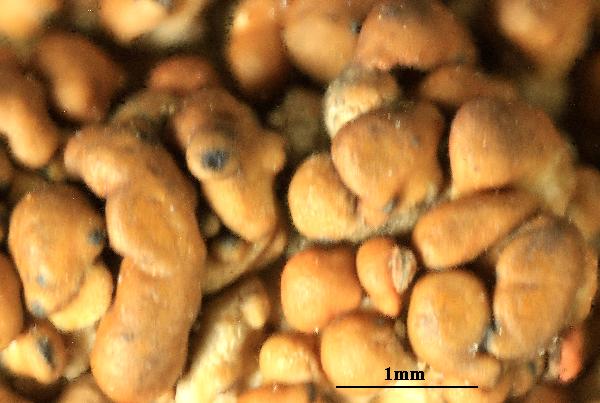
Felix Schumm - CC BY 4.0
[VZ1961], Austria. Styria: Koralpe, ad latera australis montis Handalpe,
20 m ad occidentem versus Deutschlandsberg, 1750-1800 m. Ad
saxa gneissacea impendentia. Leg. et det. J. Hafellner, 19.6.1983. EX A.
VEZDA LICHENES SELECTI EXSICCATI NR. 1961. As Lecanora cavicola
Felix Schumm - CC BY 4.0
[VZ1961], Austria. Styria: Koralpe, ad latera australis montis Handalpe,
20 m ad occidentem versus Deutschlandsberg, 1750-1800 m. Ad
saxa gneissacea impendentia. Leg. et det. J. Hafellner, 19.6.1983. EX A.
VEZDA LICHENES SELECTI EXSICCATI NR. 1961. As Lecanora cavicola
Growth form: Crustose
Substrata: rocks
Photobiont: green algae other than Trentepohlia
Reproductive strategy: mainly asexual, by soredia, or soredia-like structures (e.g. blastidia)
In underhangs rarely wetted by rain
Commonnes-rarity: (info)
Alpine belt: very rare
Subalpine belt: very rare
Montane belt: absent
Dry submediterranean belt: absent
Humid submediterranean belt: absent
Padanian area: absent
pH of the substrata:
| 1 | 2 | 3 | 4 | 5 |
Solar irradiation:
| 1 | 2 | 3 | 4 | 5 |
Aridity:
| 1 | 2 | 3 | 4 | 5 |
Eutrophication:
| 1 | 2 | 3 | 4 | 5 |
Poleotolerance:
| 0 | 1 | 2 | 3 |
Altitudinal distribution:
| 1 | 2 | 3 | 4 | 5 | 6 |
Rarity
absent
extremely rare
very rare
rare
rather rare
rather common
common
very common
extremely common
Loading data...
Occurrence data
Predictive map
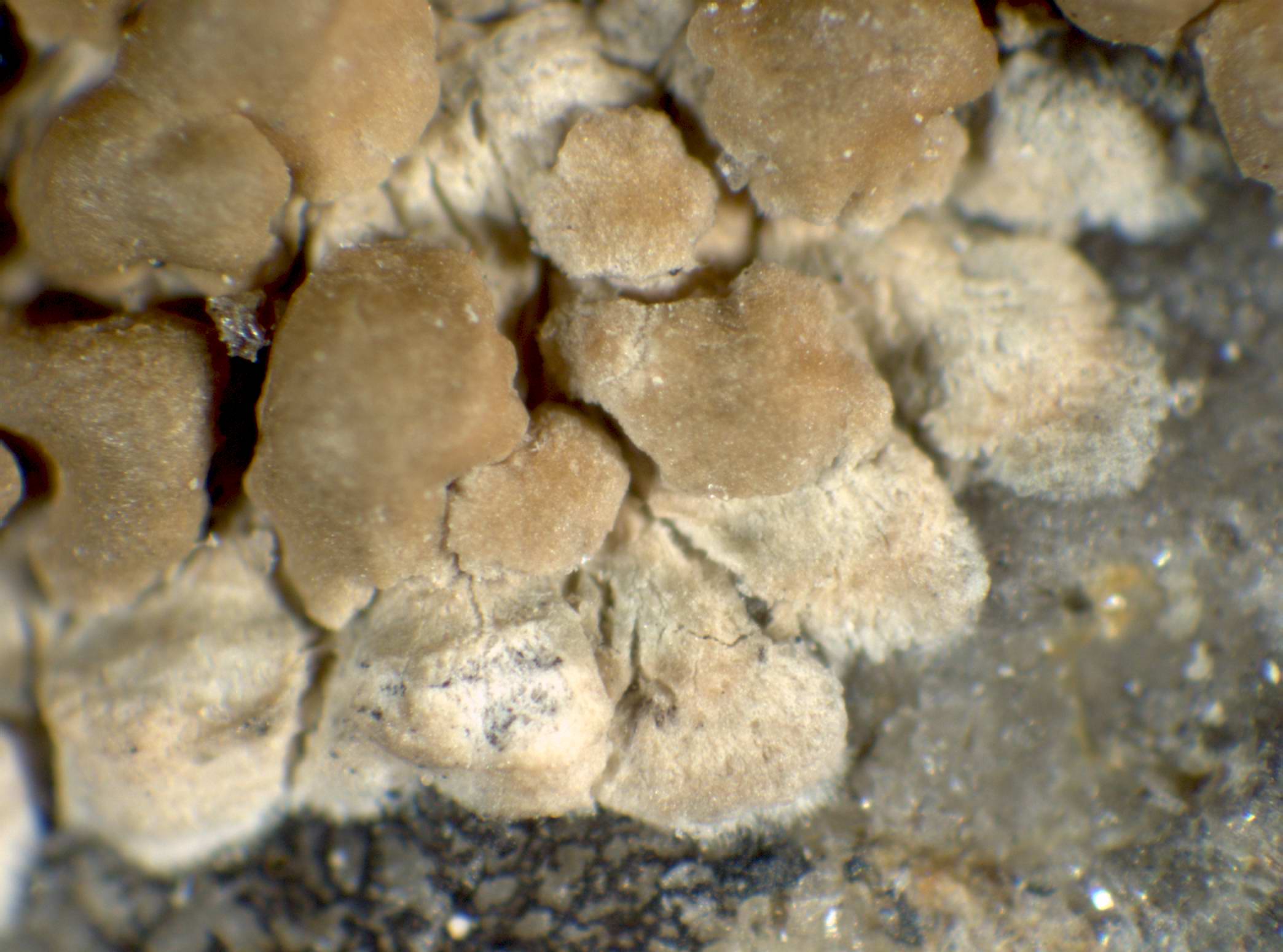
P.L. Nimis; Owner: Department of Life Sciences, University of Trieste
Herbarium: TSB (9143)
2002/01/02
thallus margin

P.L. Nimis CC BY-SA 04
TSB 9143

P.L. Nimis; Owner: Department of Life Sciences, University of Trieste
Herbarium: TSB (9143)
2002/01/02
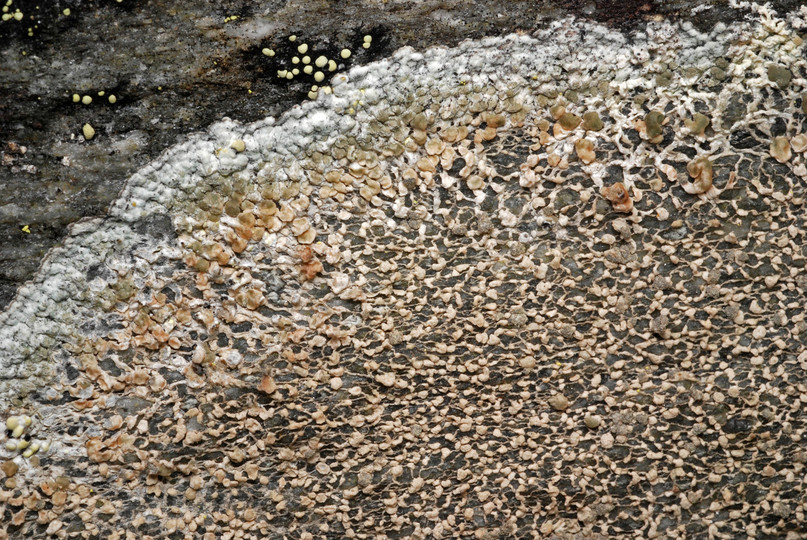
Leif Stridvall - Source: http://www.stridvall.se/la/galleries.php . Courtesy: A. Stridvall
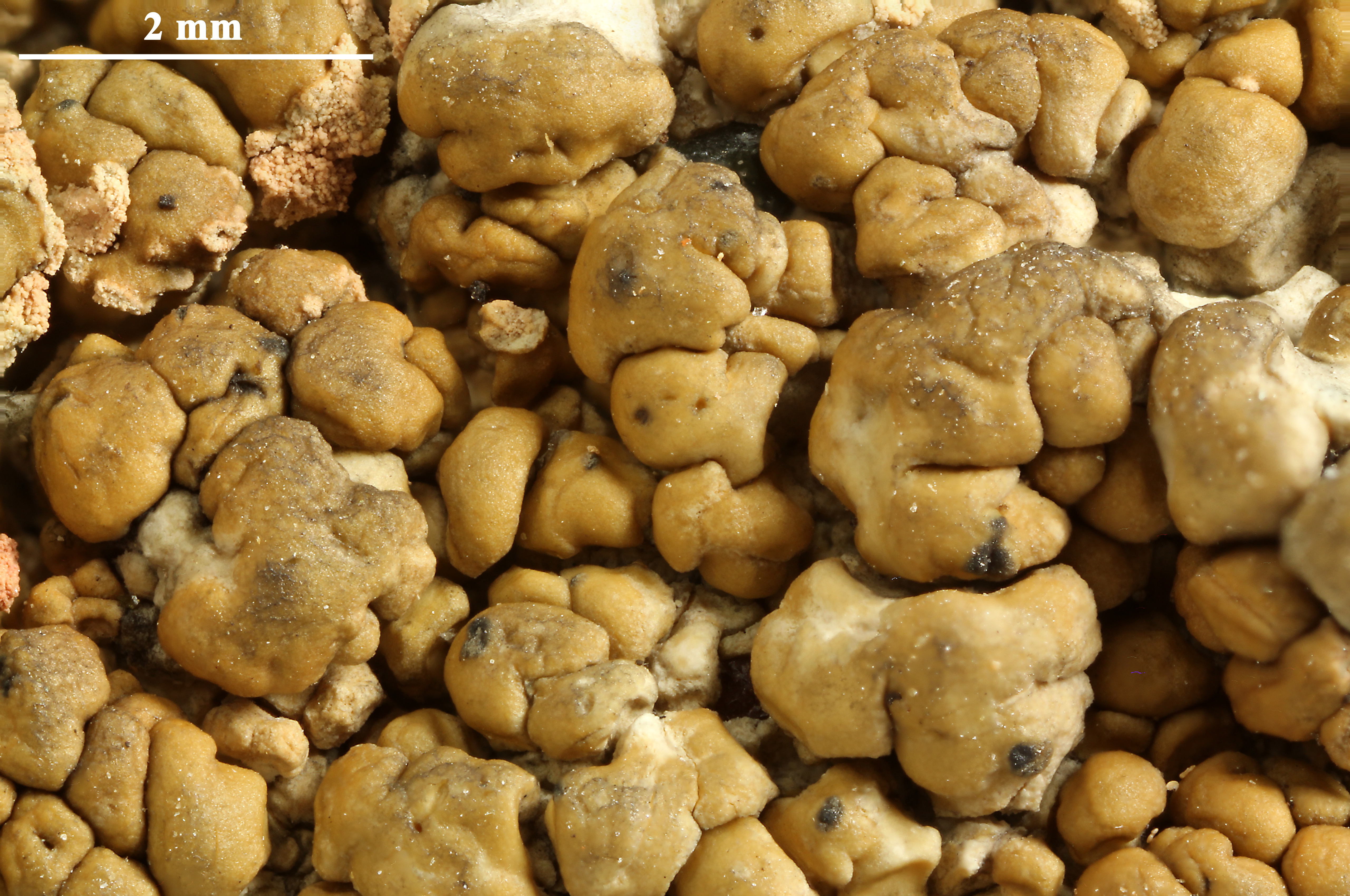
Felix Schumm - CC BY-SA4.0
20919
Felix Schumm - CC BY-SA4.0
20919
Felix Schumm - CC BY-SA4.0
20919

Pier Luigi Nimis - CC BY-SA 4.0
TSB 41821

Pier Luigi Nimis - CC BY-SA 4.0
TSB 41822
P.L. Nimis CC BY-SA 04
TSB 41821

Pier Luigi Nimis - CC BY-SA 4.0
TSB 41823
P.L. Nimis CC BY-SA 04
TSB 38833

Walter Obermayer CC BY-SA 4.0 - Source: Lichens of Noricum - http://lichens-of-noricum.uni-graz.at/

Walter Obermayer CC BY-SA 4.0 - Source: Lichens of Noricum - http://lichens-of-noricum.uni-graz.at/
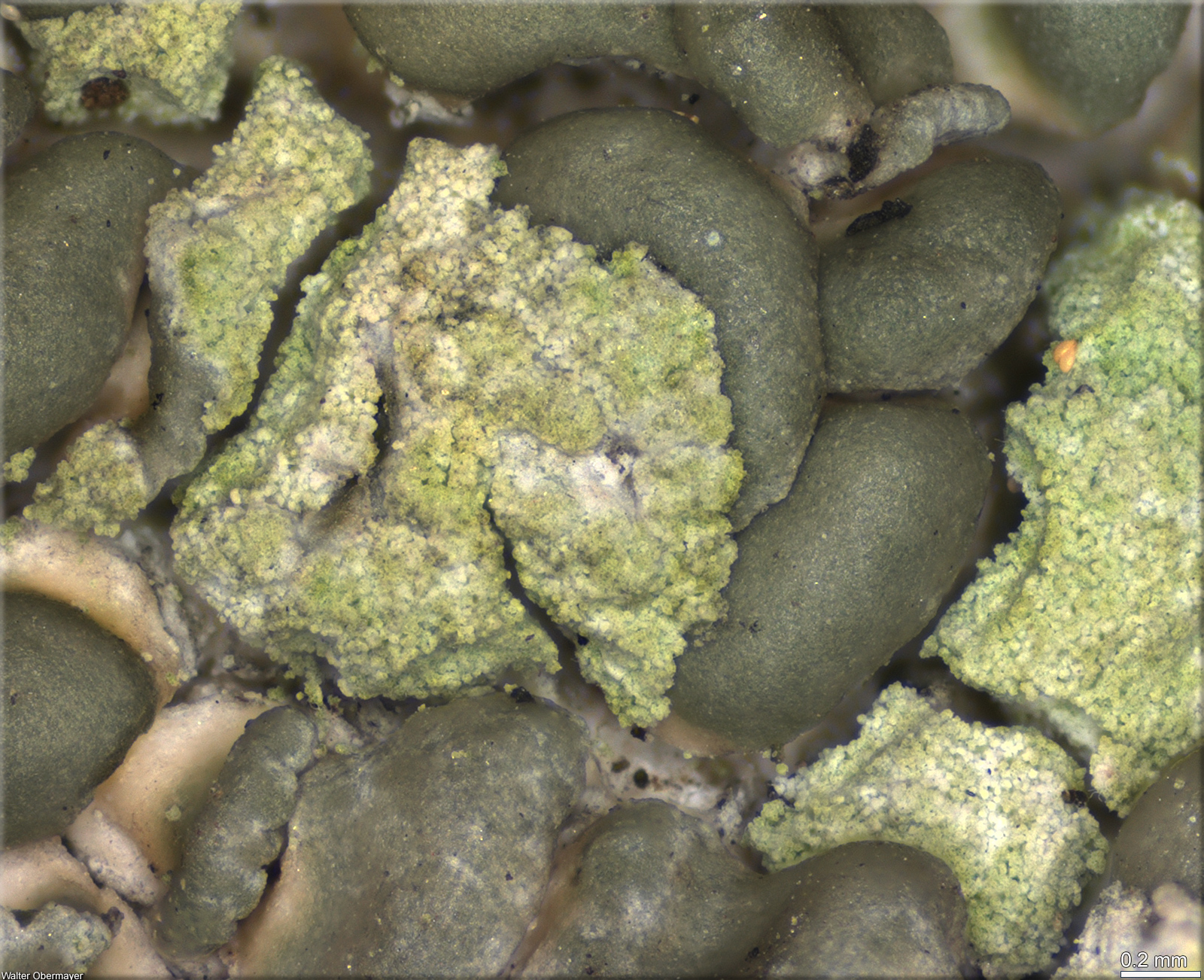
Walter Obermayer CC BY-SA 4.0 - Source: Lichens of Noricum - http://lichens-of-noricum.uni-graz.at/

Modified from: https://gzu.jacq.org/GZU000291029
GZU000291029 - Collector Creveld,M. 76 Date 1976-07 Label Flora Norvegica - SE slope Vesl. Nystuguhö; Sör Tröndelag ; Alt. 1184 m Habitat In a vegetation with Acarospora chlorophana and Lecanora subradiosa; on a sloping surface of a big boulder of phyllite, exp. NE, incl. 15° - ISOTYPE

Felix Schumm - CC BY 4.0
[VZ1961], Austria. Styria: Koralpe, ad latera australis montis Handalpe, 20 m ad occidentem versus Deutschlandsberg, 1750-1800 m. Ad saxa gneissacea impendentia. Leg. et det. J. Hafellner, 19.6.1983. EX A. VEZDA LICHENES SELECTI EXSICCATI NR. 1961. As Lecanora cavicola