Lecanora phaeostigma (Körb.) Almb.
in Santesson, The Lichens of Sweden and Norway: 148, 1984. Basionym: Biatora phaeostigma Körb. - Syst. Lich. Germ.: 199, 1855.
Synonyms: Biatora obscurella (Sommerf.) Arnold; Lecanora obscurella (Sommerf.) Hedl.; Lecidea obscurella (Sommerf.) Nyl.
Description: Thallus crustose, episubstratic or rarely endosubstratic, continuous to granular-verrucose, sometimes reduced to sparse, flat areoles surrounding the apothecia, ochre-coloured to brown or greenish brown, the areoles usually scattered, thin, ecorticate, smooth, somehow shiny. Apothecia clearly (pseudo-)lecanorine only when young, later appearing biatorine, abundant and often crowded, sessile, 0.2-0.7 mm across, with a reddish brown to dark brown, flat to finally strongly convex to hemispherical disc, and a paler, thin, entire, finally excluded thalline margin. Thalline exciple with very few algal cells, evident only in young apothecia; proper exciple thin, brown in outer part, colourless within; epithecium brown, the pigment dissolving in K, N-, K- or K+ greenish or olive-brown, without crystals; hymenium colourless, not inspersed with oil droplets; paraphyses capitate; hypothecium colourless, not inspersed with oil droplets. Asci 8-spored, clavate, with a homogeneously I+ blue tholus, without an amyloid axial mass, Catillaria- or Fuscidea-type. Ascospores 1-celled, hyaline or sometimes pale brown when overmature, narrowly ellipsoid, 8-12 x 3-5 μm, the wall <1 µm thick. Pycnidia usually abundant, immersed, black. Conidia cylindrical to ellipsoid, 3-4 x 1.5-2 µm. Spot tests: thallus K-, C-, KC-, P-. Chemistry: 2-methylene-3-carboxy-18-hydroxynonadecanoic acid.
Growth form: Crustose
Substrata: bark
Photobiont: green algae other than Trentepohlia
Reproductive strategy: mainly sexual
Commonnes-rarity: (info)
Alpine belt: absent
Subalpine belt: very rare
Montane belt: very rare
Dry submediterranean belt: absent
Humid submediterranean belt: absent
Padanian area: absent
pH of the substrata:
1 2 3 4 5

Solar irradiation:
1 2 3 4 5
Aridity:
1 2 3 4 5
Eutrophication:
1 2 3 4 5
Poleotolerance:
0 1 2 3
Altitudinal distribution:
1 2 3 4 5 6
Rarity
absent
extremely rare
very rare
rare
rather rare
rather common
common
very common
extremely common
Loading data...
Occurrence data
Predictive map

P.L. Nimis CC BY-SA 4.0
TSB 8206

P.L. Nimis CC BY-SA 4.0
TSB 8206
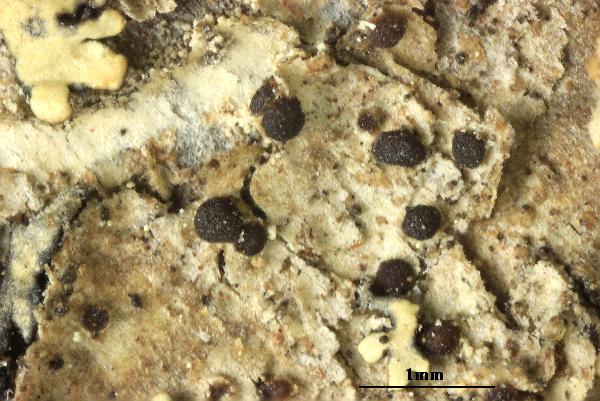
Felix Schumm - CC BY 4.0
[VZ2119], Austria. Salisburgia: Mühlbach am Hochkönig, Schneeberg,Karbachalm, 1700 m. In corticem Piceae excelsae. Leg. R. Türk (8644)et E. Blieberger, 23.5.1986. EX A. VEZDA LICHENES SELECTI EXSICCATI NR. 2119. - As Lecanora obscurella
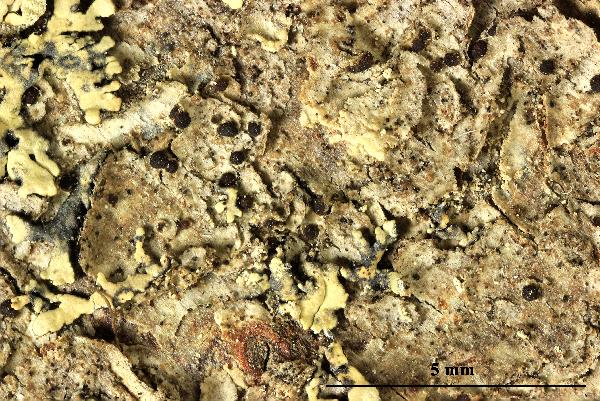
Felix Schumm - CC BY 4.0
[VZ2119], Austria. Salisburgia: Mühlbach am Hochkönig, Schneeberg,Karbachalm, 1700 m. In corticem Piceae excelsae. Leg. R. Türk (8644)et E. Blieberger, 23.5.1986. EX A. VEZDA LICHENES SELECTI EXSICCATI NR. 2119. - As Lecanora obscurella
Growth form: Crustose
Substrata: bark
Photobiont: green algae other than Trentepohlia
Reproductive strategy: mainly sexual
Commonnes-rarity: (info)
Alpine belt: absent
Subalpine belt: very rare
Montane belt: very rare
Dry submediterranean belt: absent
Humid submediterranean belt: absent
Padanian area: absent
pH of the substrata:
| 1 | 2 | 3 | 4 | 5 |
Solar irradiation:
| 1 | 2 | 3 | 4 | 5 |
Aridity:
| 1 | 2 | 3 | 4 | 5 |
Eutrophication:
| 1 | 2 | 3 | 4 | 5 |
Poleotolerance:
| 0 | 1 | 2 | 3 |
Altitudinal distribution:
| 1 | 2 | 3 | 4 | 5 | 6 |
Rarity
absent
extremely rare
very rare
rare
rather rare
rather common
common
very common
extremely common
Loading data...
Occurrence data
Predictive map
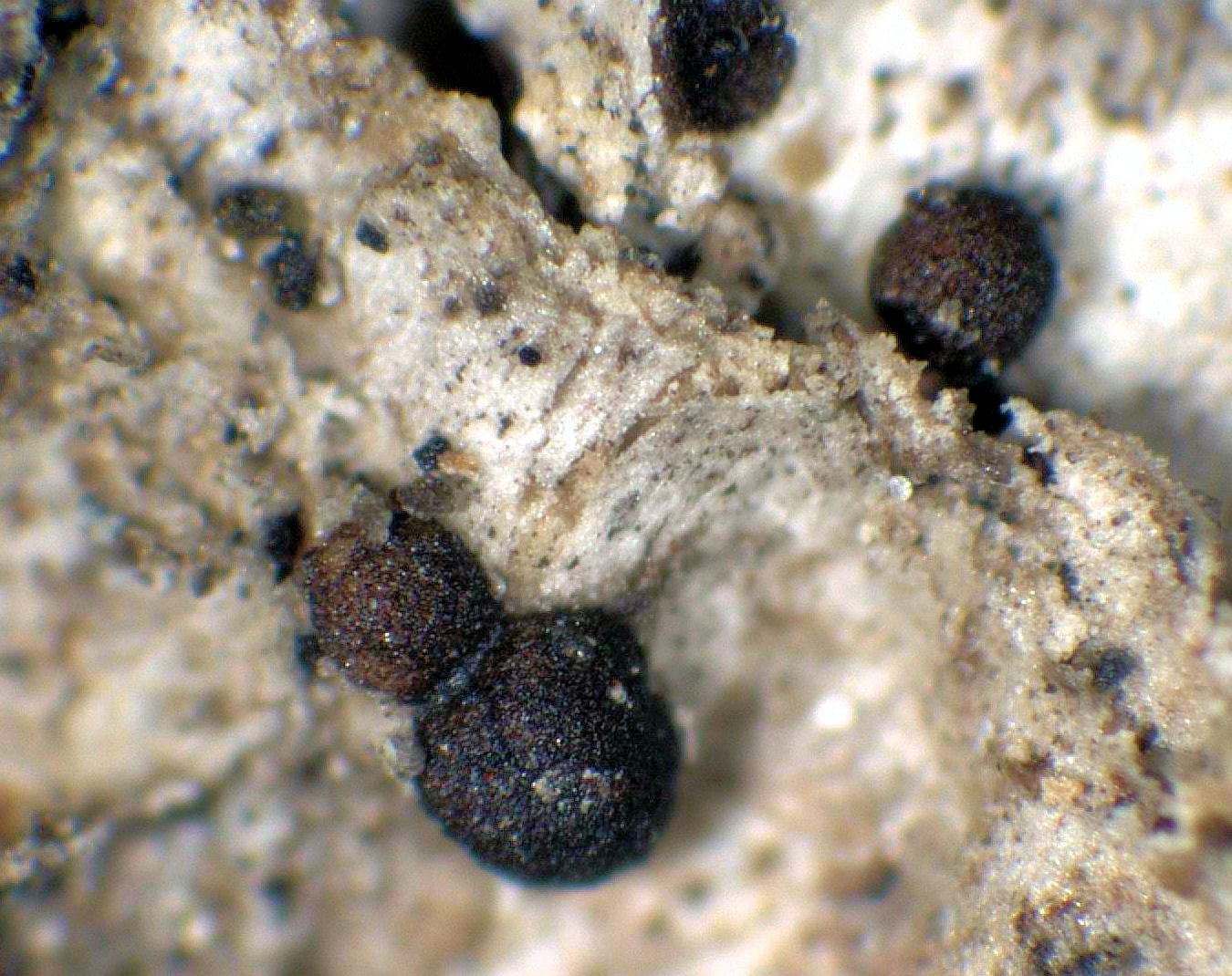
P.L. Nimis CC BY-SA 4.0
TSB 8206
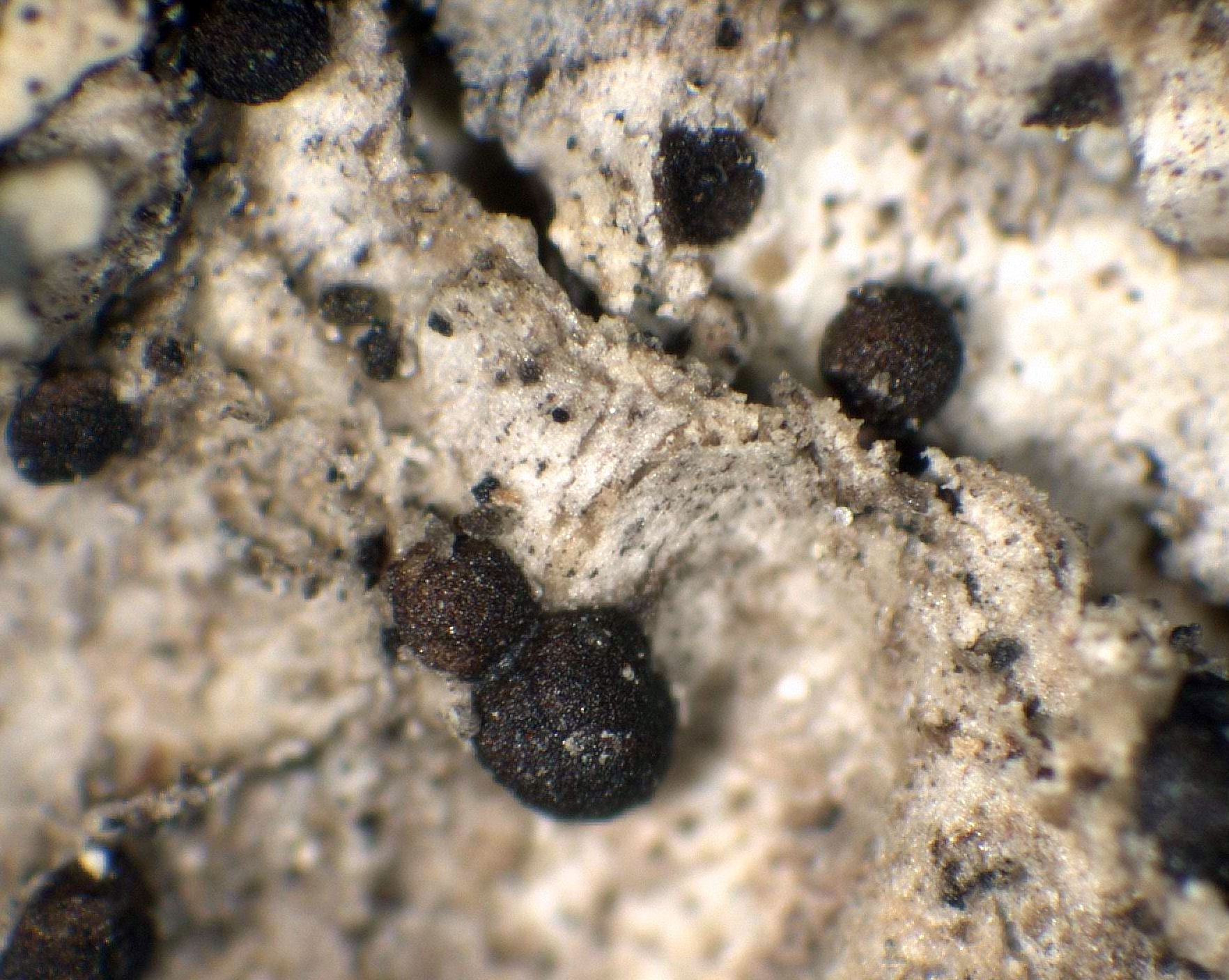
P.L. Nimis CC BY-SA 4.0
TSB 8206

Felix Schumm - CC BY 4.0
[VZ2119], Austria. Salisburgia: Mühlbach am Hochkönig, Schneeberg,Karbachalm, 1700 m. In corticem Piceae excelsae. Leg. R. Türk (8644)et E. Blieberger, 23.5.1986. EX A. VEZDA LICHENES SELECTI EXSICCATI NR. 2119. - As Lecanora obscurella