Lecidea auriculata subsp. brachyspora Th. Fr.
Lichenogr. Scand., 2: 501, 1874.
Synonyms: Lecidea brachyspora var. dissentiens Bagl. & Carestia?
Description: Thallus crustose, episubstratic, cracked-areolate, white to grey-white, usually without a distinct prothallus, more rarely poorly developed and hardly evident. Medulla I+ violet-blue. Apothecia lecideine, black, adnate and slightly constricted at base, l-2(-2.5) mm across, with a flat, epruinose disc, and an irregularly flexuose, prominent, persistent proper margin. Proper exciple 80-130 μm thick, partially extending below the hypothecium, dark brown to violet-brown in outer part, pale brown, pinkish brown or colourless within, of intricate-radiating, 2-3 μm thick, thin walled, loosely arranged hyphae, C- or C+ red, I+ blue; epithecium blue-green; hymenium colourless or pale green, 40-50 μm high; paraphyses mostly simple, 1.3-2 µm thick at mid-level, the apical cells 3-4(-5) µm wide, with a dark green cap; hypothecium conspicuous, violet-brown. Asci 8-spored, narrowly clavate, thick-walled, with a K/I+ pale blue tholus and a strongly amyloid, thin apical cushion, surrounded by a I+ blue outer layer, Lecidea-type. Ascospores 1-celled, hyaline, appearing pseudodiblastic, broadly ellipsoid to subglobose 4.8-8 x 3.5-4.5(-5) µm, 1.1-1.7 times as long as wide. Spot tests: thallus K-, C-, KC-, P-, UV-. Chemistry: confluentic acid, glomelliferic acid (trace), 2-0-methylconfluentic acid (trace), 2'-0-methylanziaic acid (trace).
Growth form: Crustose
Substrata: rocks
Photobiont: green algae other than Trentepohlia
Reproductive strategy: mainly sexual
Commonnes-rarity: (info)
Alpine belt: extremely rare
Subalpine belt: very rare
Montane belt: absent
Dry submediterranean belt: absent
Humid submediterranean belt: absent
Padanian area: absent
pH of the substrata:
1 2 3 4 5

Solar irradiation:
1 2 3 4 5
Aridity:
1 2 3 4 5
Eutrophication:
1 2 3 4 5
Poleotolerance:
0 1 2 3
Altitudinal distribution:
1 2 3 4 5 6
Rarity
absent
extremely rare
very rare
rare
rather rare
rather common
common
very common
extremely common
Loading data...
Occurrence data
Predictive map
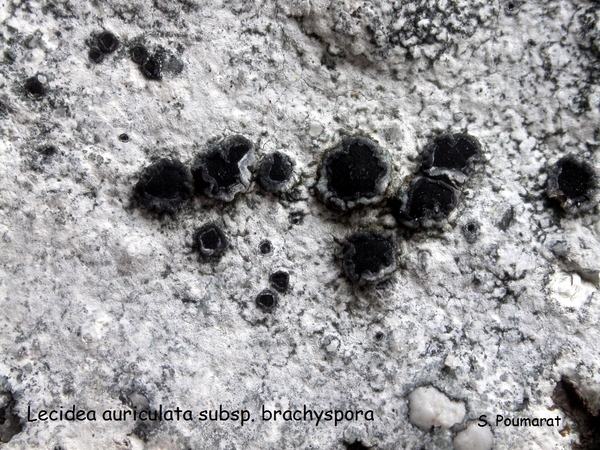
Serge Poumarat - Source: http://mycologie.catalogne.free.fr/lichenPhoto2009/Lecidea_auriculata_brachyspora_2.jpg
France, Alpes de Haut-Provence
Growth form: Crustose
Substrata: rocks
Photobiont: green algae other than Trentepohlia
Reproductive strategy: mainly sexual
Commonnes-rarity: (info)
Alpine belt: extremely rare
Subalpine belt: very rare
Montane belt: absent
Dry submediterranean belt: absent
Humid submediterranean belt: absent
Padanian area: absent
pH of the substrata:
| 1 | 2 | 3 | 4 | 5 |
Solar irradiation:
| 1 | 2 | 3 | 4 | 5 |
Aridity:
| 1 | 2 | 3 | 4 | 5 |
Eutrophication:
| 1 | 2 | 3 | 4 | 5 |
Poleotolerance:
| 0 | 1 | 2 | 3 |
Altitudinal distribution:
| 1 | 2 | 3 | 4 | 5 | 6 |
Rarity
absent
extremely rare
very rare
rare
rather rare
rather common
common
very common
extremely common
Loading data...
Occurrence data
Predictive map