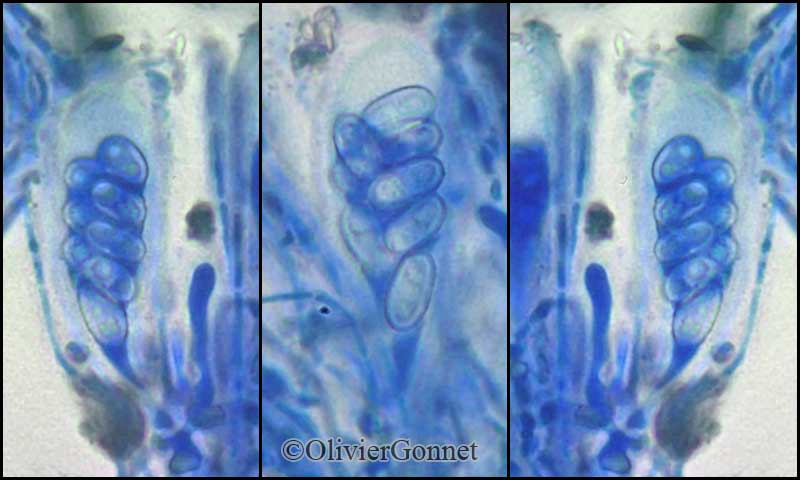
Lecidea tessellata var. caesia (Anzi) Arnold
Arnold, Verh. zool.-bot. Ges. Wien, 39: 264, 1889. Basionym: Lecidea spilota var. caesia Anzi - Cat. Lich. Sondr.: 80, 1860.
Synonyms: Biatora casimirii Müll. Arg.; Lecidea azurea Kremp.; Lecidea casimirii (Müll. Arg.) Müll. Arg.; Lecidea injuncta Nyl.; Lecidella azurea (Kremp.) Körb.
Description: Thallus crustose, episubstratic, 1.5-3(-5) mm thick in central parts, forming small patches, sometimes delimited by a pale grey prothallus, finely rimose-areolate, the areoles contiguous, flat to slightly convex, greyish white to pale bluish grey. Cortex 10-17 µm thick; medulla thick, white, I+ deep blue. Apothecia lecideine, black, mostly developed between the areoles, usually clustered, 0.3-1.8 mm across, with a black, flat to slightly convex, epruinose or weakly pruinose disc, and a thin, often soon excluded proper margin. Proper exciple poorly developed, with a brownish rim, colourless within; epithecium olive-brown, grey or green-black, 10-15 µm high; hymenium colourless or pale green, 40-75 µm high, I+ blue; paraphyses simple or rarely branched, usually not anastomosing, 1.8-2.7 µm thick at mid-level, the apical cell 3.5-6 µm wide; hypothecium colourless to very pale green or yellowish brown. Asci 8-spored, clavate, Lecidea-type. Ascospores 1-celled, hyaline, ellipsoid to broadly ellipsoid, 8-11 x 4.5-6(-6.5) µm, not halonate, rather thick-walled. Pycnidia semi-immersed, black, the ostiolar region often elongate and almost lirelliform. Conidia bacilliform, 7-19 x 1-1.5 µm. Photobiont chlorococcoid. Spot tests: thallus K-, C-, KC-, P-. Chemistry: confluentic acid (major).
Growth form: Crustose
Substrata: rocks
Photobiont: green algae other than Trentepohlia
Reproductive strategy: mainly sexual
paras crustose lichens
Commonnes-rarity: (info)
Alpine belt: rather rare
Subalpine belt: rather common
Montane belt: absent
Dry submediterranean belt: absent
Humid submediterranean belt: absent
Padanian area: absent
pH of the substrata:
1 2 3 4 5

Solar irradiation:
1 2 3 4 5
Aridity:
1 2 3 4 5
Eutrophication:
1 2 3 4 5
Poleotolerance:
0 1 2 3
Altitudinal distribution:
1 2 3 4 5 6
Rarity
absent
extremely rare
very rare
rare
rather rare
rather common
common
very common
extremely common
Loading data...
Occurrence data
Predictive map

P.L. Nimis; Owner: Department of Life Sciences, University of Trieste
Herbarium: TSB (33416)
2003/03/12

Courtesy Danièle et Olivier Gonnet - Source: https://www.afl-lichenologie.fr/Photos_AFL/Photos_AFL_L/Texte_L_3/Lecidea_tessellata.htm
France, 24/7/2014 - session AFL dans le Mercatour - Alpes-de-Haute-Provence

Courtesy Danièle et Olivier Gonnet - Source: https://www.afl-lichenologie.fr/Photos_AFL/Photos_AFL_L/Texte_L_3/Lecidea_tessellata.htm
France, 24/7/2014 - session AFL dans le Mercatour - Alpes-de-Haute-Provence

Courtesy Danièle et Olivier Gonnet - Source: https://www.afl-lichenologie.fr/Photos_AFL/Photos_AFL_L/Texte_L_3/Lecidea_tessellata.htm
France, 24/7/2014 - session AFL dans le Mercatour - Alpes-de-Haute-Provence
Growth form: Crustose
Substrata: rocks
Photobiont: green algae other than Trentepohlia
Reproductive strategy: mainly sexual
paras crustose lichens
Commonnes-rarity: (info)
Alpine belt: rather rare
Subalpine belt: rather common
Montane belt: absent
Dry submediterranean belt: absent
Humid submediterranean belt: absent
Padanian area: absent
pH of the substrata:
| 1 | 2 | 3 | 4 | 5 |
Solar irradiation:
| 1 | 2 | 3 | 4 | 5 |
Aridity:
| 1 | 2 | 3 | 4 | 5 |
Eutrophication:
| 1 | 2 | 3 | 4 | 5 |
Poleotolerance:
| 0 | 1 | 2 | 3 |
Altitudinal distribution:
| 1 | 2 | 3 | 4 | 5 | 6 |
Rarity
absent
extremely rare
very rare
rare
rather rare
rather common
common
very common
extremely common
Loading data...
Occurrence data
Predictive map
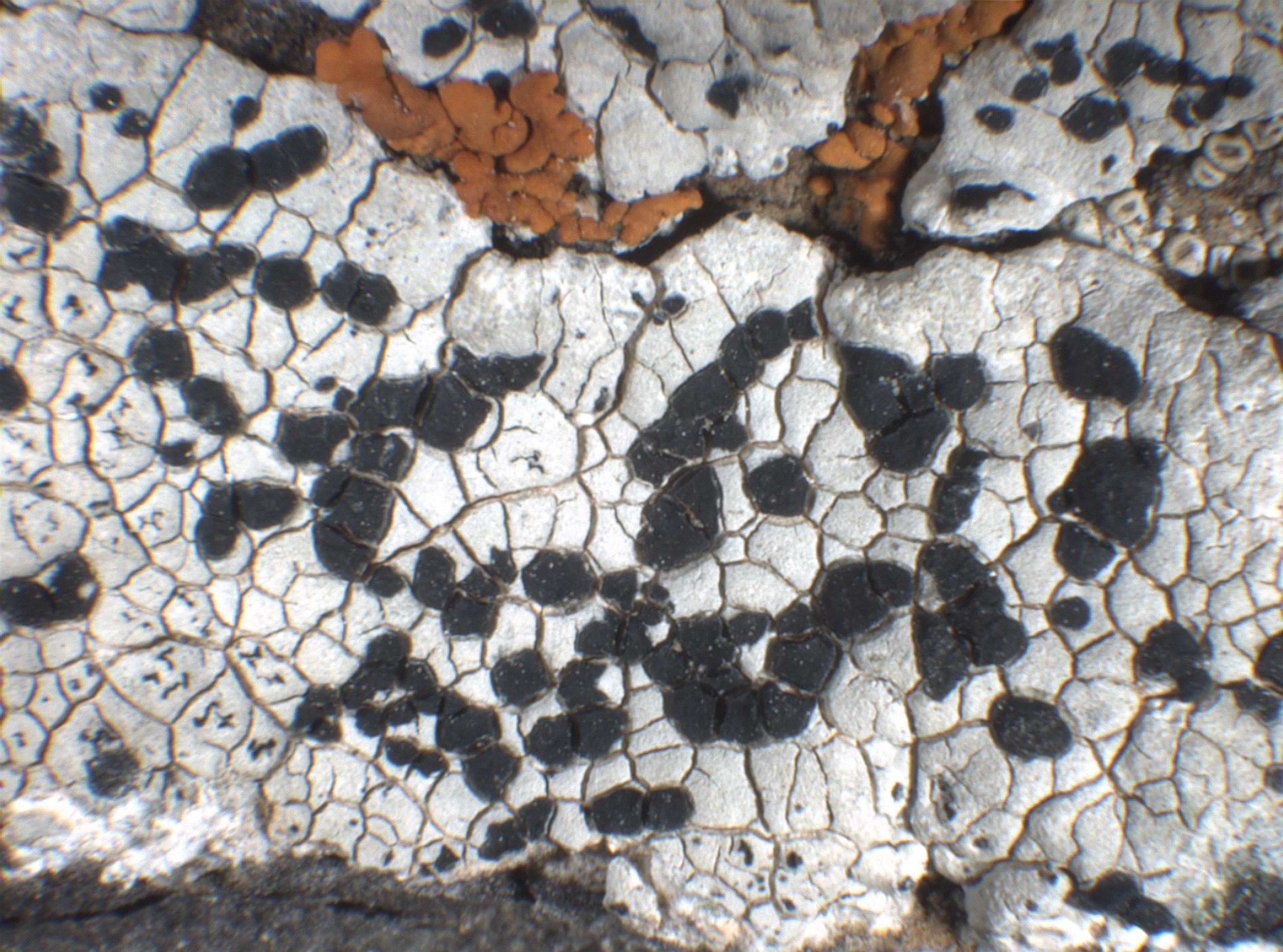
P.L. Nimis; Owner: Department of Life Sciences, University of Trieste
Herbarium: TSB (33416)
2003/03/12
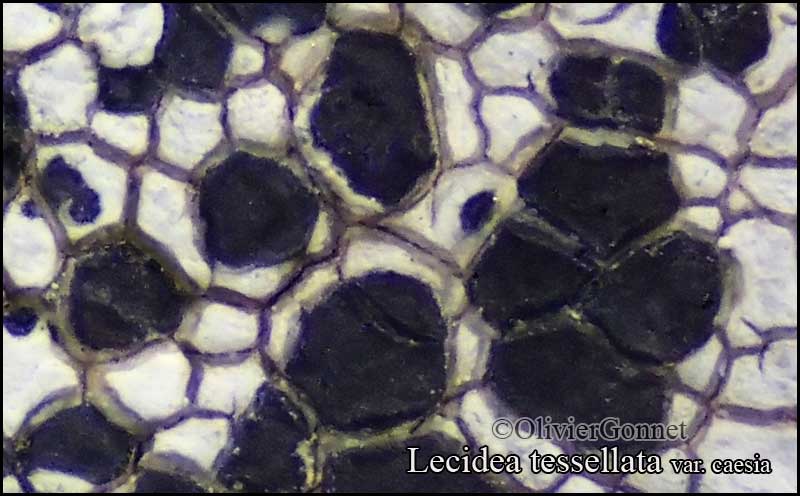
Courtesy Danièle et Olivier Gonnet - Source: https://www.afl-lichenologie.fr/Photos_AFL/Photos_AFL_L/Texte_L_3/Lecidea_tessellata.htm
France, 24/7/2014 - session AFL dans le Mercatour - Alpes-de-Haute-Provence
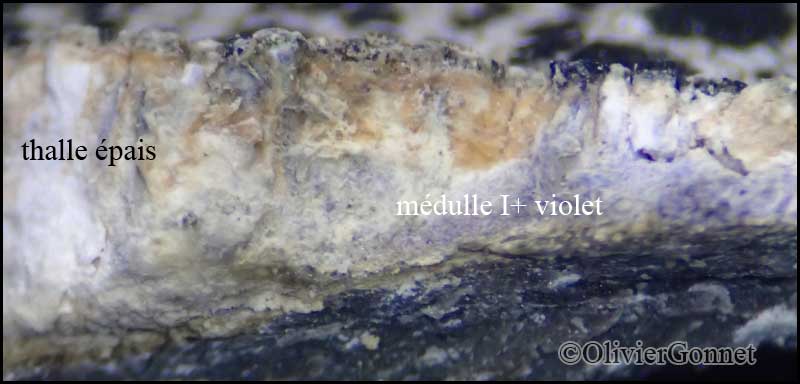
Courtesy Danièle et Olivier Gonnet - Source: https://www.afl-lichenologie.fr/Photos_AFL/Photos_AFL_L/Texte_L_3/Lecidea_tessellata.htm
France, 24/7/2014 - session AFL dans le Mercatour - Alpes-de-Haute-Provence