Megaspora verrucosa var. mutabilis (Ach.) Nimis & Cl. Roux
in Nimis, The Lichens of Italy: 430, 1993. Basionym: Urceolaria mutabilis Ach. - Lichenogr. Univ.: 335, 1810.
Synonyms: Aspicilia mutabilis (Ach.) Körb.; Lecanora mutabilis (Ach.) Nyl.; Pachyospora mutabilis (Ach.) A. Massal.; Patellaria mutabilis (Ach.) Trevis.; Pertusaria lapieana B. de Lesd.
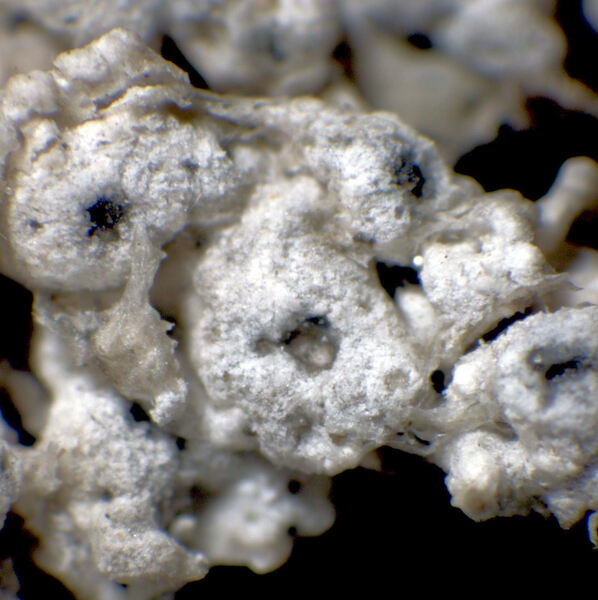
Description: Thallus crustose, whitish to brownish grey, usually warted, more or less densely white-pruinose, usually rather well-delimited. Apothecia frequent, aspicilioid, immersed in thalline warts, up to 1.5 mm across (usually less), with a black, initially pore-like then expanded, concave to finally flat, rough but epruinose disc, the black colour expanding to the margin, forming a dark halo; thalline margin thick, smooth, whitish to grey, darker in inner part, pruinose. Thalline exciple with numerous small crystals; proper exciple thin, of strongly coherent, vertically aligned hyphae; epithecium olivaceous green to partly grey-black, N+ bright green, the darkest parts K+ brownish, without crystals; hymenium colourless, 80-120 µm high, I+ blue; paraphysoids coherent, branched and anastomosing, slender, c. 1.5 µm thick, the apical cells not markedly thickened; hypothecium colourless to yellowish. Asci (4-)8-spored, clavate or cylindrical-clavate, thin walled except towards the apex, with a K/I+ pale blue tholus, Biatora-type. Ascospores 1-celled, hyaline, broadly ellipsoid to subglobose, 34-60 x 22-42 µm, the wall 1.5-2.5 µm thick. Photobiont chlorococcoid. Spot tests: thallus K-, C-, KC-, P-, UV-. Chemistry: thallus without lichen substances; apothecia with the Caesiocinerea-green pigment.
Growth form: Crustose
Substrata: bark
Photobiont: green algae other than Trentepohlia
Reproductive strategy: mainly sexual
Commonnes-rarity: (info)
Alpine belt: absent
Subalpine belt: extremely rare
Montane belt: rare
Dry submediterranean belt: very rare
Humid submediterranean belt: very rare
Padanian area: absent
pH of the substrata:
1 2 3 4 5

Solar irradiation:
1 2 3 4 5
Aridity:
1 2 3 4 5
Eutrophication:
1 2 3 4 5
Poleotolerance:
0 1 2 3
Altitudinal distribution:
1 2 3 4 5 6
Rarity
absent
extremely rare
very rare
rare
rather rare
rather common
common
very common
extremely common
Loading data...
Occurrence data
Predictive map
P.L. Nimis CC BY-SA 4.0
TSB 24376
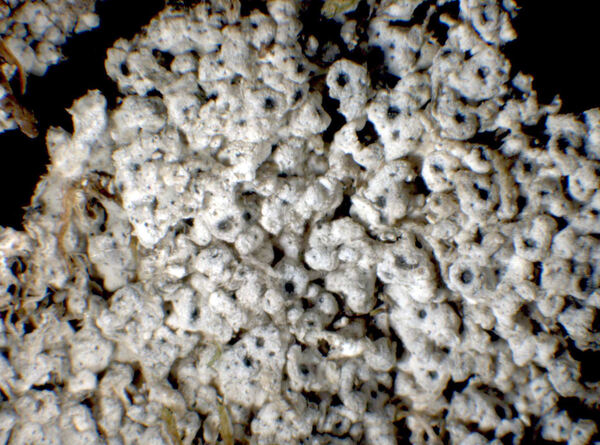
P.L. Nimis CC BY-SA 4.0
TSB 24376
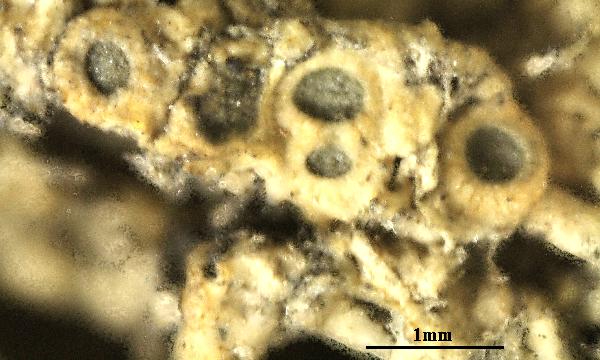
Felix Schumm - CC BY 4.0
[VZ1278], USSR. Distr. Krasnodar: In jugo collis Orlinnyje skaly
prope balneas Sotschi, 320 m. Ad corticem Quercus petraeae. Leg. I.
Pišút, 12.8.1973. EX A. VEZDA LICHENES SELECTI EXSICCATI NR. 1278. - As Pachyospora mutabilis
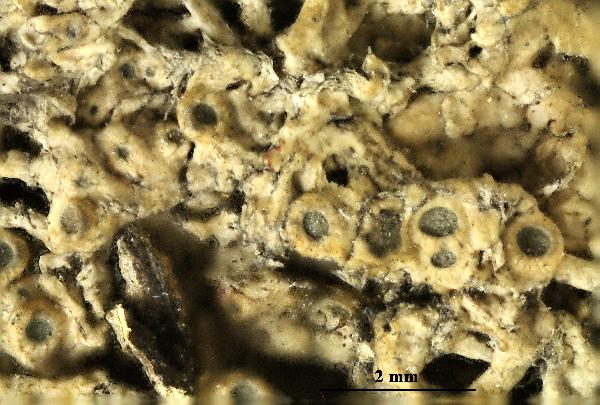
Felix Schumm - CC BY 4.0
[VZ1278], USSR. Distr. Krasnodar: In jugo collis Orlinnyje skaly
prope balneas Sotschi, 320 m. Ad corticem Quercus petraeae. Leg. I.
Pišút, 12.8.1973. EX A. VEZDA LICHENES SELECTI EXSICCATI NR. 1278. - As Pachyospora mutabilis
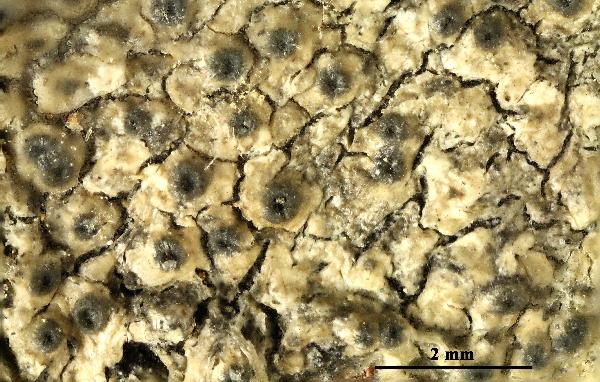
Felix Schumm - CC BY 4.0
[VZ1761], Suecia. Värmland: Vitsand, Kullberget, 360 m. Ad corticem
Populi tremulae. Leg. S. W. Sundell, 27.8.1976. EX A. VEZDA LICHENES
SELECTI EXSICCATI NR. 1761. - As Pachyospora mutabilis
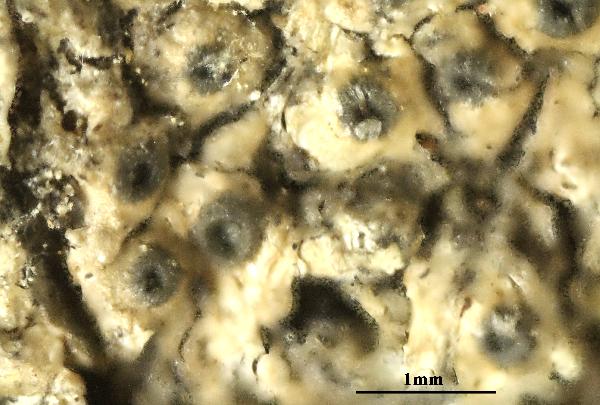
Felix Schumm - CC BY 4.0
[VZ1761], Suecia. Värmland: Vitsand, Kullberget, 360 m. Ad corticem
Populi tremulae. Leg. S. W. Sundell, 27.8.1976. EX A. VEZDA LICHENES
SELECTI EXSICCATI NR. 1761. - As Pachyospora mutabilis
Growth form: Crustose
Substrata: bark
Photobiont: green algae other than Trentepohlia
Reproductive strategy: mainly sexual
Commonnes-rarity: (info)
Alpine belt: absent
Subalpine belt: extremely rare
Montane belt: rare
Dry submediterranean belt: very rare
Humid submediterranean belt: very rare
Padanian area: absent
pH of the substrata:
| 1 | 2 | 3 | 4 | 5 |
Solar irradiation:
| 1 | 2 | 3 | 4 | 5 |
Aridity:
| 1 | 2 | 3 | 4 | 5 |
Eutrophication:
| 1 | 2 | 3 | 4 | 5 |
Poleotolerance:
| 0 | 1 | 2 | 3 |
Altitudinal distribution:
| 1 | 2 | 3 | 4 | 5 | 6 |
Rarity
absent
extremely rare
very rare
rare
rather rare
rather common
common
very common
extremely common
Loading data...
Occurrence data
Predictive map
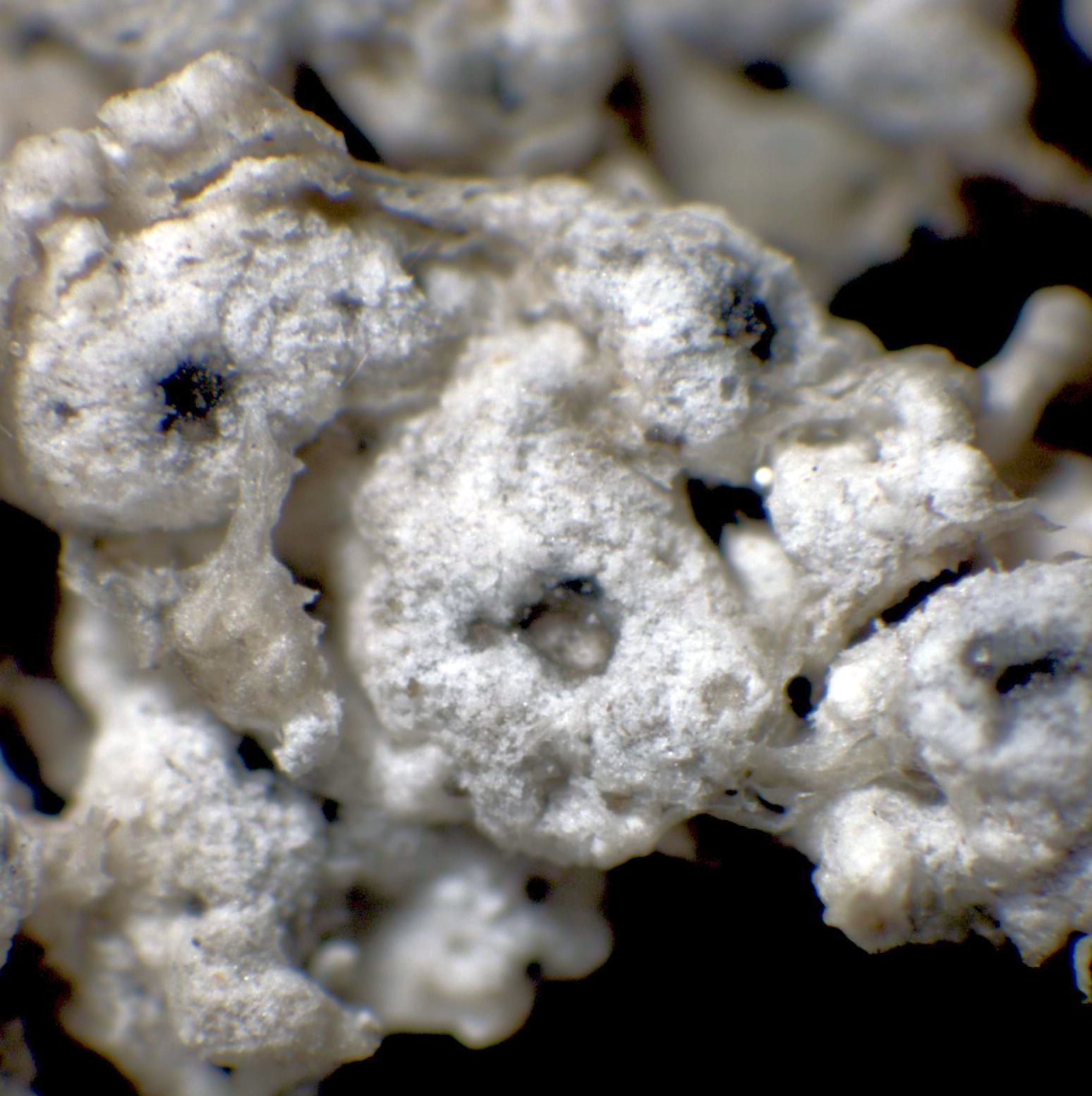
P.L. Nimis CC BY-SA 4.0
TSB 24376
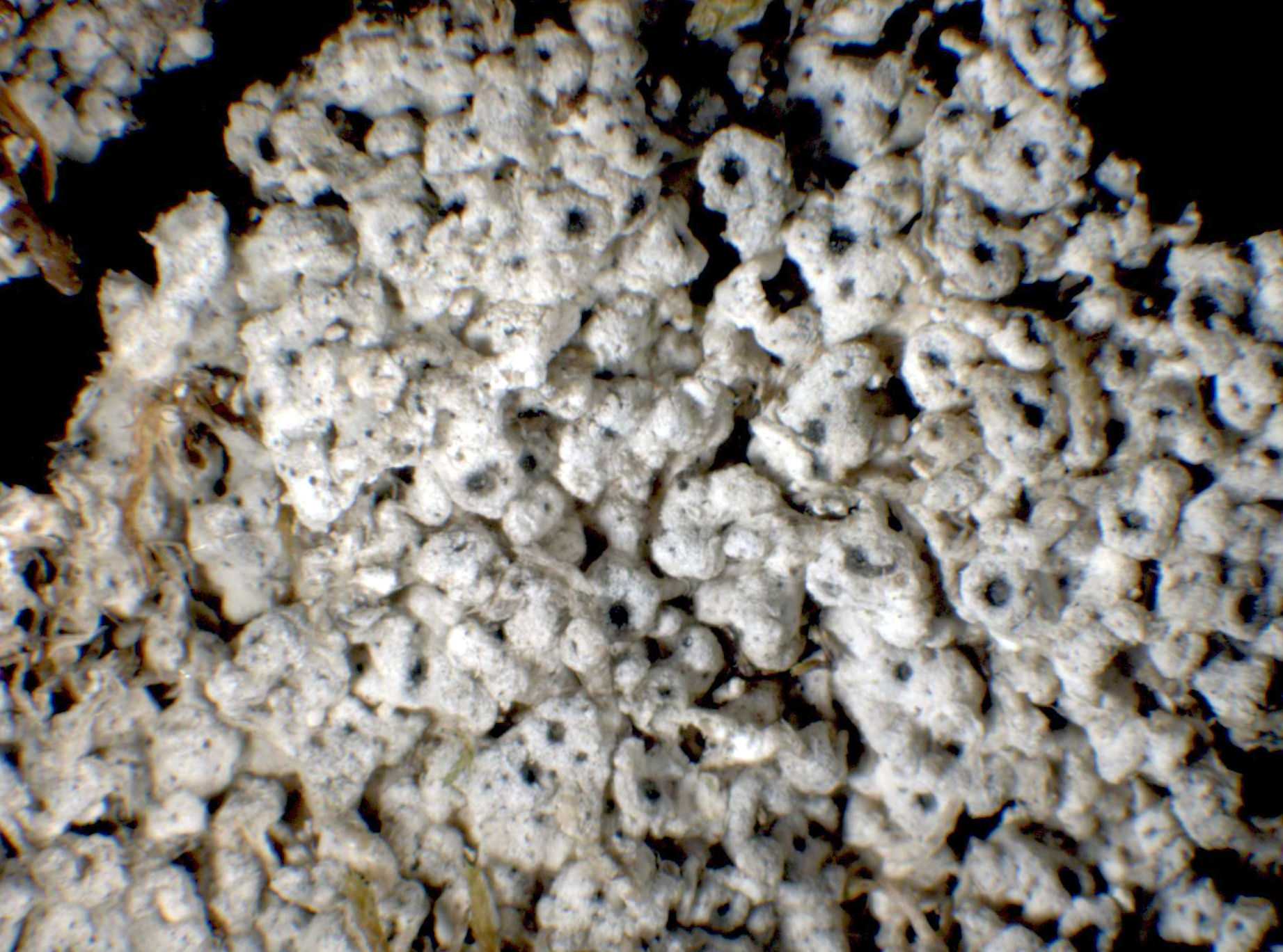
P.L. Nimis CC BY-SA 4.0
TSB 24376

Felix Schumm - CC BY 4.0
[VZ1278], USSR. Distr. Krasnodar: In jugo collis Orlinnyje skaly prope balneas Sotschi, 320 m. Ad corticem Quercus petraeae. Leg. I. Pišút, 12.8.1973. EX A. VEZDA LICHENES SELECTI EXSICCATI NR. 1278. - As Pachyospora mutabilis

Felix Schumm - CC BY 4.0
[VZ1278], USSR. Distr. Krasnodar: In jugo collis Orlinnyje skaly prope balneas Sotschi, 320 m. Ad corticem Quercus petraeae. Leg. I. Pišút, 12.8.1973. EX A. VEZDA LICHENES SELECTI EXSICCATI NR. 1278. - As Pachyospora mutabilis

Felix Schumm - CC BY 4.0
[VZ1761], Suecia. Värmland: Vitsand, Kullberget, 360 m. Ad corticem Populi tremulae. Leg. S. W. Sundell, 27.8.1976. EX A. VEZDA LICHENES SELECTI EXSICCATI NR. 1761. - As Pachyospora mutabilis