Placidiopsis cinerascens (Nyl.) Breuss
Plant Syst. Evol., 148: 315, 1985. Basionym: Endocarpon cinerascens Nyl. - Bot. Not.: 160, 1853.
Synonyms: Catapyrenium circinatum (Bagl.) Jatta; Catapyrenium grappae (Beltr.) Jatta; Catapyrenium pisanum (Bagl.) Jatta; Dermatocarpon baumgartneri (Zahlbr.) Zahlbr.; Dermatocarpon cinerascens (Nyl.) Zahlbr.; Endocarpon grappae (Beltr.) Garov.; Endocarpon pervirescens Nyl.; Placidiopsis baumgartneri Zahlbr.; Placidiopsis circinata Bagl.; Placidiopsis dalmatica Servít; Placidiopsis grappae Beltr.; Placidiopsis pisana Bagl.; Placidium cinerascens (Nyl.) Arnold; Placocarpus cinerascens (Nyl.) Trevis.; Verrucaria cinerascens (Nyl.) Nyl.
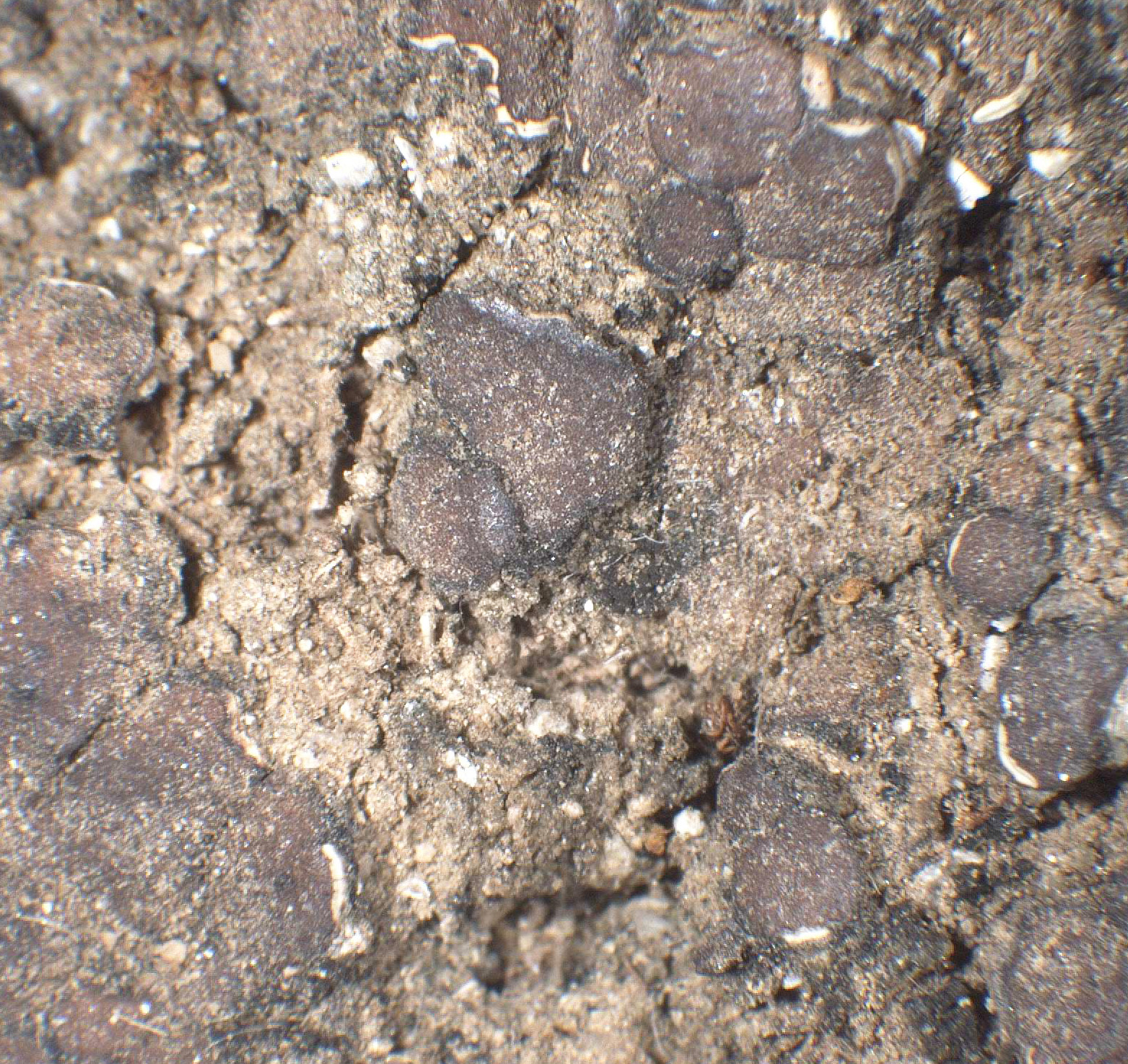
Description: Thallus squamulose, the squamules rounded to lobulate, 1-3 mm wide, 0.15-0.35 mm thick, flattened to weakly convex, smooth, scattered to contiguous, sometimes weakly overlapping at margins, adpressed to the substratum, greenish grey to brownish grey, sometimes pruinose, matt; lower surface pale, attached by 3-4 μm thick, colourless rhizohyphae. Upper cortex 15-25 μm thick, pseudoparenchymatous, with a 10-30 μm thick epinecral layer; medulla poorly developed, of mostly globose cells; lower cortex absent or poorly developed and consisting of 1-3 layers of isodiametrical cells. Perithecia frequent, laminal, immersed in the squamules, slightly pyriform to globose, up to 0.3 mm across, without involucrellum. Exciple initially colourless, then brownish, darker only around the ostiole, of tangentially arranged, elongate cells; periphyses present around the ostiole, 20-30 x 2.5-3 μm, the terminal cells somewhat enlarged, interascal filaments absent; hymenial gel hemiamyloid. Asci 8-spored, narrowly clavate, thin-walled, apically slightly thickened, with a small ocular chamber, K/I-, 55-65 x 11-16 μm. Ascospores 1-septate, often slightly constricted at septum, hyaline, broadly ellipsoid to subclavate, thin-walled, (12-)15-19(-21) x 5-8 μm. Photobiont chlorococcoid (Diplosphaera). Spot tests: cortex and medulla K-, C-, KC-, P-, UV-. Chemistry: without lichen substances.
Growth form: Crustose
Substrata: soil, terricolous mosses, and plant debris
Photobiont: green algae other than Trentepohlia
Reproductive strategy: mainly sexual
Commonnes-rarity: (info)
Alpine belt: absent
Subalpine belt: absent
Montane belt: absent
Dry submediterranean belt: extremely rare
Humid submediterranean belt: very rare
Padanian area: absent
pH of the substrata:
1 2 3 4 5

Solar irradiation:
1 2 3 4 5
Aridity:
1 2 3 4 5
Eutrophication:
1 2 3 4 5
Poleotolerance:
0 1 2 3
Altitudinal distribution:
1 2 3 4 5 6
Rarity
absent
extremely rare
very rare
rare
rather rare
rather common
common
very common
extremely common
Loading data...
Occurrence data
Predictive map
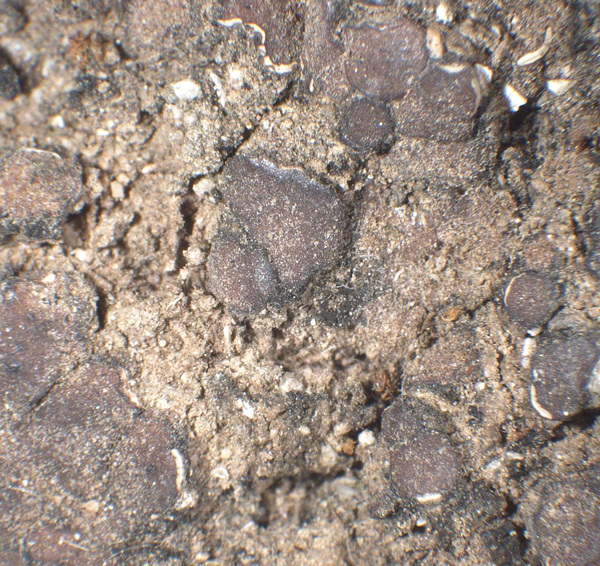
P.L. Nimis CC BY-SA 04
TSB 24493
topotype of Placidiopsis grappae
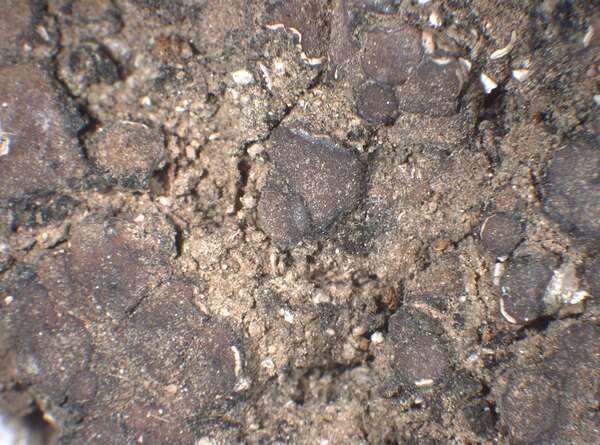
P.L. Nimis; Owner: Department of Life Sciences, University of Trieste
Herbarium: TSB (24493)
2003/03/06
topotype of Placidiopsis grappae
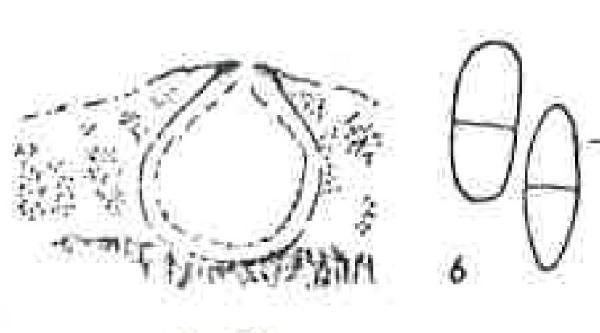
Source: Servit, M 1955: Nove lisejniky. Lichenes novi. - Rozp. Ceskoslov. Acad. Ved 65(3): 1-45. - Public Domain
as Placidiopsis dalmatica
Growth form: Crustose
Substrata: soil, terricolous mosses, and plant debris
Photobiont: green algae other than Trentepohlia
Reproductive strategy: mainly sexual
Commonnes-rarity: (info)
Alpine belt: absent
Subalpine belt: absent
Montane belt: absent
Dry submediterranean belt: extremely rare
Humid submediterranean belt: very rare
Padanian area: absent
pH of the substrata:
| 1 | 2 | 3 | 4 | 5 |
Solar irradiation:
| 1 | 2 | 3 | 4 | 5 |
Aridity:
| 1 | 2 | 3 | 4 | 5 |
Eutrophication:
| 1 | 2 | 3 | 4 | 5 |
Poleotolerance:
| 0 | 1 | 2 | 3 |
Altitudinal distribution:
| 1 | 2 | 3 | 4 | 5 | 6 |
Rarity
absent
extremely rare
very rare
rare
rather rare
rather common
common
very common
extremely common
Loading data...
Occurrence data
Predictive map
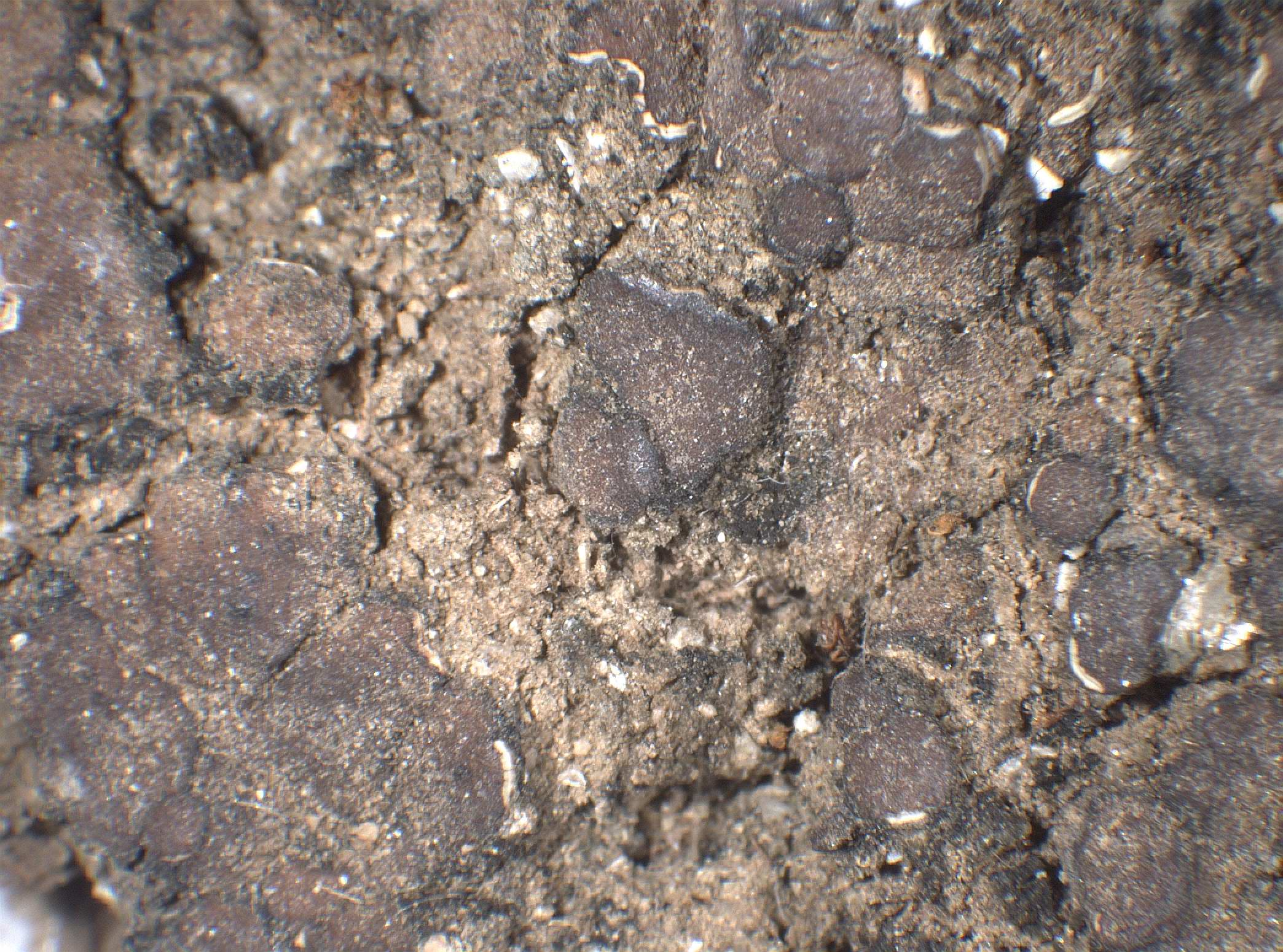
P.L. Nimis CC BY-SA 04
TSB 24493 topotype of Placidiopsis grappae
P.L. Nimis; Owner: Department of Life Sciences, University of Trieste
Herbarium: TSB (24493)
2003/03/06
topotype of Placidiopsis grappae