Placynthium hungaricum Gyeln.
Borbasia, 1: 52, 1939.
Synonyms:
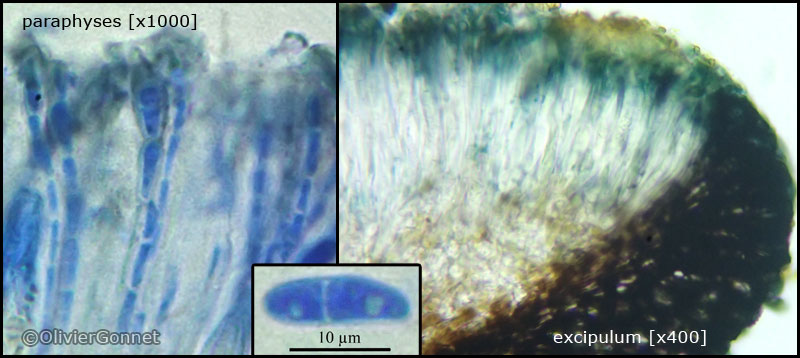
Description: Thallus crustose-placodioid, firmly attached, forming 2(-3) cm wide rosettes or convex pillows, brown-black but densely whitish to blue-grey-pruinose due numerous small crystals of calcium oxalates, usually without a distinct prothallus. Central part of thallus consisting of cylindrical, up to 1(-1.5) mm tall, simple or sparingly branched, ascending to erect, often densely crowded outgrowths; marginal lobes radiating, continuous to slightly overlapping, up to 1.5 mm long and up to 0.3 mm wide, simple or weakly branched. Thallus paraplectenchymatous throughout, the photobiont occupying a c. 0.4 mm thick upper layer. Apothecia rather frequent, biatorine, up to 1 mm across, black, rounded. Epithecium dark blue-green; hymenium colourless, 100-110 µm high, I+ blue; paraphyses distinctly septate, sparingly branched; hypothecium pale brown. Asci 8-spored, apically thickened, with a distinct amyloid tube structure in the apex. Ascospores 1(-3)-septate, hyaline, ellipsoid, sometimes weakly curved, (10-)13-19(-21) x 4-6(-7.5) µm. Pycnidia up to 180(250) µm across, the wall blue-green to green-black at least in upper part. Conidia bacilliform, 4.5–6.5 x c. 1 µm. Photobiont cyanobacterial, Scytonema-like. Spot tests: all negative. Chemistry: without lichen substances.
Growth form: Crustose
Substrata: rocks
Photobiont: cyanobacteria, filamentous (e.g. Nostoc, Scytonema)
Reproductive strategy: mainly sexual
On otherwise dry surfaces with short periods of water seepage after rain
Commonnes-rarity: (info)
Alpine belt: absent
Subalpine belt: absent
Montane belt: rather rare
Dry submediterranean belt: rare
Humid submediterranean belt: absent
Padanian area: absent
pH of the substrata:
1 2 3 4 5

Solar irradiation:
1 2 3 4 5
Aridity:
1 2 3 4 5
Eutrophication:
1 2 3 4 5
Poleotolerance:
0 1 2 3
Altitudinal distribution:
1 2 3 4 5 6
Rarity
absent
extremely rare
very rare
rare
rather rare
rather common
common
very common
extremely common
Loading data...
Occurrence data
Predictive map
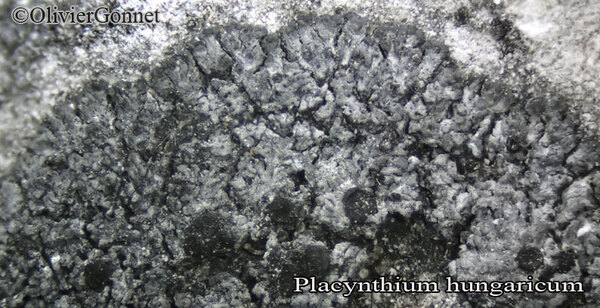
Courtesy Danièle et Olivier Gonnet - Source: https://www.afl-lichenologie.fr/Photos_AFL/Photos_AFL_P/Text_P_3/Placynthium_hungaricum.htm
France, session AFL 2015 dans le Lot, Autoire
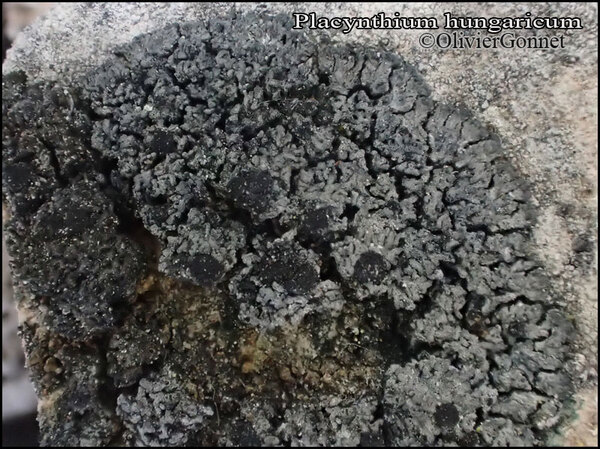
Courtesy Danièle et Olivier Gonnet - Source: https://www.afl-lichenologie.fr/Photos_AFL/Photos_AFL_P/Text_P_3/Placynthium_hungaricum.htm
France, session AFL 2015 dans le Lot, Autoire
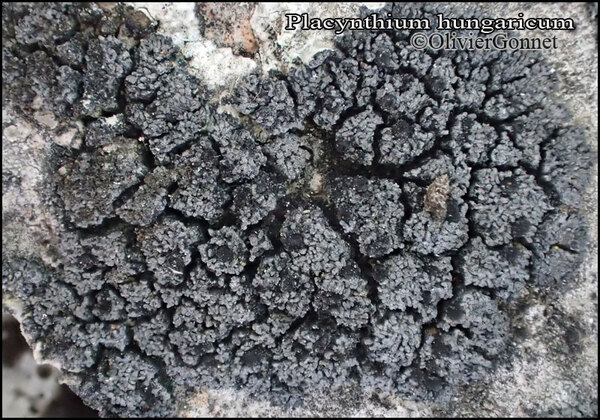
Courtesy Danièle et Olivier Gonnet - Source: https://www.afl-lichenologie.fr/Photos_AFL/Photos_AFL_P/Text_P_3/Placynthium_hungaricum.htm
France, session AFL 2015 dans le Lot, Autoire
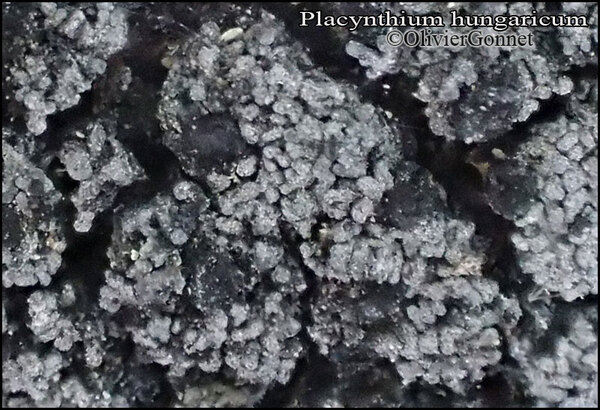
Courtesy Danièle et Olivier Gonnet - Source: https://www.afl-lichenologie.fr/Photos_AFL/Photos_AFL_P/Text_P_3/Placynthium_hungaricum.htm
France, session AFL 2015 dans le Lot, Autoire
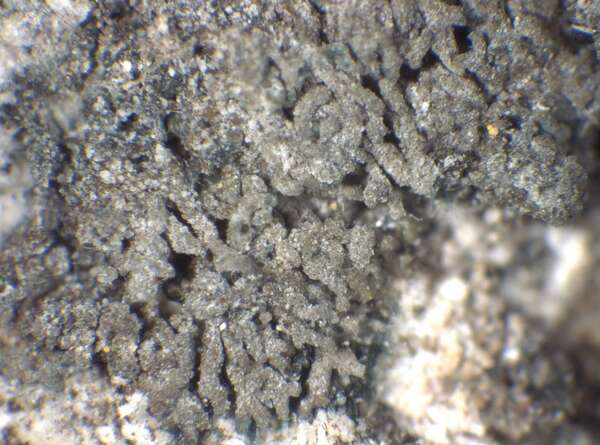
P.L. Nimis; Owner: Department of Life Sciences, University of Trieste
Herbarium: TSB (3318)
2003/03/12
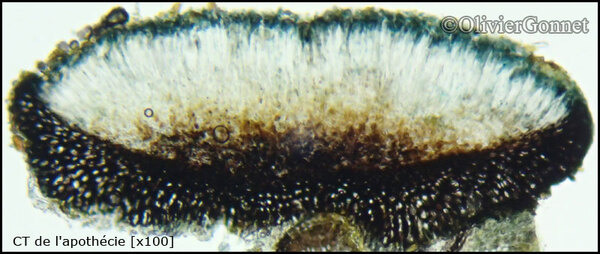
Courtesy Danièle et Olivier Gonnet - Source: https://www.afl-lichenologie.fr/Photos_AFL/Photos_AFL_P/Text_P_3/Placynthium_hungaricum.htm
France, session AFL 2015 dans le Lot, Autoire
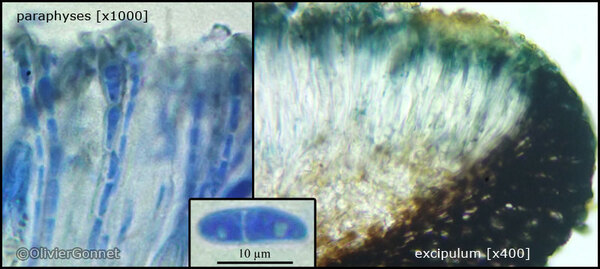
Courtesy Danièle et Olivier Gonnet - Source: https://www.afl-lichenologie.fr/Photos_AFL/Photos_AFL_P/Text_P_3/Placynthium_hungaricum.htm
France, session AFL 2015 dans le Lot, Autoire
Growth form: Crustose
Substrata: rocks
Photobiont: cyanobacteria, filamentous (e.g. Nostoc, Scytonema)
Reproductive strategy: mainly sexual
On otherwise dry surfaces with short periods of water seepage after rain
Commonnes-rarity: (info)
Alpine belt: absent
Subalpine belt: absent
Montane belt: rather rare
Dry submediterranean belt: rare
Humid submediterranean belt: absent
Padanian area: absent
pH of the substrata:
| 1 | 2 | 3 | 4 | 5 |
Solar irradiation:
| 1 | 2 | 3 | 4 | 5 |
Aridity:
| 1 | 2 | 3 | 4 | 5 |
Eutrophication:
| 1 | 2 | 3 | 4 | 5 |
Poleotolerance:
| 0 | 1 | 2 | 3 |
Altitudinal distribution:
| 1 | 2 | 3 | 4 | 5 | 6 |
Rarity
absent
extremely rare
very rare
rare
rather rare
rather common
common
very common
extremely common
Loading data...
Occurrence data
Predictive map
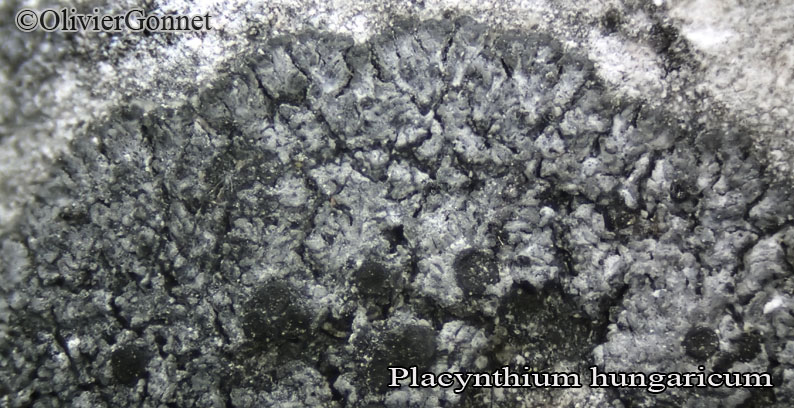
Courtesy Danièle et Olivier Gonnet - Source: https://www.afl-lichenologie.fr/Photos_AFL/Photos_AFL_P/Text_P_3/Placynthium_hungaricum.htm
France, session AFL 2015 dans le Lot, Autoire
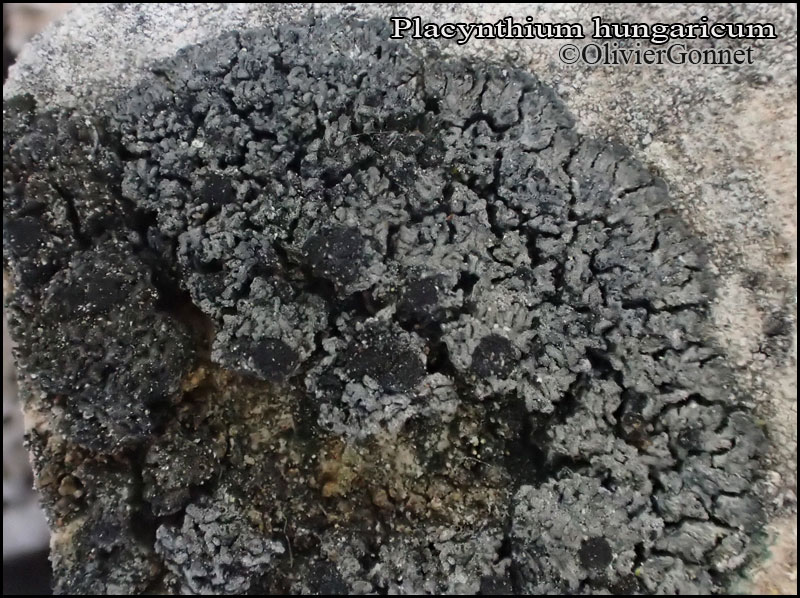
Courtesy Danièle et Olivier Gonnet - Source: https://www.afl-lichenologie.fr/Photos_AFL/Photos_AFL_P/Text_P_3/Placynthium_hungaricum.htm
France, session AFL 2015 dans le Lot, Autoire
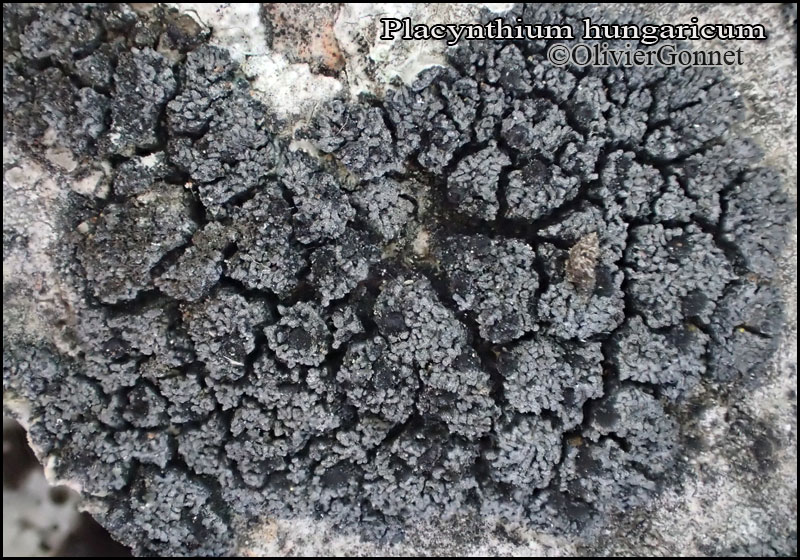
Courtesy Danièle et Olivier Gonnet - Source: https://www.afl-lichenologie.fr/Photos_AFL/Photos_AFL_P/Text_P_3/Placynthium_hungaricum.htm
France, session AFL 2015 dans le Lot, Autoire
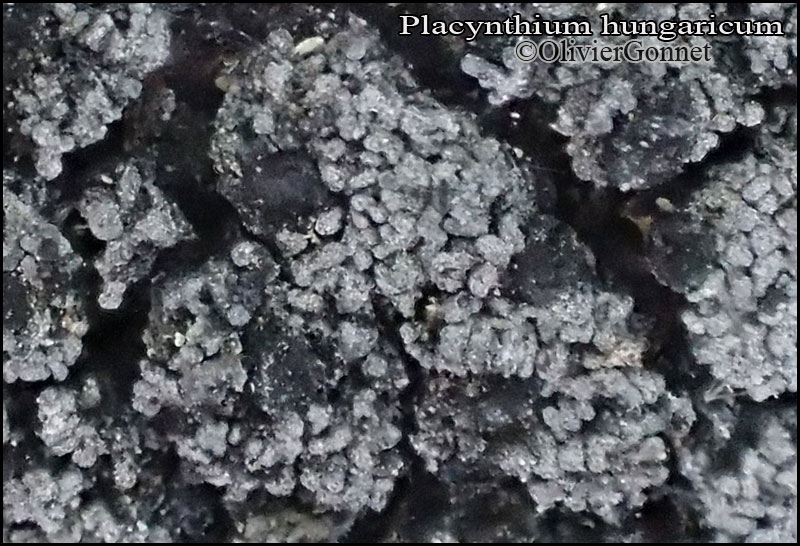
Courtesy Danièle et Olivier Gonnet - Source: https://www.afl-lichenologie.fr/Photos_AFL/Photos_AFL_P/Text_P_3/Placynthium_hungaricum.htm
France, session AFL 2015 dans le Lot, Autoire
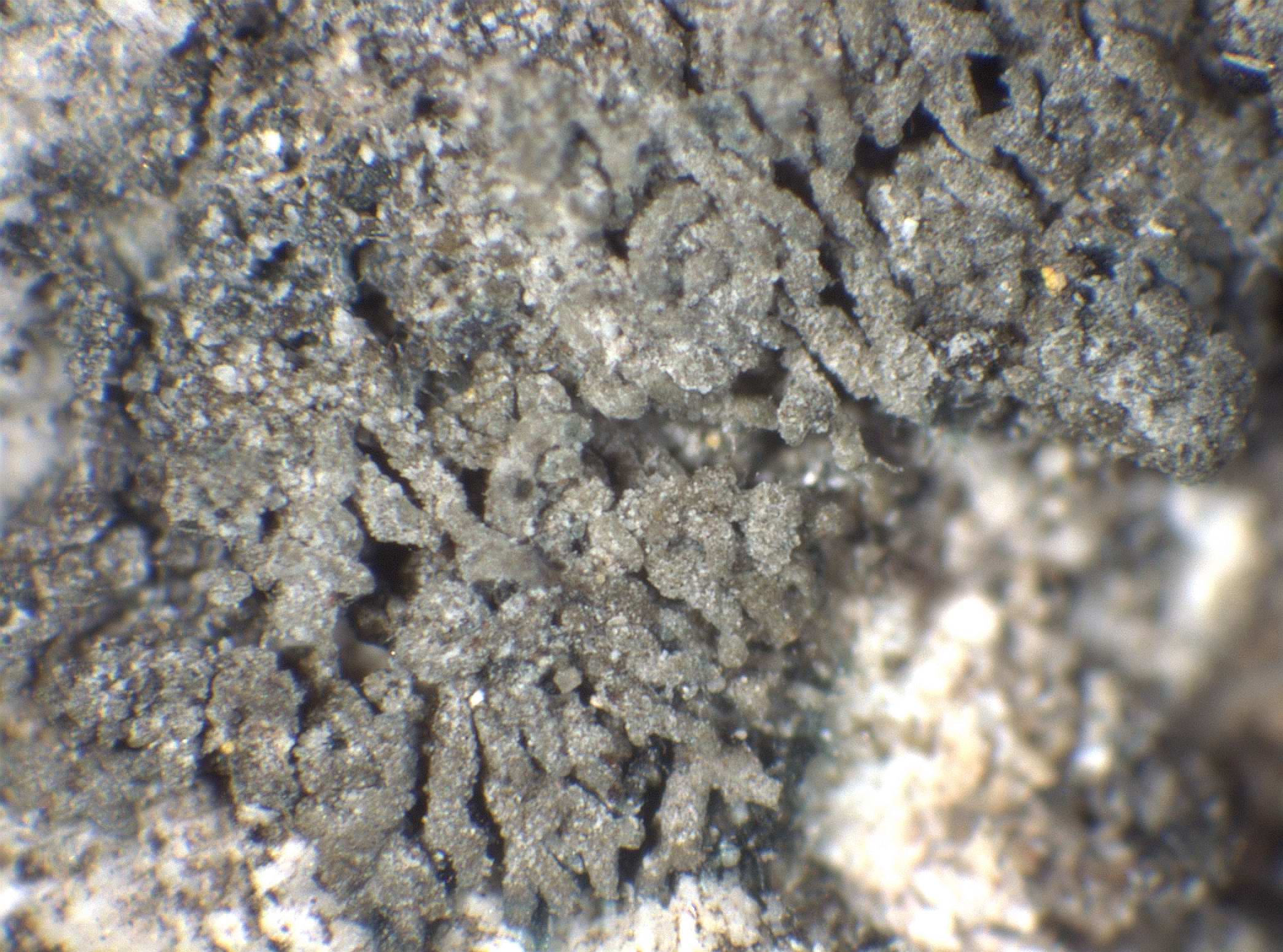
P.L. Nimis; Owner: Department of Life Sciences, University of Trieste
Herbarium: TSB (3318)
2003/03/12
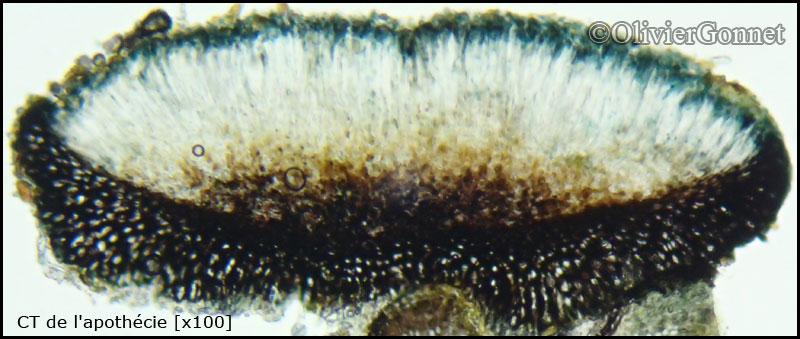
Courtesy Danièle et Olivier Gonnet - Source: https://www.afl-lichenologie.fr/Photos_AFL/Photos_AFL_P/Text_P_3/Placynthium_hungaricum.htm
France, session AFL 2015 dans le Lot, Autoire