Acarospora heufleriana Körb.
Parerga Lichenol.: 57, 1859.
Synonyms: Acarospora heufleriana var. massiliensis Harm.; Acarospora massiliensis (Harm.) H. Magn.; Acarospora perpulchra Hue
Description: Thallus crustose, areolate, bright to dull yellow, epruinose or rarely faintly pruinose, forming up to 5 cm wide patches, the areoles angular and flat to orbicular and convex, 0.5-2 mm wide and up to 0.8 mm thick, dispersed to usually contiguous, the peripheral ones sometimes slightly elongated. Cortex paraplectenchymatous, 30-60 µm thick, yellow in upper part, colourless in lower part; algal layer thin, continuous, the algae scattered below the apothecia; medulla white, prosoplectenchymatous. Apothecia 0.3-1 mm across, 1-5 per areole, immersed, at first punctiform then expanded, with a round to irregular, yellowish brown to dark reddish brown disc and a thin, often inconspicuous thalline margin. Proper exciple 20-30 µm wide laterally; epithecium yellowish, 10-15 µm high; hymenium colourless, 80-135 µm high, the hymenial gel euamyloid, I+ persistently dark blue; paraphyses weakly coherent, 1-1.8 µm thick at base, the apical cells hardly swollen; subhymenium pale yellow, up to 40 µm high; hypothecium 20-30 µm high. Asci >100-spored, clavate, the apical dome K/I-. Ascospores 1-celled, hyaline, ellipsoid to subglobose, 3-4.5 x 2-3 µm. Pycnidia globose, immersed, the ostiole visible as a pale brown dot. Conidia bacilliform, 3-4 x 1(-1.5) µm. Photobiont chlorococcoid. Spot tests: medulla K+ yellow turning red (often forming needle-like crystals, the reaction sometimes poorly evident), C-, KC-, P-, UV+ orange. Chemistry: rhizocarpic and norstictic acids, the latter often in low amounts.
Growth form: Crustose
Substrata: rocks
Photobiont: green algae other than Trentepohlia
Reproductive strategy: mainly sexual
Subcontinental: restricted to areas with a dry-subcontinental climate (e.g. dry Alpine valleys, parts of Mediterranean Italy)
paras crustose lichens
Commonnes-rarity: (info)
Alpine belt: absent
Subalpine belt: absent
Montane belt: very rare
Dry submediterranean belt: extremely rare
Humid submediterranean belt: very rare
Padanian area: absent
pH of the substrata:
1 2 3 4 5

Solar irradiation:
1 2 3 4 5
Aridity:
1 2 3 4 5
Eutrophication:
1 2 3 4 5
Poleotolerance:
0 1 2 3
Altitudinal distribution:
1 2 3 4 5 6
Rarity
absent
extremely rare
very rare
rare
rather rare
rather common
common
very common
extremely common
Loading data...
Occurrence data
Predictive map
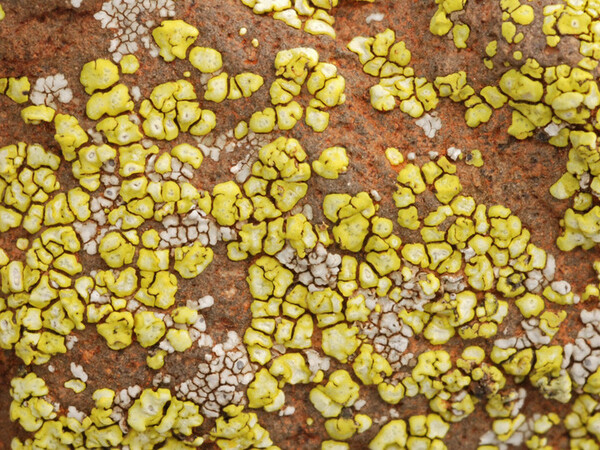
Leif Stridvall - Source: http://www.stridvall.se/la/galleries.php (Courtesy: Anita Stridvall)
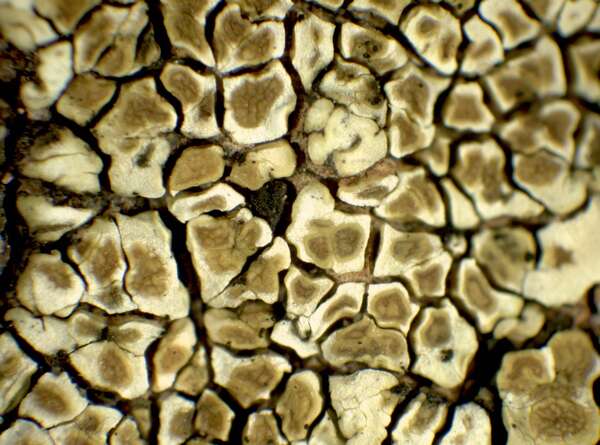
P.L. Nimis; Owner: Department of Life Sciences, University of Trieste
Herbarium: TSB (5177)
2001/12/08
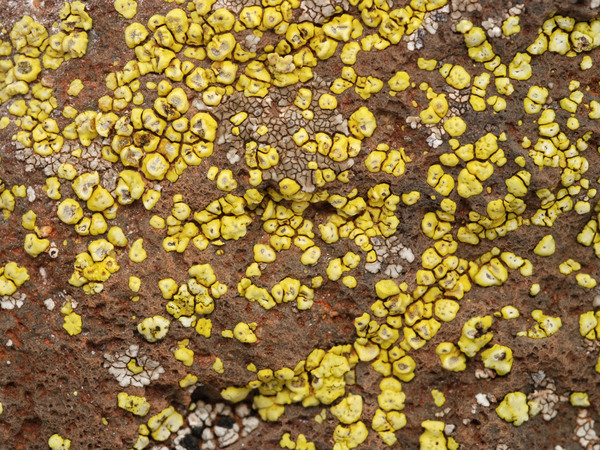
Leif Stridvall - Source: http://www.stridvall.se/lichens/gallery/
Courtesy: Anita Stridvall
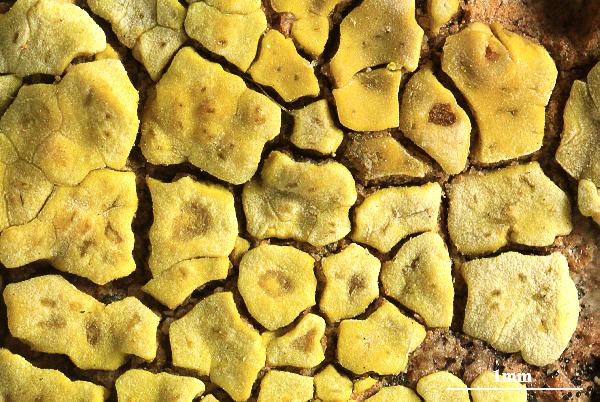
Felix Schumm - CC BY-SA 4.0
[VZ1186], Gallia, Var: Hyéres, Le Fenouillet, 250 m. Ad saxa schistosa
et quartzitica. Leg. Y. Rondon, 29.3.1973. Ex A. VEZDA: LICHENES
SELECTI EXSICCATI NR. 1186.
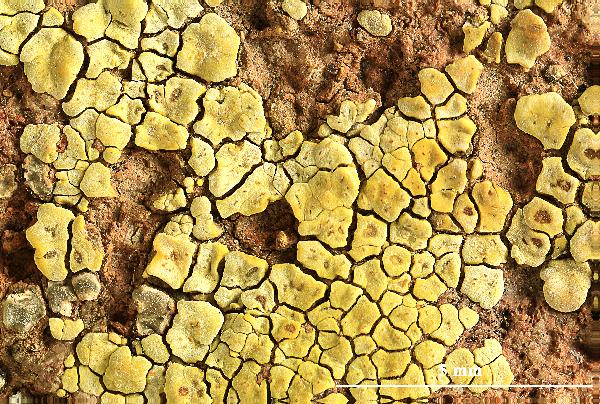
Felix Schumm - CC BY-SA 4.0
[VZ1186], Gallia, Var: Hyéres, Le Fenouillet, 250 m. Ad saxa schistosa
et quartzitica. Leg. Y. Rondon, 29.3.1973. Ex A. VEZDA: LICHENES
SELECTI EXSICCATI NR. 1186.
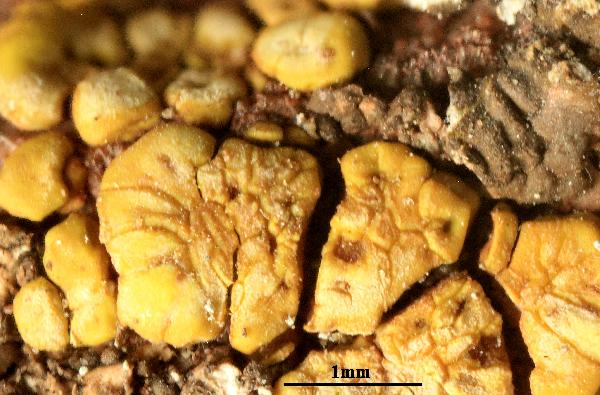
Felix Schumm - CC BY-SA 4.0
[VZ1901], Hispania. Prov. Zaragoza: In faucibus Jalón, 4 km ad
septentriones et occidentem a Calatayud, 400 m. Ad parietes rupium
schistosarum. Leg. J. T. Corbin & A. Vezda, 24.5.1983. Ex A. Vezda:
Lichenes Selecti Exsiccati Nr. 1901.
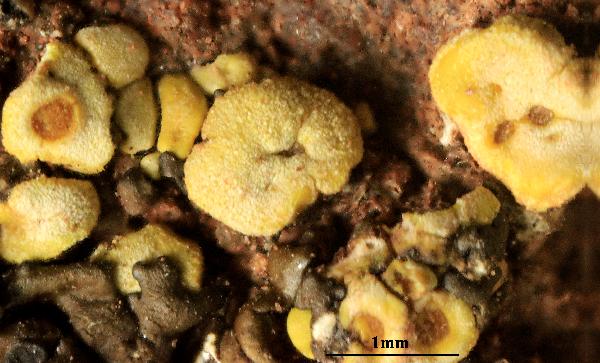
Felix Schumm - CC BY-SA 4.0
[VZ1901], Hispania. Prov. Zaragoza: In faucibus Jalón, 4 km ad
septentriones et occidentem a Calatayud, 400 m. Ad parietes rupium
schistosarum. Leg. J. T. Corbin & A. Vezda, 24.5.1983. Ex A. Vezda:
Lichenes Selecti Exsiccati Nr. 1901.
Growth form: Crustose
Substrata: rocks
Photobiont: green algae other than Trentepohlia
Reproductive strategy: mainly sexual
Subcontinental: restricted to areas with a dry-subcontinental climate (e.g. dry Alpine valleys, parts of Mediterranean Italy)
paras crustose lichens
Commonnes-rarity: (info)
Alpine belt: absent
Subalpine belt: absent
Montane belt: very rare
Dry submediterranean belt: extremely rare
Humid submediterranean belt: very rare
Padanian area: absent
pH of the substrata:
| 1 | 2 | 3 | 4 | 5 |
Solar irradiation:
| 1 | 2 | 3 | 4 | 5 |
Aridity:
| 1 | 2 | 3 | 4 | 5 |
Eutrophication:
| 1 | 2 | 3 | 4 | 5 |
Poleotolerance:
| 0 | 1 | 2 | 3 |
Altitudinal distribution:
| 1 | 2 | 3 | 4 | 5 | 6 |
Rarity
absent
extremely rare
very rare
rare
rather rare
rather common
common
very common
extremely common
Loading data...
Occurrence data
Predictive map
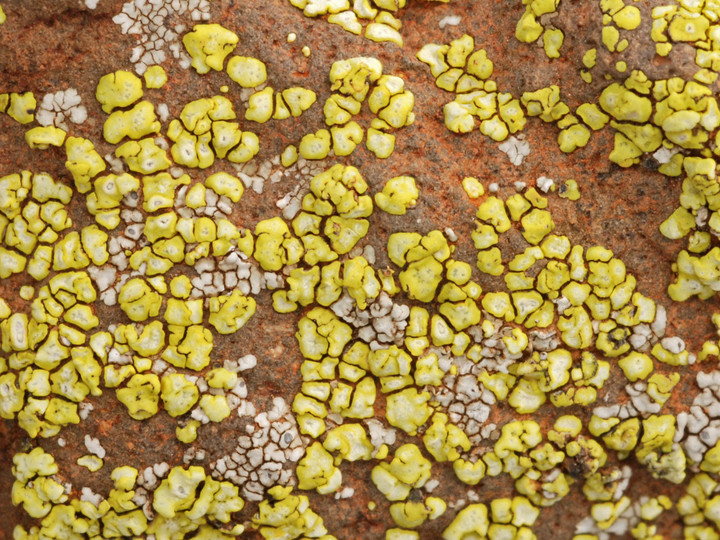
Leif Stridvall - Source: http://www.stridvall.se/la/galleries.php (Courtesy: Anita Stridvall)
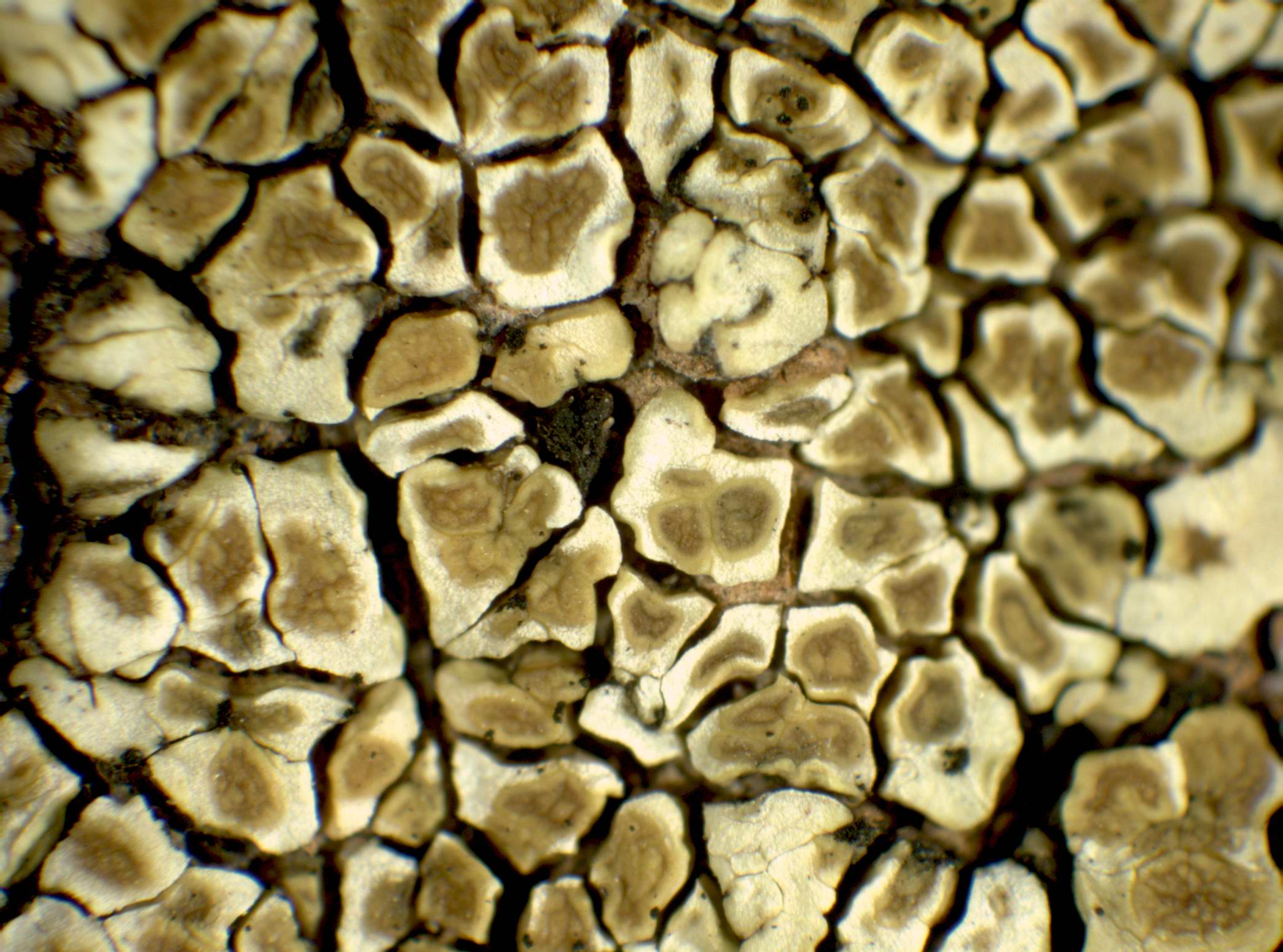
P.L. Nimis; Owner: Department of Life Sciences, University of Trieste
Herbarium: TSB (5177)
2001/12/08

Leif Stridvall - Source: http://www.stridvall.se/lichens/gallery/
Courtesy: Anita Stridvall

Felix Schumm - CC BY-SA 4.0
[VZ1186], Gallia, Var: Hyéres, Le Fenouillet, 250 m. Ad saxa schistosa et quartzitica. Leg. Y. Rondon, 29.3.1973. Ex A. VEZDA: LICHENES SELECTI EXSICCATI NR. 1186.

Felix Schumm - CC BY-SA 4.0
[VZ1186], Gallia, Var: Hyéres, Le Fenouillet, 250 m. Ad saxa schistosa et quartzitica. Leg. Y. Rondon, 29.3.1973. Ex A. VEZDA: LICHENES SELECTI EXSICCATI NR. 1186.

Felix Schumm - CC BY-SA 4.0
[VZ1901], Hispania. Prov. Zaragoza: In faucibus Jalón, 4 km ad septentriones et occidentem a Calatayud, 400 m. Ad parietes rupium schistosarum. Leg. J. T. Corbin & A. Vezda, 24.5.1983. Ex A. Vezda: Lichenes Selecti Exsiccati Nr. 1901.