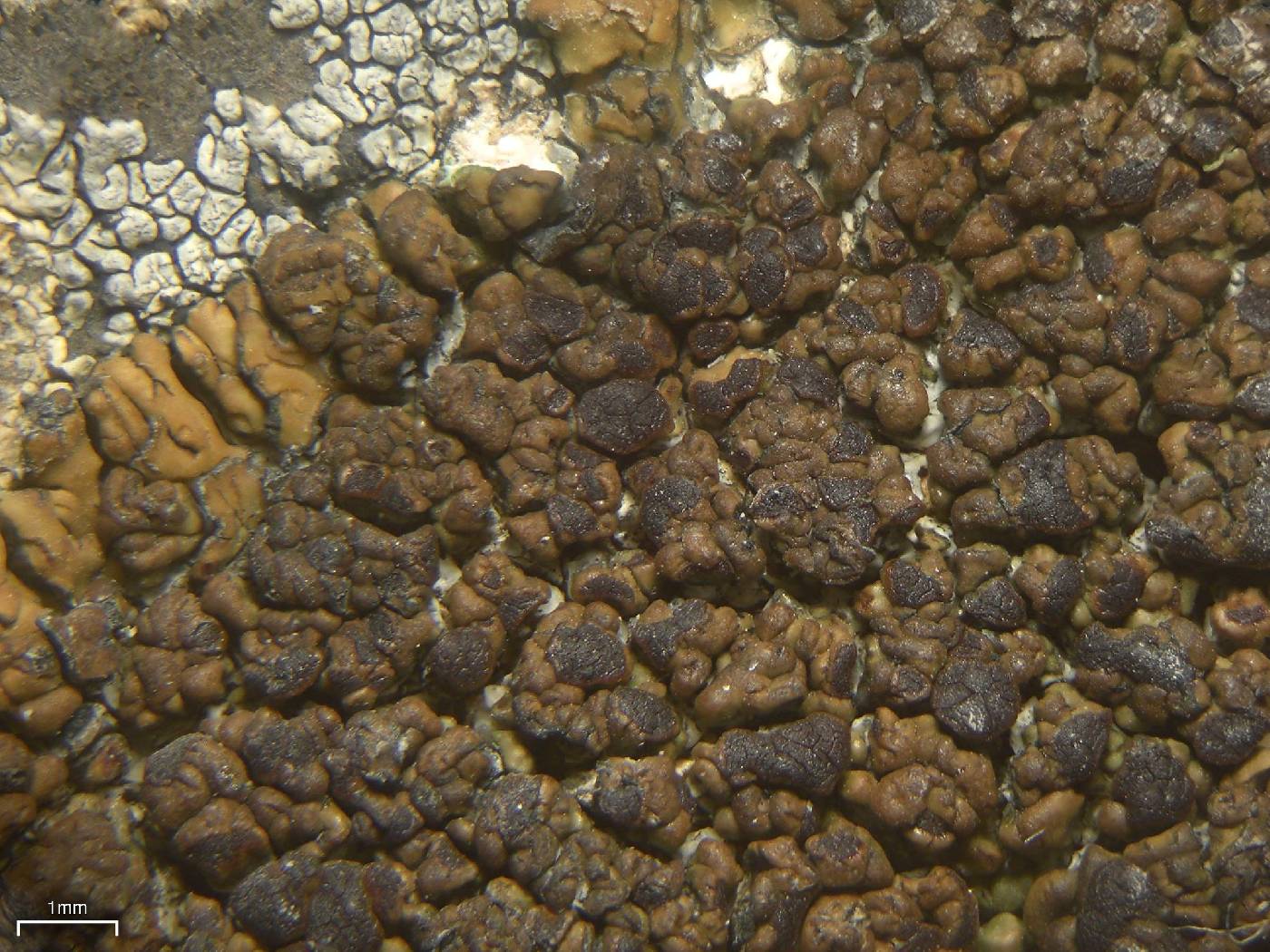
Protoparmelia cupreobadia (Nyl.) Poelt
in Poelt & Leuckert, Nova Hedwigia, 52: 52, 1991. Basionym: Lecanora cupreobadia Nyl. - Bot. Not.: 165, 1853.
Synonyms: Lecanora badia var. cupreobadia (Nyl.) Boistel
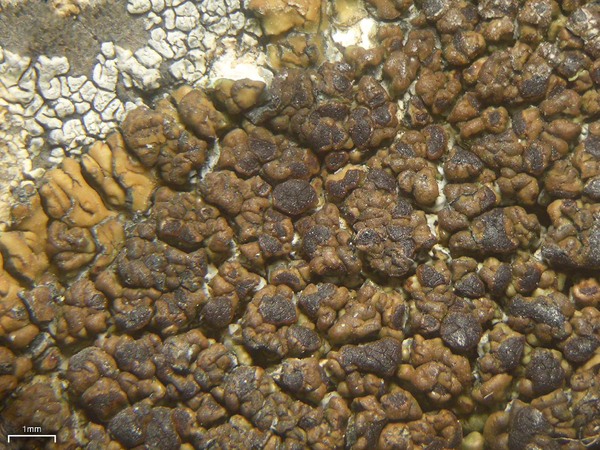
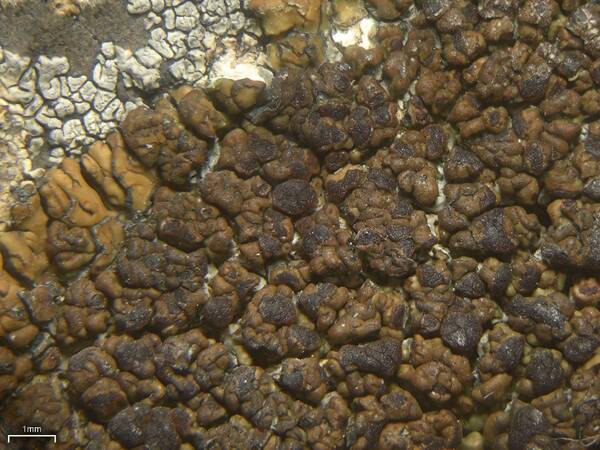
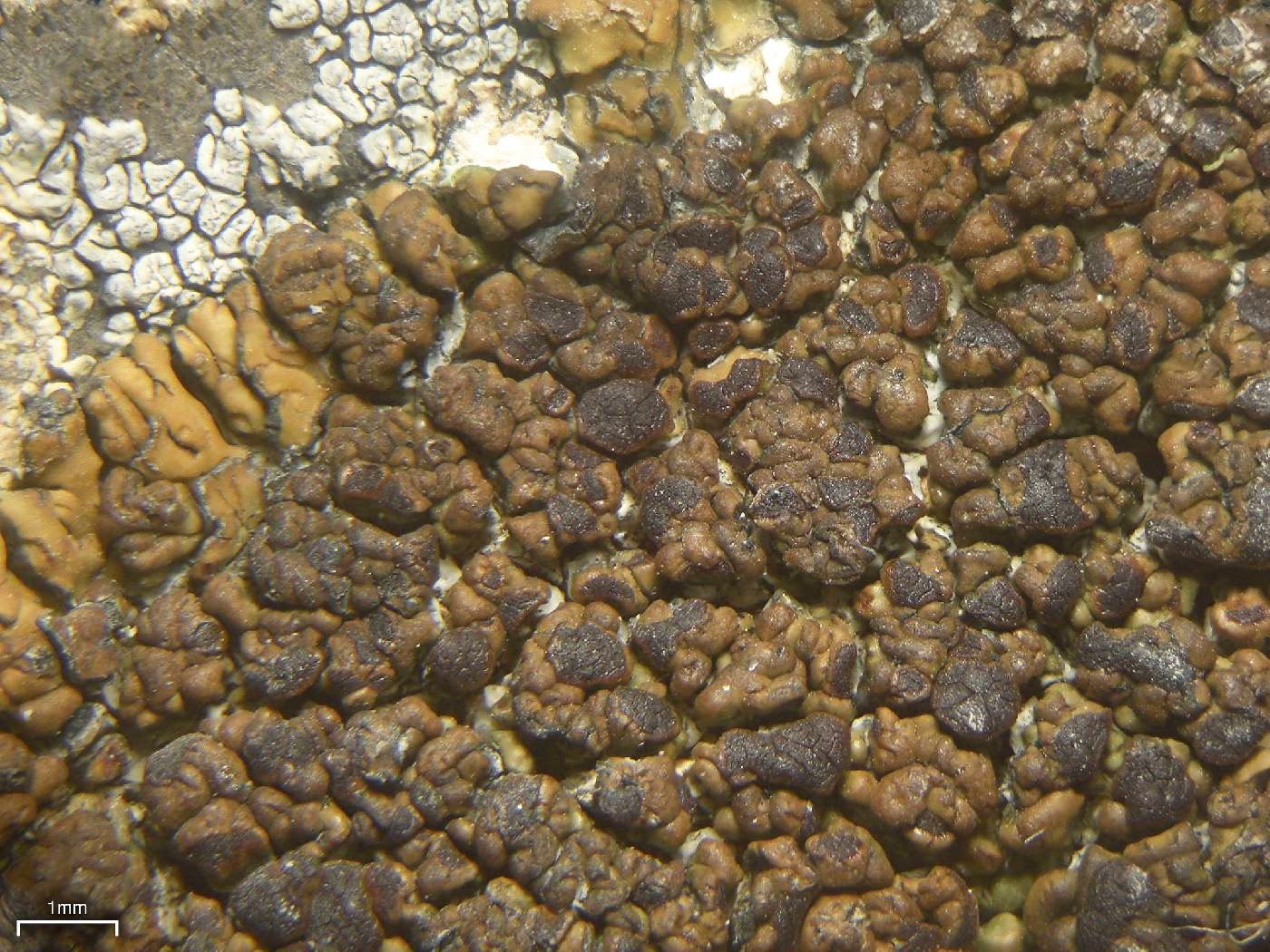
Description: Thallus crustose, episubstratic, rimose-areolate to areolate-subsquamulose, copper-brown to dark brown, forming 3-5(-10) cm wide patches, starting the development on the thalli of yellow Rhizocarpon-species, often delimited by a black prothallus, the areoles more or less round to irregularly polygonal, mostly flat, 0.5-1 mm wide, the peripheral ones elongate and slightly radiating, developing on a black hypothallus whose hyphae have thick, dark blue walls. Cortex 10-50 µm thick, with a very thick epinecral layer; medulla white, I-. Apothecia lecanorine, round to angular, broadly sessile, 0.5-1.5(-3) mm across, with a brown to brown-black, flat to convex disc and a smooth, sometimes finally excluded thalline margin. Thalline exciple corticate; proper exciple c. 150 µm thick laterally, not forming a cupula below the hypothecium; epithecium pale brown, c. 15 µm high; hymenium colourless, 40-50(-75) µm high; paraphyses branched, 2-3 µm thick at mid-level, the apical cells to 5 µm wide; hypothecium colourless. Asci 8-spored, clavate, approaching the Lecanora-type, with a well-developed amyloid tholus and a distinct, non-amyloid axial mass. Ascospores 1-celled, hyaline, ellipsoid to narrowly ellipsoid with rounded ends, (8-)10-17 x 5-7 µm. Pycnidia rare, immersed, dark around the ostiole. Conidia filiform, curved, 20-30(-35) x c. 1 µm. Photobiont chlorococcoid. Spot tests: K+ yellow turning red (needle-like crystals), C-, KC-, P+ orange. Chemistry: cortex with norstictic acid, medulla with additional rangiformic acid.
Growth form: Crustose
Substrata: rocks
Photobiont: green algae other than Trentepohlia
Reproductive strategy: mainly sexual
paras yellow Rhizocarpon spp.
Commonnes-rarity: (info)
Alpine belt: rare
Subalpine belt: very rare
Montane belt: absent
Dry submediterranean belt: absent
Humid submediterranean belt: absent
Padanian area: absent
pH of the substrata:
1 2 3 4 5

Solar irradiation:
1 2 3 4 5
Aridity:
1 2 3 4 5
Eutrophication:
1 2 3 4 5
Poleotolerance:
0 1 2 3
Altitudinal distribution:
1 2 3 4 5 6
Rarity
absent
extremely rare
very rare
rare
rather rare
rather common
common
very common
extremely common
Loading data...
Occurrence data
Predictive map
Jason Hollinger - Public Domain - Source: https://lichenportal.org/cnalh/collections/individual/index.php?occid=3754260
Jason Hollinger - Public Domain - Source: https://lichenportal.org/cnalh/collections/individual/index.php?occid=3754260
Growth form: Crustose
Substrata: rocks
Photobiont: green algae other than Trentepohlia
Reproductive strategy: mainly sexual
paras yellow Rhizocarpon spp.
Commonnes-rarity: (info)
Alpine belt: rare
Subalpine belt: very rare
Montane belt: absent
Dry submediterranean belt: absent
Humid submediterranean belt: absent
Padanian area: absent
pH of the substrata:
| 1 | 2 | 3 | 4 | 5 |
Solar irradiation:
| 1 | 2 | 3 | 4 | 5 |
Aridity:
| 1 | 2 | 3 | 4 | 5 |
Eutrophication:
| 1 | 2 | 3 | 4 | 5 |
Poleotolerance:
| 0 | 1 | 2 | 3 |
Altitudinal distribution:
| 1 | 2 | 3 | 4 | 5 | 6 |
Rarity
absent
extremely rare
very rare
rare
rather rare
rather common
common
very common
extremely common
Loading data...
Occurrence data
Predictive map
Jason Hollinger - Public Domain - Source: https://lichenportal.org/cnalh/collections/individual/index.php?occid=3754260