Protothelenella corrosa (Körb.) H. Mayrhofer & Poelt
Herzogia, 7: 42, 1985. Basionym: Limboria corrosa Körb. - Syst. Lich. Germ.: 376, 1855.
Synonyms: Acrorixis corrosa (Körb.) Trevis.; Microglaena corrosa (Körb.) Arnold; Microglaena gibbosula (Nyl.) Blomb. & Forssell; Microglaena nericiensis Hellb.; Polyblastia arenaria (Hampe) Jatta; Thelenella corrosa (Körb.) Vain.
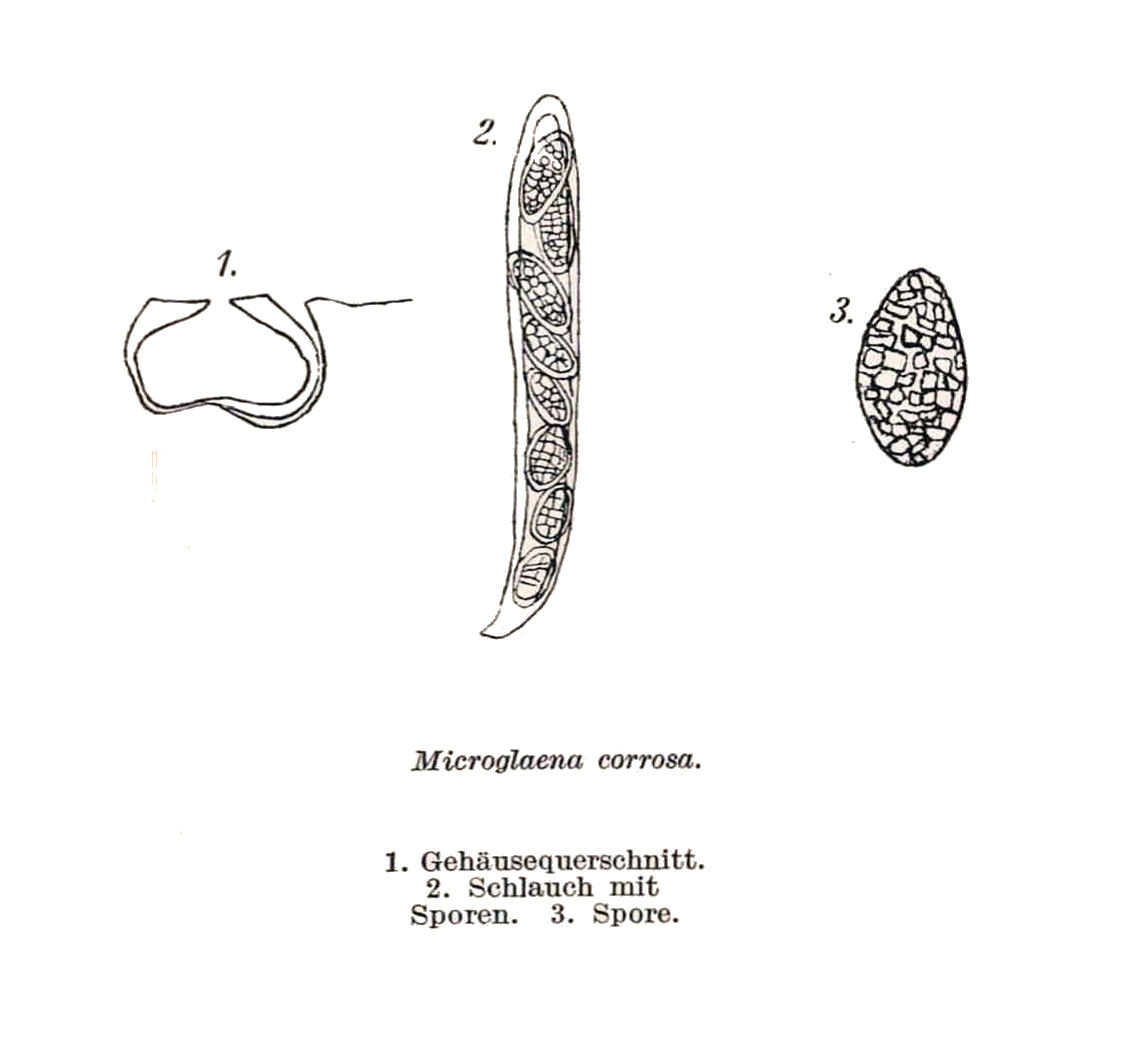
Description: Thallus crustose, smooth to granular-uneven, warted, or forming a cracked crust, often consisting of dispersed areoles surrounding the perithecia, whitish, dirty yellowish or brownish white, bright green when wet, sometimes poorly evident. Perithecia 0.2-0.5 mm across, scattered, partly immersed, forming low to prominent, black projections, the apex often with a small central depression. Exciple dull greenish brown to dark brown in upper part, colourless to very pale brown towards the base, of strongly anastomosing, up to 1 μm wide, conglutinate hyphae with narrow lumina; paraphysoids thread-like, c. 1 μm thick, persistent, strongly branched and anastomosing; periphysoids absent; hymenial gel I+ reddish or I+ blue at low concentrations, K/I+ blue. Asci 8-spored, cylindrical, short-stalked, thick-walled (2-3 μm), fissitunicate, the outer gelatinous wall layer I+ blue, with a very faintly I+ blue apical plug. Ascospores muriform, hyaline, broadly ellipsoid to ovoid, (16-)18-32 x (8-)10-15(-18) μm, the outer wall distinctly thicker than the septa. Photobiont chlorococcoid (Elliptochloris), the algal cells surrounded by a gelatinous sheath. Spot tests: thallus K-, C- or C+ red, KC- or KC+ red, P-. Chemistry: an unidentified C+ red pigment in thallus.
Growth form: Crustose
Substrata: rocks
Photobiont: green algae other than Trentepohlia
Reproductive strategy: mainly sexual
Most common in areas with a humid-warm climate (e.g. most of Tyrrenian Italy)
Commonnes-rarity: (info)
Alpine belt: very rare
Subalpine belt: rare
Montane belt: very rare
Dry submediterranean belt: absent
Humid submediterranean belt: absent
Padanian area: absent
pH of the substrata:
1 2 3 4 5

Solar irradiation:
1 2 3 4 5
Aridity:
1 2 3 4 5
Eutrophication:
1 2 3 4 5
Poleotolerance:
0 1 2 3
Altitudinal distribution:
1 2 3 4 5 6
Rarity
absent
extremely rare
very rare
rare
rather rare
rather common
common
very common
extremely common
Loading data...
Occurrence data
Predictive map
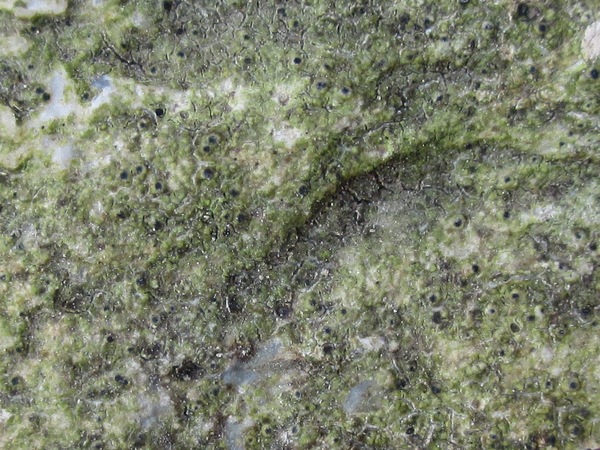
Troy McMullin CC BY-SA 3.0 – Source: https://lichenportal.org/cnalh/taxa/index.php?taxon=52356&clid=1231
Canada, Quebec, Gaspè Peninsula
TSB 32749
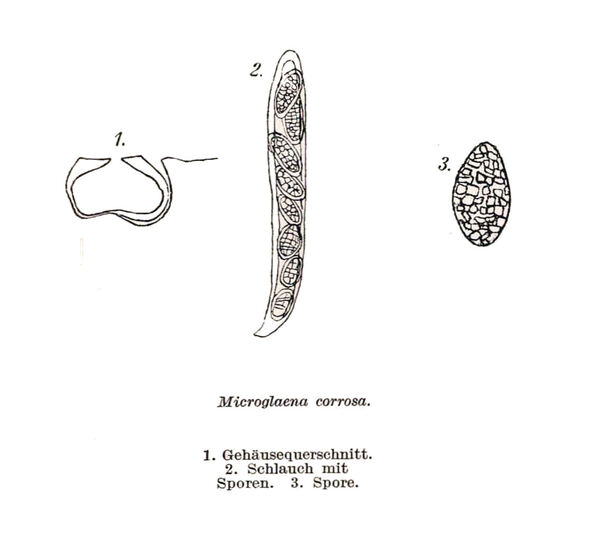
Zschacke, H. (1934) Epigloeaceae, Verrucariaceae und Dermatocarpaceae. In: Dr. L. Rabenhorst‘s Kryptogamen-Flora, Band 9, Abt. 1, Teil 1. Akademische Verlagsgesellschaft, Leipzig, 695 pp. - Public Domain
Growth form: Crustose
Substrata: rocks
Photobiont: green algae other than Trentepohlia
Reproductive strategy: mainly sexual
Most common in areas with a humid-warm climate (e.g. most of Tyrrenian Italy)
Commonnes-rarity: (info)
Alpine belt: very rare
Subalpine belt: rare
Montane belt: very rare
Dry submediterranean belt: absent
Humid submediterranean belt: absent
Padanian area: absent
pH of the substrata:
| 1 | 2 | 3 | 4 | 5 |
Solar irradiation:
| 1 | 2 | 3 | 4 | 5 |
Aridity:
| 1 | 2 | 3 | 4 | 5 |
Eutrophication:
| 1 | 2 | 3 | 4 | 5 |
Poleotolerance:
| 0 | 1 | 2 | 3 |
Altitudinal distribution:
| 1 | 2 | 3 | 4 | 5 | 6 |
Rarity
absent
extremely rare
very rare
rare
rather rare
rather common
common
very common
extremely common
Loading data...
Occurrence data
Predictive map
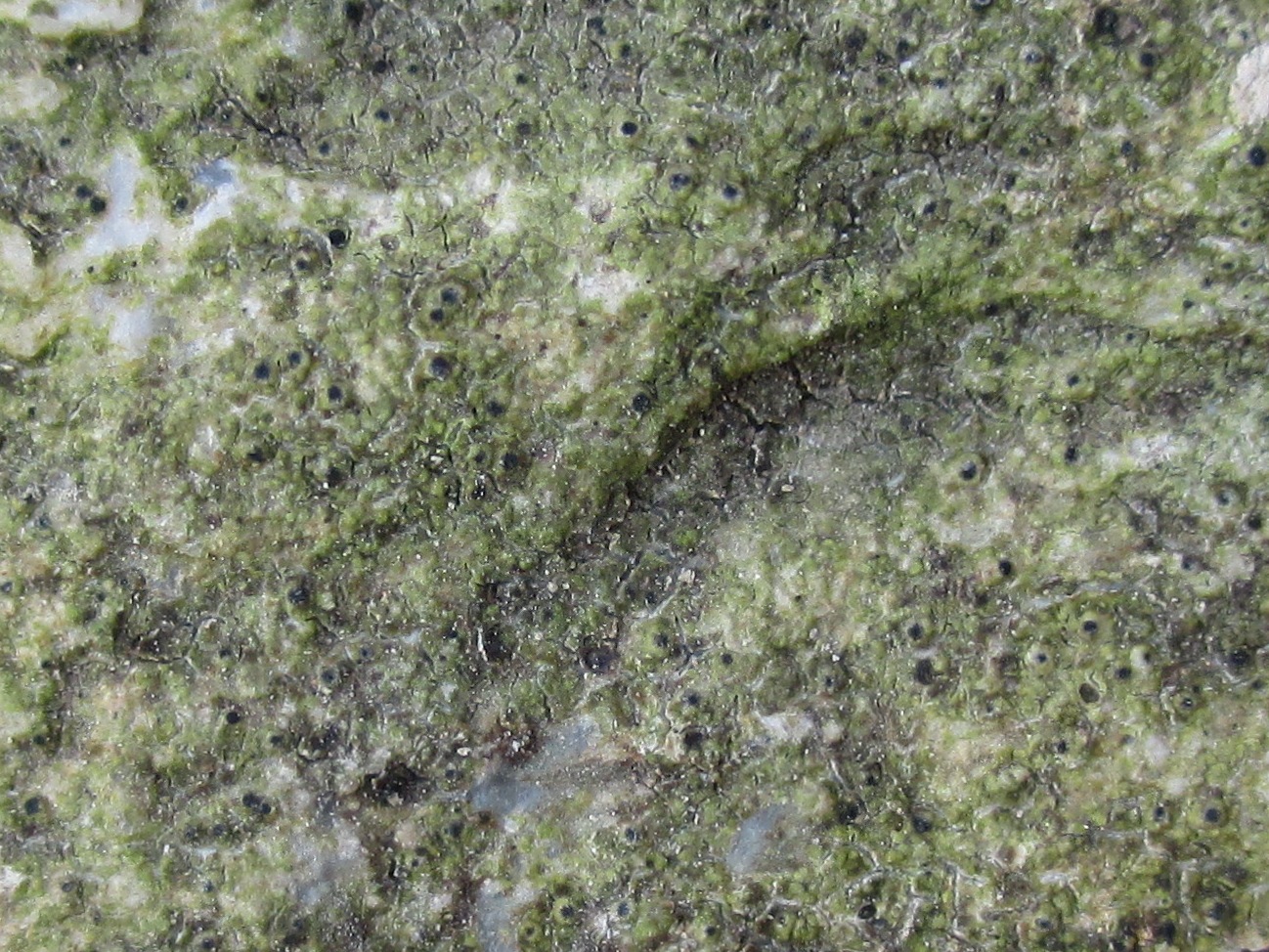
Troy McMullin CC BY-SA 3.0 – Source: https://lichenportal.org/cnalh/taxa/index.php?taxon=52356&clid=1231
Canada, Quebec, Gaspè Peninsula
TSB 32749