Puttea caesia (Fr.) M. Svenss. & T. Sprib.
in Dillman & al., Herzogia, 25: 182, 2012. Basionym: Agyrium caesium Fr. - Syst. Mycol. (Lundae) 2, 1: 231, 1822.
Synonyms: Biatora symmictella (Nyl.) Arnold; Lecidea symmictella Nyl.
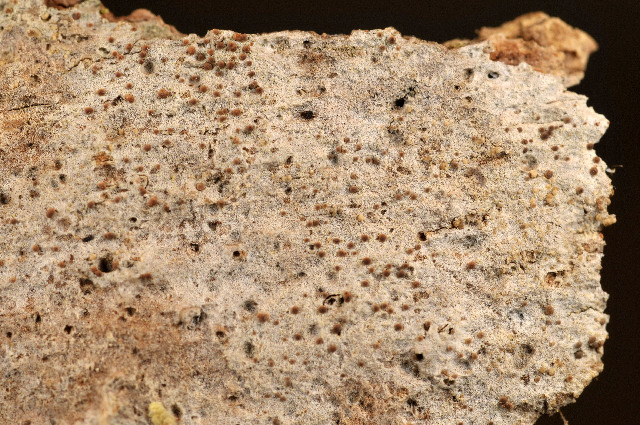
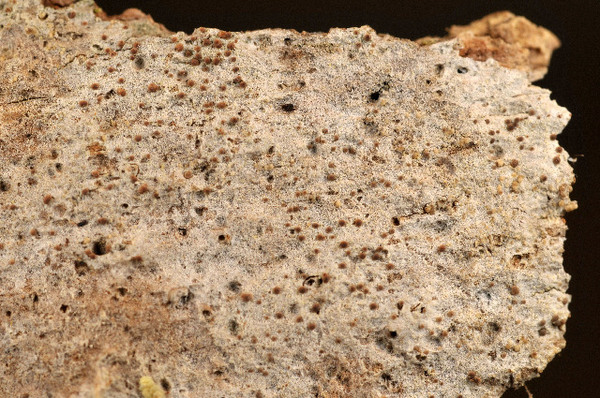
Description: Thallus crustose, mostly endosubstratic and poorly evident, consisting of a thin layer of delicate hyphae and small algal cells. Apothecia lecideine to biatorine, 0.1-0.2(-0.3) mm across, whitish, pale yellow or pale brown-pink, often mottled when old, more or less round, with a convex disc and a thin, dark, finally sometimes excluded proper margin. Proper exciple with an outer wall of perpendicularly arranged, parallel, gelatinized hyphae with narrow lumina, the apical cells thickened (to c. 4 µm) and often brown-capped, the inner part of gelatinized, interwoven hyphae; epithecium scarcely differentiated from the hymenium, covered with a narrow gelatinous layer overlain by yellowish crystals dissolving in K and in N; hymenium colourless, 30-40 μm high; paraphyses branched and anastomosing, as long as the asci, the apical cells hardly swollen; hypothecium colourless. Asci 8-spored, clavate, with a K/I+ blue tholus including a thin, darker K/I+ blue tubular ring-structure. Ascospores 1-celled, hyaline, ellipsoid to subfusiform, (3-)4-7(-10) x 1-2(-2.5) μm, thin-walled. Photobiont chlorococcoid. Spot tests: thallus K-, C-, KC-, P-, UV-. Chemistry: without lichen substances.
Growth form: Crustose
Substrata: lignum
Photobiont: green algae other than Trentepohlia
Reproductive strategy: mainly sexual
Poorly known taxon in need of further study
Commonnes-rarity: (info)
Alpine belt: absent
Subalpine belt: very rare
Montane belt: very rare
Dry submediterranean belt: absent
Humid submediterranean belt: absent
Padanian area: absent
pH of the substrata:
1 2 3 4 5

Solar irradiation:
1 2 3 4 5
Aridity:
1 2 3 4 5
Eutrophication:
1 2 3 4 5
Poleotolerance:
0 1 2 3
Altitudinal distribution:
1 2 3 4 5 6
Rarity
absent
extremely rare
very rare
rare
rather rare
rather common
common
very common
extremely common
Loading data...
Occurrence data
Predictive map
Einar Timdal, Natural History Museum, University of Oslo, Norway
Growth form: Crustose
Substrata: lignum
Photobiont: green algae other than Trentepohlia
Reproductive strategy: mainly sexual
Poorly known taxon in need of further study
Commonnes-rarity: (info)
Alpine belt: absent
Subalpine belt: very rare
Montane belt: very rare
Dry submediterranean belt: absent
Humid submediterranean belt: absent
Padanian area: absent
pH of the substrata:
| 1 | 2 | 3 | 4 | 5 |
Solar irradiation:
| 1 | 2 | 3 | 4 | 5 |
Aridity:
| 1 | 2 | 3 | 4 | 5 |
Eutrophication:
| 1 | 2 | 3 | 4 | 5 |
Poleotolerance:
| 0 | 1 | 2 | 3 |
Altitudinal distribution:
| 1 | 2 | 3 | 4 | 5 | 6 |
Rarity
absent
extremely rare
very rare
rare
rather rare
rather common
common
very common
extremely common
Loading data...
Occurrence data
Predictive map