Aspicilia inornata Arnold
Verh. zool.-bot. Ges. Wien, 27: 550, 1877.
Synonyms:
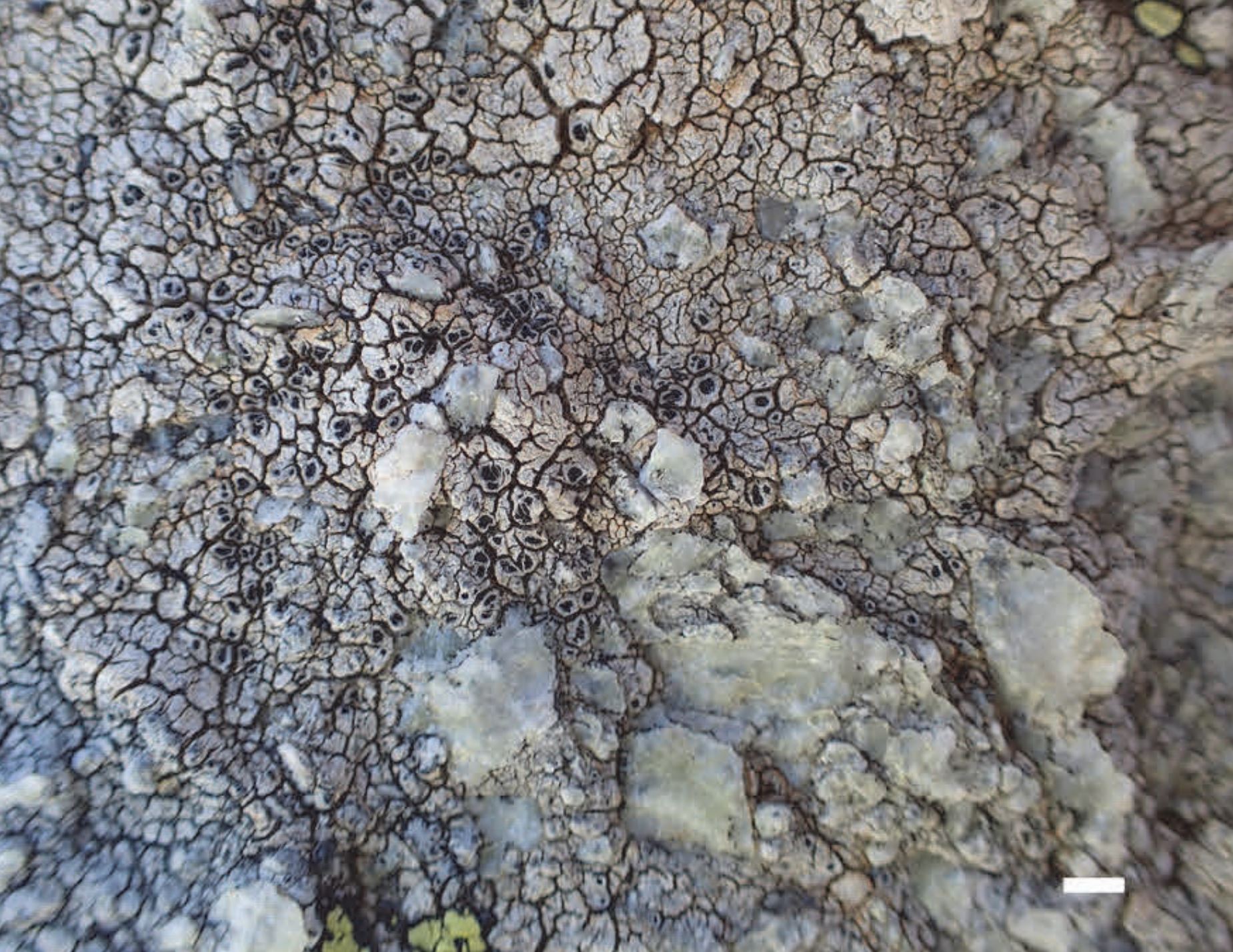
Description: Thallus crustose, episubstratic, rimose-areolate, <0.5 mm thick, the areoles smooth, flat to slightly convex, 0.5-0.7 mm wide, ochraceous white, whitish grey or pale lead-grey, forming large patches, with or (usually) without a dark prothallus. Cortex paraplectenchymatous, indistinctly delimited, (20-)30-40(-50) µm thick formed by 3-5 µm wide polygonal cells, rich in large crystals insoluble in N and small crystals soluble in N; medulla white, filled by crystals resembling those of the cortex, I-; algal layer not extending below the hypothecium. Apothecia aspicilioid, immersed in the areoles, 1-3 per areole, (0.2-)0.3-0.6(-0.7) mm across, usually irregular in outline, with a concave to flat, black, epruinose disc, a thin, black proper margin and a thick but not prominent, dark thalline margin. Proper exciple wider and paraplectenchymatous in upper part, the outer terminal cells capitate and dark-capped; epithecium greenish to olive-brown, 10-20 µm high, N+ emerald green; hymenium colourless, (100-)120-140(-150) µm high, I- or I+ yellowish brown; paraphyses coherent, submoniliform in upper part, the apical cells 3-4.5 µm wide; hypothecium colourless, 40-50 µm high, I+ blue. Asci (6-)8-spored, clavate, the thin outer coat K/I+ blue, the wall and apical dome K/I-. Ascospores 1-celled, hyaline, ellipsoid to broadly ellipsoid, 17-24(-27) x (8-)10-12(-15) µm. Pycnidia immersed, with a black to brown, punctiform ostiole and a pale wall. Conidia bacilliform, straight, 6-7 x 0.8-1 µm. Photobiont chlorococcoid. Spot tests: cortex and medulla K-, C-, KC-, P-. Chemistry: without lichen substances.
Growth form: Crustose
Substrata: rocks
Photobiont: green algae other than Trentepohlia
Reproductive strategy: mainly sexual
Periodically submerged (e.g. in creeks)
Commonnes-rarity: (info)
Alpine belt: very rare
Subalpine belt: very rare
Montane belt: very rare
Dry submediterranean belt: absent
Humid submediterranean belt: absent
Padanian area: absent
pH of the substrata:
1 2 3 4 5

Solar irradiation:
1 2 3 4 5
Aridity:
1 2 3 4 5
Eutrophication:
1 2 3 4 5
Poleotolerance:
0 1 2 3
Altitudinal distribution:
1 2 3 4 5 6
Rarity
absent
extremely rare
very rare
rare
rather rare
rather common
common
very common
extremely common
Loading data...
Occurrence data
Predictive map
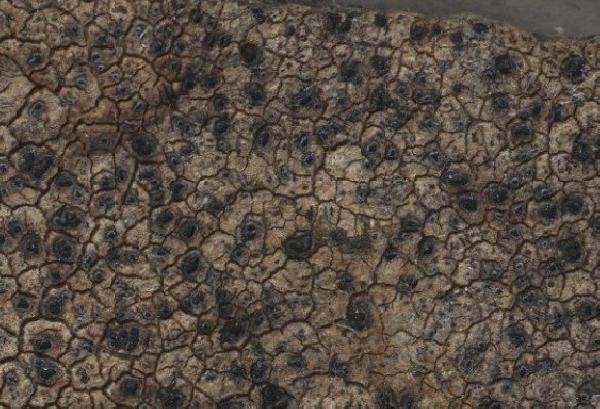
Source: https://www.europeana.eu/it/item/870/NHMUKXBOTXBM001107796
Aspicilia inornata Arnold - 1877 - The Trustees of the Natural History Museum, London, United Kingdom - CC BY.
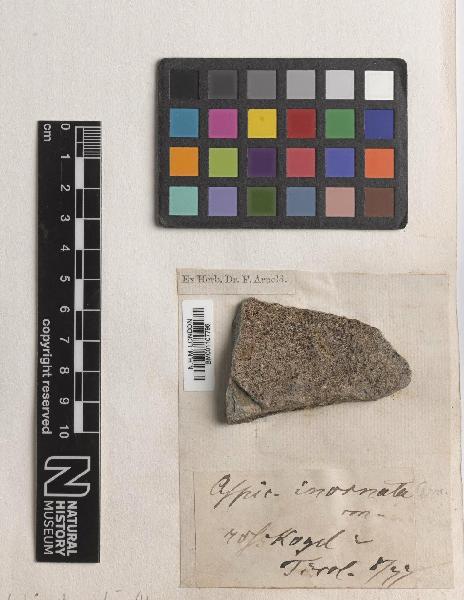
Source: https://www.europeana.eu/it/item/870/NHMUKXBOTXBM001107796
Aspicilia inornata Arnold - 1877 - The Trustees of the Natural History Museum, London, United Kingdom - CC BY.
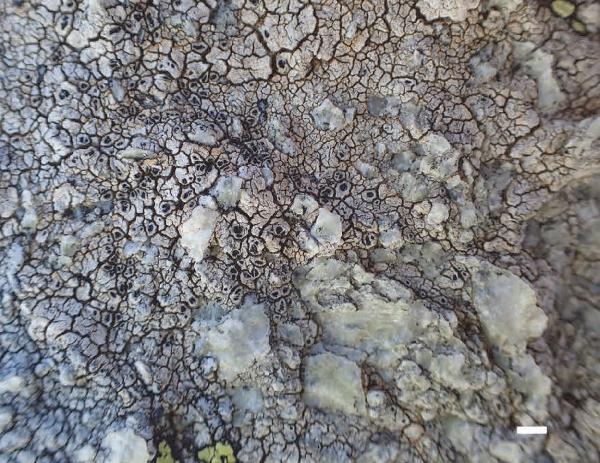
Michel Bertrand - Source: M. Bertrand & al. (2023). Lichens nouveaux ou intéressants pour la flore française. Bull. Assoc. Fr. Lichénologie, 2023, 48(1)
Massif de la Vanoise, étage subalpin.
Barre d’échelle : 10 mm.
Growth form: Crustose
Substrata: rocks
Photobiont: green algae other than Trentepohlia
Reproductive strategy: mainly sexual
Periodically submerged (e.g. in creeks)
Commonnes-rarity: (info)
Alpine belt: very rare
Subalpine belt: very rare
Montane belt: very rare
Dry submediterranean belt: absent
Humid submediterranean belt: absent
Padanian area: absent
pH of the substrata:
| 1 | 2 | 3 | 4 | 5 |
Solar irradiation:
| 1 | 2 | 3 | 4 | 5 |
Aridity:
| 1 | 2 | 3 | 4 | 5 |
Eutrophication:
| 1 | 2 | 3 | 4 | 5 |
Poleotolerance:
| 0 | 1 | 2 | 3 |
Altitudinal distribution:
| 1 | 2 | 3 | 4 | 5 | 6 |
Rarity
absent
extremely rare
very rare
rare
rather rare
rather common
common
very common
extremely common
Loading data...
Occurrence data
Predictive map

Source: https://www.europeana.eu/it/item/870/NHMUKXBOTXBM001107796
Aspicilia inornata Arnold - 1877 - The Trustees of the Natural History Museum, London, United Kingdom - CC BY.

Source: https://www.europeana.eu/it/item/870/NHMUKXBOTXBM001107796
Aspicilia inornata Arnold - 1877 - The Trustees of the Natural History Museum, London, United Kingdom - CC BY.