Karstenia chrysophaea (Pers.) Coppins, Aptroot & P.F. Cannon
in Cannon & al., Revisions of British and Irish Lichens, 38: 51, 2024. Basionym: Peziza chrysophaea Pers. - Icon. Descr. Fung. 2: 17, tab. 8, fig. 1-2, 1798.
Synonyms: Lecidea chrysophaea (Pers.) Nyl.; Ramonia chrysophaea (Pers.) Vězda; Stictis chrysophaea (Pers.) Pers.
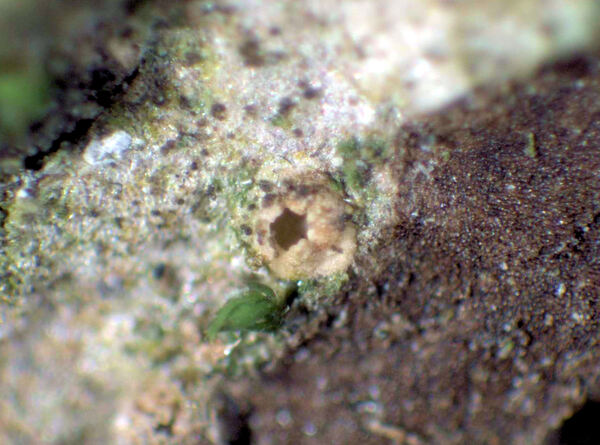
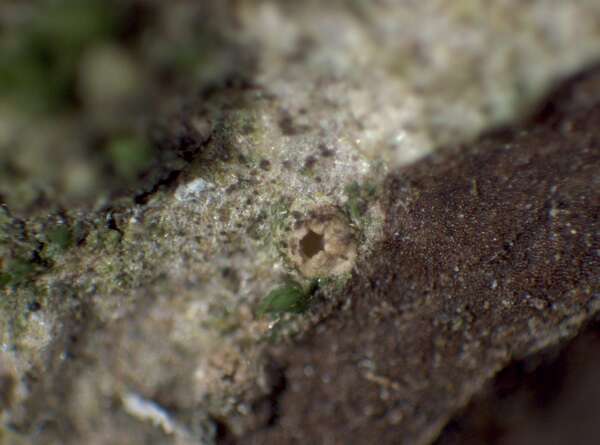
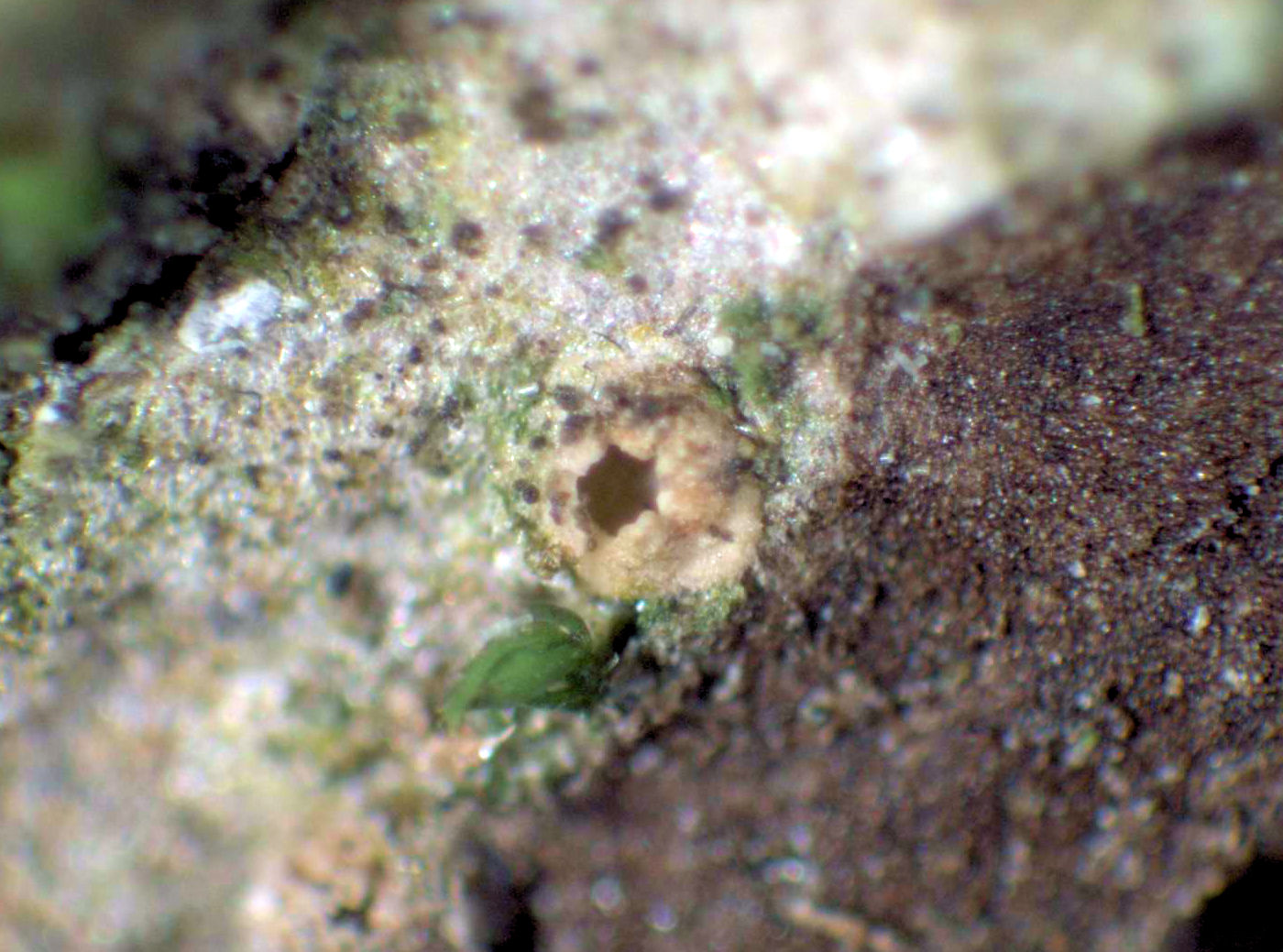
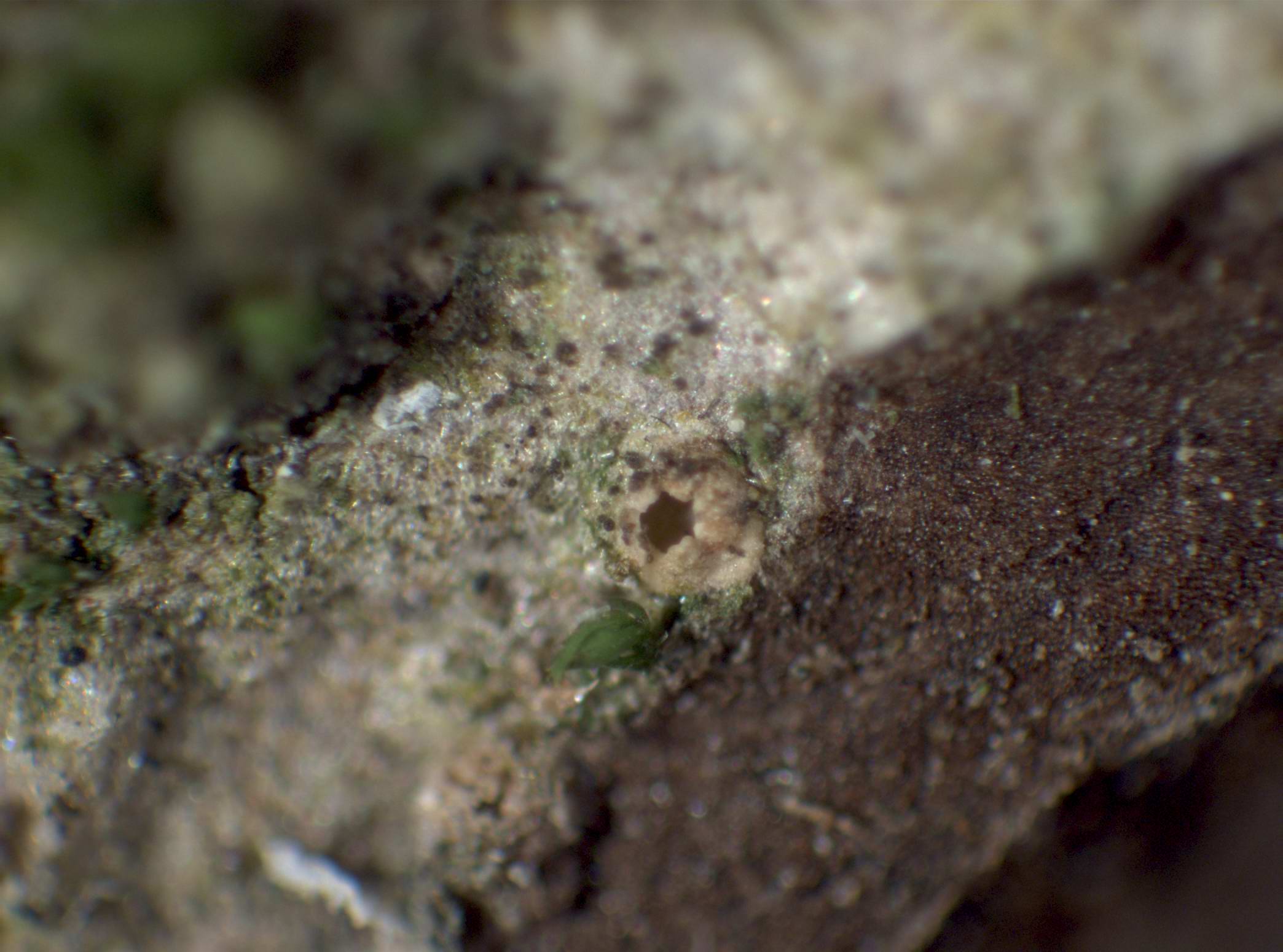
Description: Thallus crustose, very thin, continuous, poorly evident, finally often disappearing. Apothecia 0.4-0.7 mm across, 0.15-0.25 mm high, urceolate, at first immersed and perithecioid, with the exciple hiding the disc except for a minute, to 0.5 mm wide pore, later erumpent and with an exposed, pinkish to pale grey-brown disc surrounded by a thick, inrolled proper margin. Proper exciple well developed laterally, the outer part of small, thin-walled, angular cells, the inner part with rectangular cells ending in periphysoids; hymenium colourless, 90-120 µm high, I+ blue at least in upper part; paraphyses slender, simple, slightly swollen at apex; hypothecium colourless. Asci 8-spored, cylindrical-clavate, with a single, thin, K/I- wall layer, and an amyloid exoascus with a ring structure. Ascospores 8-14-septate, hyaline, needle-like to cylindrical, 45-75 x 3-4(-5) µm. Photobiont trentepohlioid. Spot tests: thallus K-, C-, KC-, P-, UV-. Chemistry: without lichen substances.
Growth form: Crustose
Substrata: bark
Photobiont: Trentepohlia
Reproductive strategy: mainly sexual
Most common in areas with a humid-warm climate (e.g. most of Tyrrenian Italy)
Commonnes-rarity: (info)
Alpine belt: absent
Subalpine belt: absent
Montane belt: absent
Dry submediterranean belt: extremely rare
Humid submediterranean belt: extremely rare
Padanian area: absent
pH of the substrata:
1 2 3 4 5

Solar irradiation:
1 2 3 4 5
Aridity:
1 2 3 4 5
Eutrophication:
1 2 3 4 5
Poleotolerance:
0 1 2 3
Altitudinal distribution:
1 2 3 4 5 6
Rarity
absent
extremely rare
very rare
rare
rather rare
rather common
common
very common
extremely common
Loading data...
Occurrence data
Predictive map
P.L. Nimis CC BY-SA 4.0
(Sine numero)
P.L. Nimis; Owner: Department of Life Sciences, University of Trieste
Herbarium: TSB (sine numero)
2002/03/27

Source: Vězda A. (1966) Folia Geobot. Phytotax. 1: 154-175 Flechtensystematische Studien III. Die Gattung Ramonia Stiz. und Gloeolecta. Lett.
as Ramonia c.
Growth form: Crustose
Substrata: bark
Photobiont: Trentepohlia
Reproductive strategy: mainly sexual
Most common in areas with a humid-warm climate (e.g. most of Tyrrenian Italy)
Commonnes-rarity: (info)
Alpine belt: absent
Subalpine belt: absent
Montane belt: absent
Dry submediterranean belt: extremely rare
Humid submediterranean belt: extremely rare
Padanian area: absent
pH of the substrata:
| 1 | 2 | 3 | 4 | 5 |
Solar irradiation:
| 1 | 2 | 3 | 4 | 5 |
Aridity:
| 1 | 2 | 3 | 4 | 5 |
Eutrophication:
| 1 | 2 | 3 | 4 | 5 |
Poleotolerance:
| 0 | 1 | 2 | 3 |
Altitudinal distribution:
| 1 | 2 | 3 | 4 | 5 | 6 |
Rarity
absent
extremely rare
very rare
rare
rather rare
rather common
common
very common
extremely common
Loading data...
Occurrence data
Predictive map
P.L. Nimis CC BY-SA 4.0
(Sine numero)
P.L. Nimis; Owner: Department of Life Sciences, University of Trieste
Herbarium: TSB (sine numero)
2002/03/27