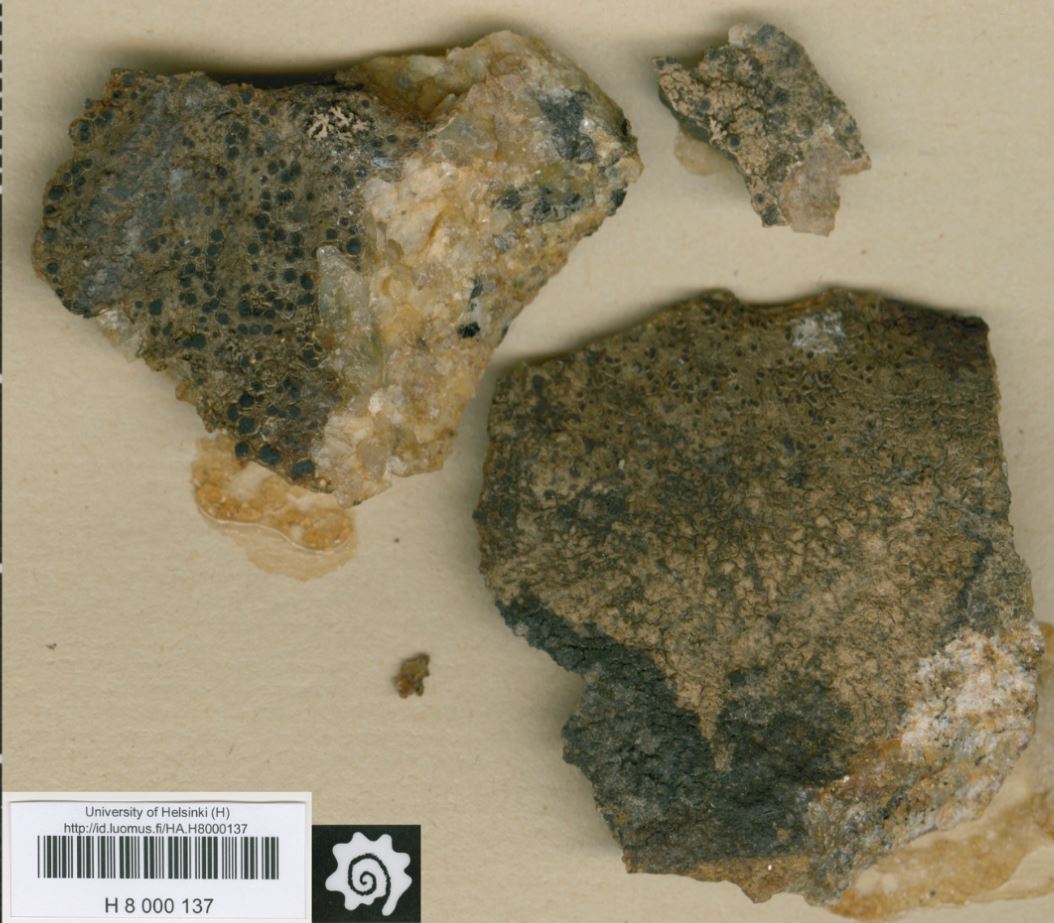
Aspicilia laevatoides (H. Magn.) Oxner
in Kopaczevskaja & al., Handbook Lich. U.S.S.R., 1: 159, 1971 comb. inval.. Basionym: Lecanora laevatoides H. Magn. - K. Svenska Vetensk.-Akad. Handl., ser. 3, 17, 5: 34, 1939.
Synonyms:
Description: Thallus crustose, episubstratic, continuous to faintly rimose, 0.1-0.2 mm thick, pale yellow-grey to ash-grey. Cortex (20-)30-35 µm thick, the upper part brownish-yellow or almost colourless: medulla white, poorly developed, I-. Apothecia aspicilioid, 0.2-0.5 mm across, with a concave to flat, black, epruinose disc and a slightly prominent, dark thalline margin. Exciple 40-50(-100) µm wide, dark greenish-brown, gradually narrowing downwards, I-; epithecium brownish yellow; hymenium 90-100 µm high, I+ blue, then brownish red: paraphyses sparingly branched, submoniliform, c. 1 µm thick at base, the uppermost cells to 3 µm wide; hypothecium c. 35 µm high, opaque. Asci 8-spored, clavate, the thin outer coat K/I+ blue, the wall and apical dome K/I-. Ascospores 1-celled, hyaline, ellipsoid, 16-18 x 9-10(-12) µm. Pycnidia immersed, with a black to brown, punctiform ostiole and a colourless wall. Conidia bacilliform, straight, 8-10 x c. 0.8 µm. Photobiont chlorococcoid. Spot tests: cortex and medulla K-, C-, KC-, P-. Chemistry: without lichen substances.
Growth form: Crustose
Substrata: rocks
Photobiont: green algae other than Trentepohlia
Reproductive strategy: mainly sexual
Periodically submerged (e.g. in creeks)
Poorly known taxon in need of further study
Commonnes-rarity: (info)
Alpine belt: absent
Subalpine belt: very rare
Montane belt: very rare
Dry submediterranean belt: absent
Humid submediterranean belt: absent
Padanian area: absent
pH of the substrata:
1 2 3 4 5

Solar irradiation:
1 2 3 4 5
Aridity:
1 2 3 4 5
Eutrophication:
1 2 3 4 5
Poleotolerance:
0 1 2 3
Altitudinal distribution:
1 2 3 4 5 6
Rarity
absent
extremely rare
very rare
rare
rather rare
rather common
common
very common
extremely common
Loading data...
Occurrence data
Predictive map
Luomus, Creative Commons Nimeä 4.0 Näytä lisätiedot (2/2)
Growth form: Crustose
Substrata: rocks
Photobiont: green algae other than Trentepohlia
Reproductive strategy: mainly sexual
Periodically submerged (e.g. in creeks)
Poorly known taxon in need of further study
Commonnes-rarity: (info)
Alpine belt: absent
Subalpine belt: very rare
Montane belt: very rare
Dry submediterranean belt: absent
Humid submediterranean belt: absent
Padanian area: absent
pH of the substrata:
| 1 | 2 | 3 | 4 | 5 |
Solar irradiation:
| 1 | 2 | 3 | 4 | 5 |
Aridity:
| 1 | 2 | 3 | 4 | 5 |
Eutrophication:
| 1 | 2 | 3 | 4 | 5 |
Poleotolerance:
| 0 | 1 | 2 | 3 |
Altitudinal distribution:
| 1 | 2 | 3 | 4 | 5 | 6 |
Rarity
absent
extremely rare
very rare
rare
rather rare
rather common
common
very common
extremely common
Loading data...
Occurrence data
Predictive map