Rehmia subpostuma (Arnold) E.J. Möller, Timdal, Haugan & Bendiksby
Fungal Syst. Evol, 16: 224, 2025. Basionym: Lecidea subpostuma Nyl. ex Arnold - Verh. zool.-bot. Ges. Wien, 27: 554, 1877.
Synonyms:
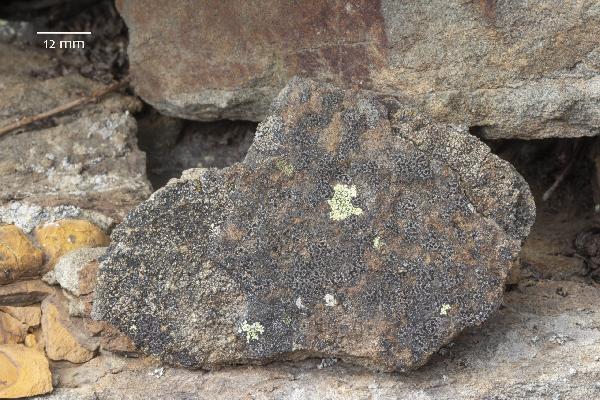
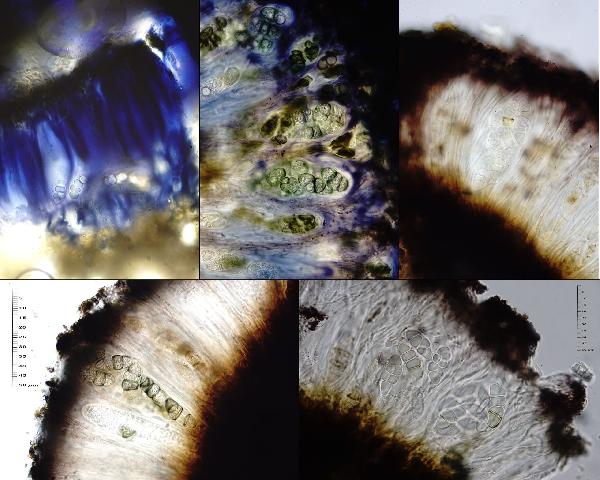
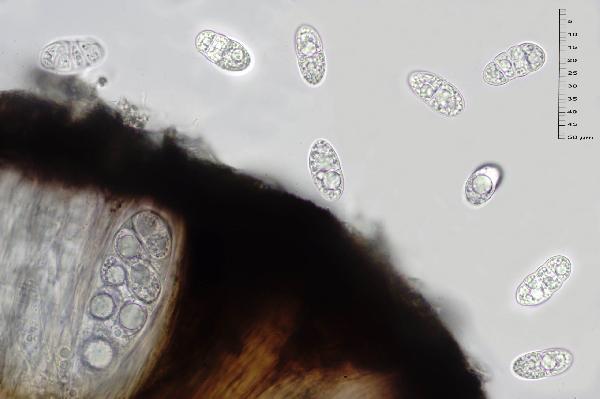
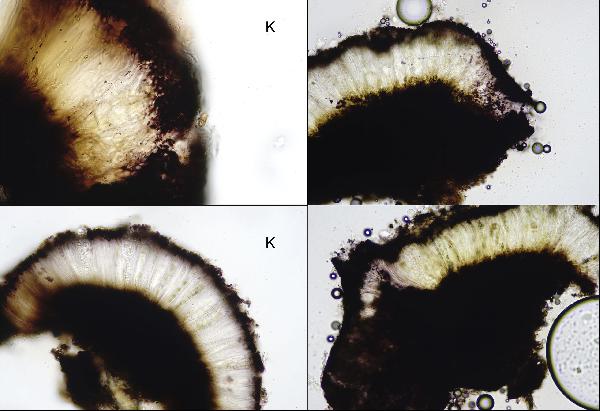
Description: Thallus crustose, episubstratic, grey-brown, epruinose, areolate, forming up to 4 cm wide patches, rarely delimited by a thin black prothallus. Areoles 0.3-0.6 mm wide, flat to slightly convex, polygonal to rounded. Medulla white, I-. Apothecia lecideine, black, 0.3-0.5(-0.6) mm across, with a concave to flat, epruinose disc and an up to 0.1 mm thick, distinctly raised, sometimes finally excluded proper margin. Proper exciple dark brown in outer part, K+ purple-red (solution); epithecium brown, brown-black or greenish brown, K+ purple-red; hymenium colourless, (60-)78-140(-162) mm high; paraphysoids strongly coherent, richly branched and anastomosing, the apical cells clavate; hypothecium brown. Asci 8-spored, clavate, fissitunicate, with a well-developed tholus that is K/I- in lower part and K/I+ blue near the apex, lacking an ocular chamber, Rhizocarpon-type. Ascospores 3-septate to sometimes weakly submuriform, with (4-)5-7(-8) cells in optical view and 1-2 oblique septa, long remaining hyaline, sometimes turning pale brown when overmature, narrowly ellipsoid to ellipsoid, (15-)18-23(-25) x (7-)9.5-12.5(-13) µm, halonate. Photobiont chlorococcoid. Spot tests: cortex K-, C-, KC-, P-; medulla sometimes fleeting C+ and KC+ pink. Chemistry: medulla sometimes with gyrophoric acid.
Growth form: Crustose
Substrata: rocks
Photobiont: green algae other than Trentepohlia
Reproductive strategy: mainly sexual
Poorly known taxon in need of further study
Commonnes-rarity: (info)
Alpine belt: very rare
Subalpine belt: very rare
Montane belt: very rare
Dry submediterranean belt: absent
Humid submediterranean belt: absent
Padanian area: absent
pH of the substrata:
1 2 3 4 5

Solar irradiation:
1 2 3 4 5
Aridity:
1 2 3 4 5
Eutrophication:
1 2 3 4 5
Poleotolerance:
0 1 2 3
Altitudinal distribution:
1 2 3 4 5 6
Rarity
absent
extremely rare
very rare
rare
rather rare
rather common
common
very common
extremely common
Loading data...
Occurrence data
Predictive map
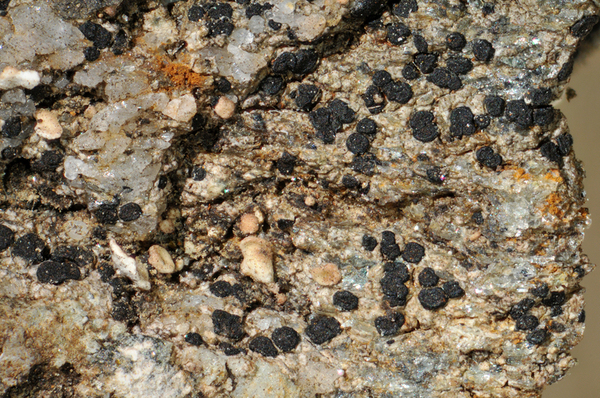
Einar Timdal - Source: http://nhm2.uio.no/lav/web/index.html - CC BY-NC
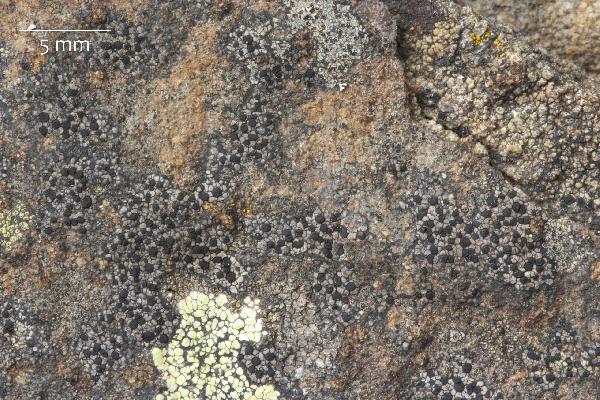
Marta González García - Souce: https://www.centrodeestudiosmicologicosasturianos.org/?p=53662
Spain, Aparcamiento El Alba (Quirós-Asturias), 15-IX-2022, en rocas ácidas, leg & det. M. González, ERD-9580.
Marta González García - Souce: https://www.centrodeestudiosmicologicosasturianos.org/?p=53662
Spain, Aparcamiento El Alba (Quirós-Asturias), 15-IX-2022, en rocas ácidas, leg & det. M. González, ERD-9580.
Marta González García - Souce: https://www.centrodeestudiosmicologicosasturianos.org/?p=53662
Spain, Aparcamiento El Alba (Quirós-Asturias), 15-IX-2022, en rocas ácidas, leg & det. M. González, ERD-9580.
Marta González García - Souce: https://www.centrodeestudiosmicologicosasturianos.org/?p=53662
Spain, Aparcamiento El Alba (Quirós-Asturias), 15-IX-2022, en rocas ácidas, leg & det. M. González, ERD-9580.
Marta González García - Souce: https://www.centrodeestudiosmicologicosasturianos.org/?p=53662
Spain, Aparcamiento El Alba (Quirós-Asturias), 15-IX-2022, en rocas ácidas, leg & det. M. González, ERD-9580.
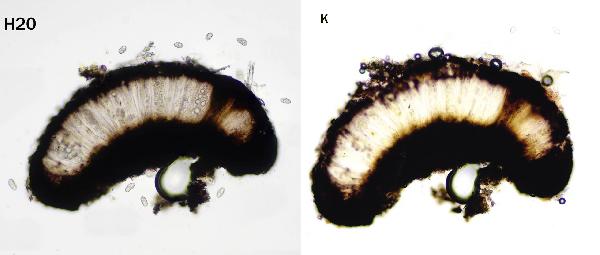
Marta González García - Souce: https://www.centrodeestudiosmicologicosasturianos.org/?p=53662
Spain, Aparcamiento El Alba (Quirós-Asturias), 15-IX-2022, en rocas ácidas, leg & det. M. González, ERD-9580.
Growth form: Crustose
Substrata: rocks
Photobiont: green algae other than Trentepohlia
Reproductive strategy: mainly sexual
Poorly known taxon in need of further study
Commonnes-rarity: (info)
Alpine belt: very rare
Subalpine belt: very rare
Montane belt: very rare
Dry submediterranean belt: absent
Humid submediterranean belt: absent
Padanian area: absent
pH of the substrata:
| 1 | 2 | 3 | 4 | 5 |
Solar irradiation:
| 1 | 2 | 3 | 4 | 5 |
Aridity:
| 1 | 2 | 3 | 4 | 5 |
Eutrophication:
| 1 | 2 | 3 | 4 | 5 |
Poleotolerance:
| 0 | 1 | 2 | 3 |
Altitudinal distribution:
| 1 | 2 | 3 | 4 | 5 | 6 |
Rarity
absent
extremely rare
very rare
rare
rather rare
rather common
common
very common
extremely common
Loading data...
Occurrence data
Predictive map
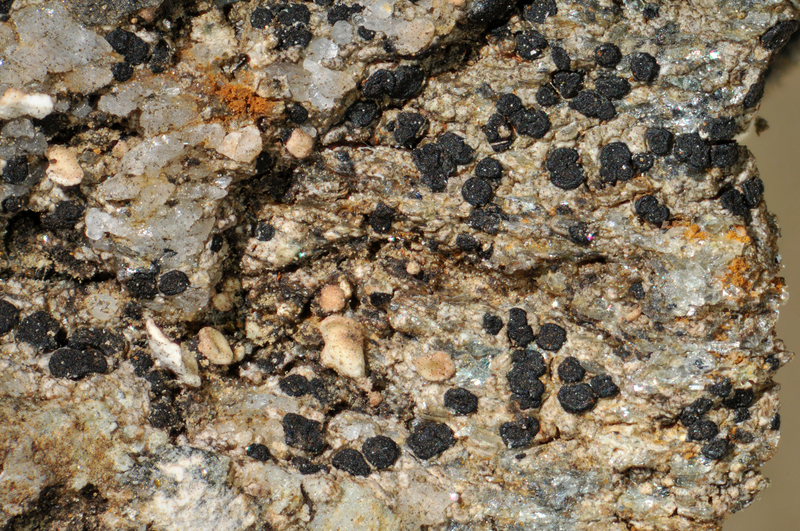
Einar Timdal - Source: http://nhm2.uio.no/lav/web/index.html - CC BY-NC

Marta González García - Souce: https://www.centrodeestudiosmicologicosasturianos.org/?p=53662
Spain, Aparcamiento El Alba (Quirós-Asturias), 15-IX-2022, en rocas ácidas, leg & det. M. González, ERD-9580.

Marta González García - Souce: https://www.centrodeestudiosmicologicosasturianos.org/?p=53662
Spain, Aparcamiento El Alba (Quirós-Asturias), 15-IX-2022, en rocas ácidas, leg & det. M. González, ERD-9580.

Marta González García - Souce: https://www.centrodeestudiosmicologicosasturianos.org/?p=53662
Spain, Aparcamiento El Alba (Quirós-Asturias), 15-IX-2022, en rocas ácidas, leg & det. M. González, ERD-9580.

Marta González García - Souce: https://www.centrodeestudiosmicologicosasturianos.org/?p=53662
Spain, Aparcamiento El Alba (Quirós-Asturias), 15-IX-2022, en rocas ácidas, leg & det. M. González, ERD-9580.

Marta González García - Souce: https://www.centrodeestudiosmicologicosasturianos.org/?p=53662
Spain, Aparcamiento El Alba (Quirós-Asturias), 15-IX-2022, en rocas ácidas, leg & det. M. González, ERD-9580.