Rinodina parasitica H. Mayrhofer & Poelt
Bibl. Lichenol., 12: 137, 1979.
Synonyms: Rinodina milvina var. amphibolitica Räsänen
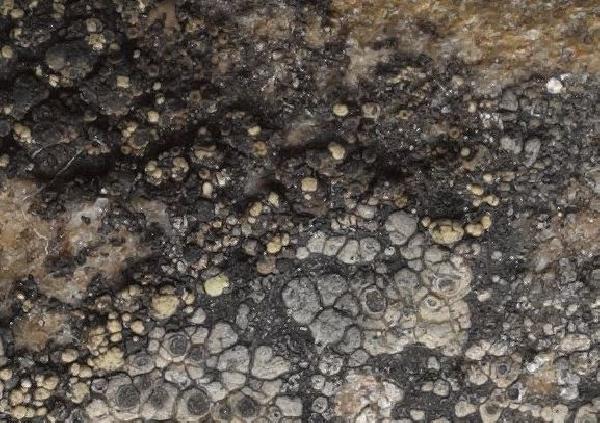
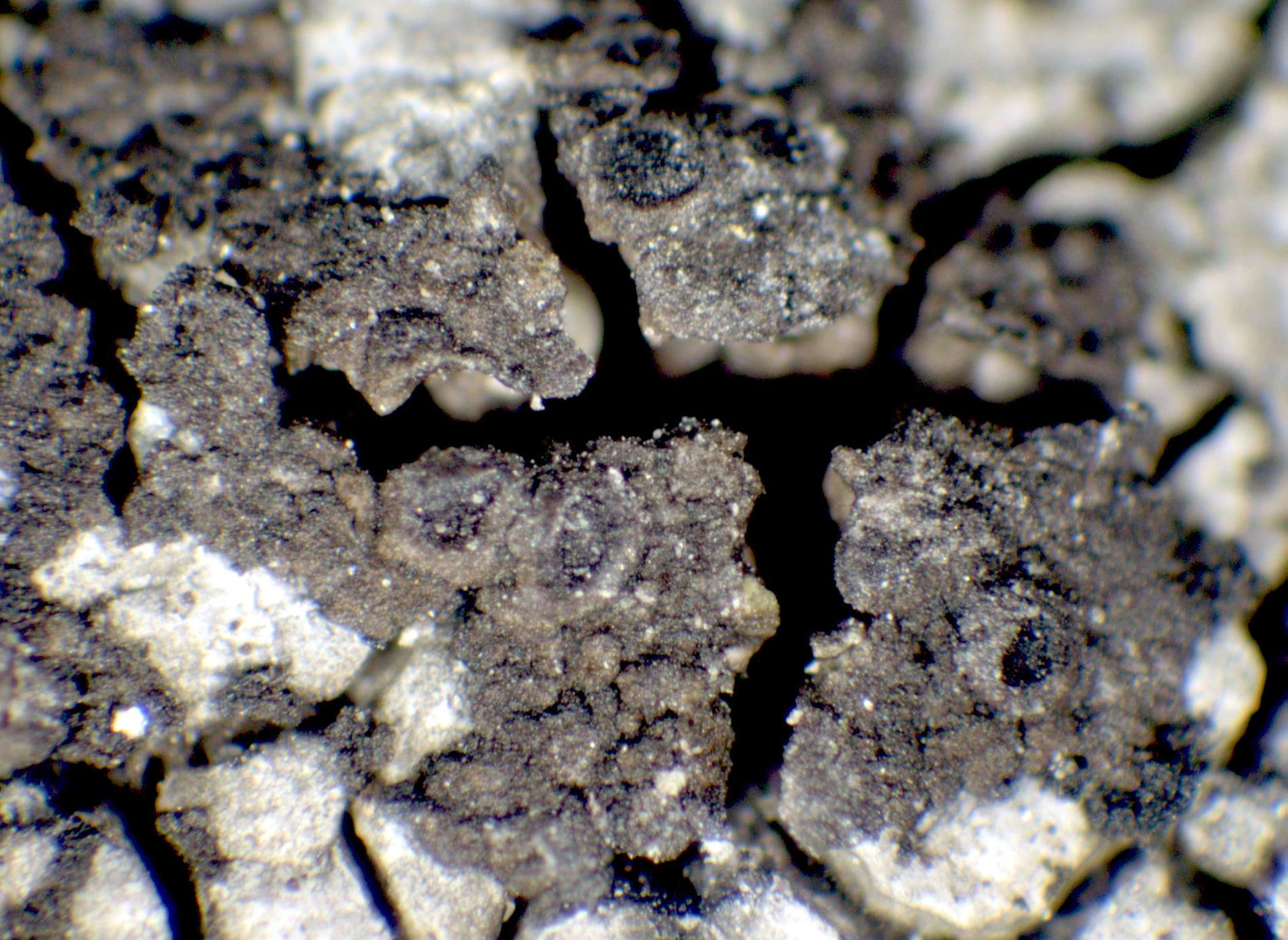
Description: Thallus crustose, episubstratic, rather thick, forming small patches on the thalli of crustose silicicolous lichens, at first of contiguous, 0.1-0.2 mm wide granules, finally areolate-verrucose, sometimes delimited by a dark prothallus, the areoles up to 0.6-0.7 mm wide, grey-brown to usually dark reddish brown, dull. Apothecia lecanorine, abundant and often confluent, innate to sessile, 0.3-0.5(-0.7) mm across, with a dark brown to black, flat to convex disc and a thick, prominent, smooth to crenulate thalline margin; a raised parathecial ring is sometimes visible between disc and thalline margin. Thalline exciple 40-90 µm wide laterally, corticate, expanding in lower part; proper exciple colourless, 5-15 µm wide laterally, expanding to (10-)20-40 µm in upper part; epithecium reddish brown, K-; hymenium colourless, 70-100 µm high; paraphyses 1.5-2(-3) µm thick, the apical cells to 4-6 µm wide, immersed in a diffuse pigment; hypothecium colourless, 50-90 µm high. Asci 8-spored, clavate, the K/I+ blue tholus penetrated by a faintly amyloid apical cushion with parallel or diverging flanks, the wall K/I-, surrounded by a K/I+ blue outer layer, Lecanora-type. Ascospores 1-septate, brown, broadly ellipsoid, (13-)16-18(-21) x (7-)8-10(-11) µm, Physcia-type, sometimes becoming thin-walled (Physconia-like), with ornamented walls and thickened apical walls, the ontogeny of type A (apical wall thickening after septum formation). Pycnidia black, immersed in thallus. Conidia bacilliform, 3.5-4.5 µm long. Photobiont chlorococcoid. Spot tests: K-, C-, KC-, P-, UV-. Chemistry: without lichen substances.
Growth form: Crustose
Substrata: rocks
Photobiont: green algae other than Trentepohlia
Reproductive strategy: mainly sexual
paras crustose lichens
Commonnes-rarity: (info)
Alpine belt: extremely rare
Subalpine belt: very rare
Montane belt: very rare
Dry submediterranean belt: absent
Humid submediterranean belt: absent
Padanian area: absent
pH of the substrata:
1 2 3 4 5

Solar irradiation:
1 2 3 4 5
Aridity:
1 2 3 4 5
Eutrophication:
1 2 3 4 5
Poleotolerance:
0 1 2 3
Altitudinal distribution:
1 2 3 4 5 6
Rarity
absent
extremely rare
very rare
rare
rather rare
rather common
common
very common
extremely common
Loading data...
Occurrence data
Predictive map
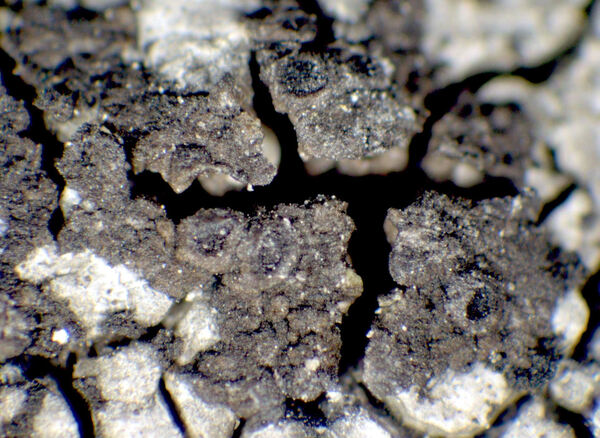
P.L. Nimis CC BY-SA 4.0
TSB 26484
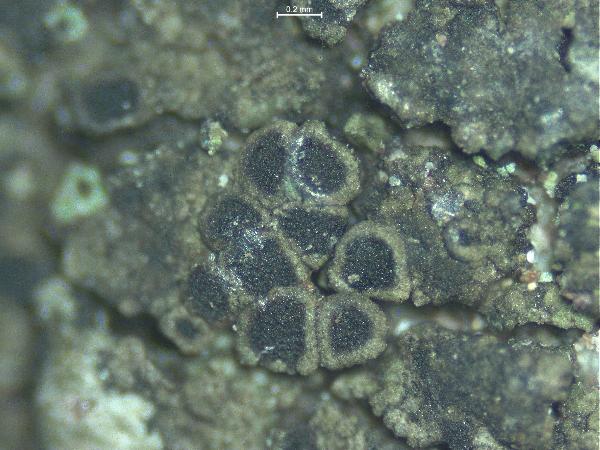
Courtesy Philippe Blaise - Source: https://likenoj.ch/index.php/samples/865
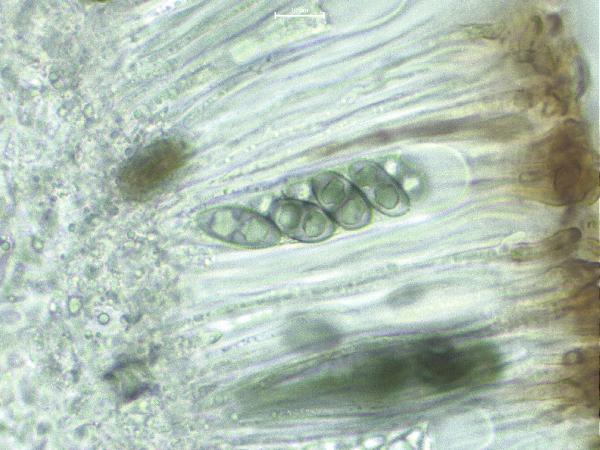
Courtesy Philippe Blaise - Source: https://likenoj.ch/index.php/samples/865
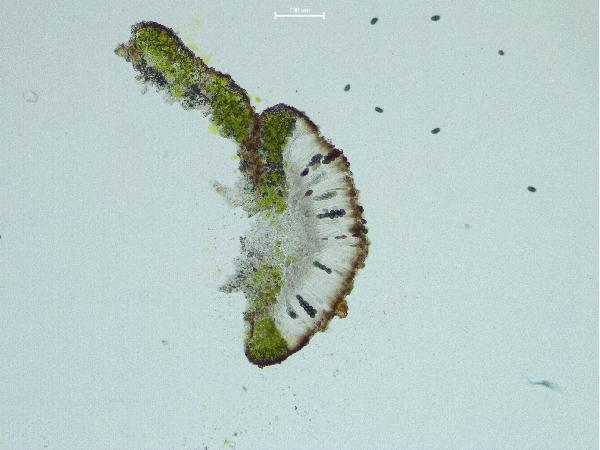
Courtesy Philippe Blaise - Source: https://likenoj.ch/index.php/samples/865
Modified from: https://gzu.jacq.org/GZU000286114
GZU000286114 - Collector Henssen,A. 20 133b
Date 1969-08-06
Location Norway / Finnmark
Label Norwegen, Finnmark: Varangerfjord, N-Ufer Paddeby, auf anstehendem Fels am Paddebyelven
Habitat auf anstehendem Fels

Source: Giralt M. & Llimona X. (1997) Mycotaxon 52: 175-224
Growth form: Crustose
Substrata: rocks
Photobiont: green algae other than Trentepohlia
Reproductive strategy: mainly sexual
paras crustose lichens
Commonnes-rarity: (info)
Alpine belt: extremely rare
Subalpine belt: very rare
Montane belt: very rare
Dry submediterranean belt: absent
Humid submediterranean belt: absent
Padanian area: absent
pH of the substrata:
| 1 | 2 | 3 | 4 | 5 |
Solar irradiation:
| 1 | 2 | 3 | 4 | 5 |
Aridity:
| 1 | 2 | 3 | 4 | 5 |
Eutrophication:
| 1 | 2 | 3 | 4 | 5 |
Poleotolerance:
| 0 | 1 | 2 | 3 |
Altitudinal distribution:
| 1 | 2 | 3 | 4 | 5 | 6 |
Rarity
absent
extremely rare
very rare
rare
rather rare
rather common
common
very common
extremely common
Loading data...
Occurrence data
Predictive map
P.L. Nimis CC BY-SA 4.0
TSB 26484

Courtesy Philippe Blaise - Source: https://likenoj.ch/index.php/samples/865

Courtesy Philippe Blaise - Source: https://likenoj.ch/index.php/samples/865

Courtesy Philippe Blaise - Source: https://likenoj.ch/index.php/samples/865

Modified from: https://gzu.jacq.org/GZU000286114
GZU000286114 - Collector Henssen,A. 20 133b Date 1969-08-06 Location Norway / Finnmark Label Norwegen, Finnmark: Varangerfjord, N-Ufer Paddeby, auf anstehendem Fels am Paddebyelven Habitat auf anstehendem Fels