Scytinium callopismum (A. Massal.) Otálora, P.M. Jørg. & Wedin
Fungal Divers., 64, 1: 290, 2013. Basionym: Collema callopismum A. Massal. - Miscell. Lichenol.: 23, 1856.
Synonyms: Collema callopismum f. granulosum Degel.; Leptogium callopismum (A. Massal.) Harm.
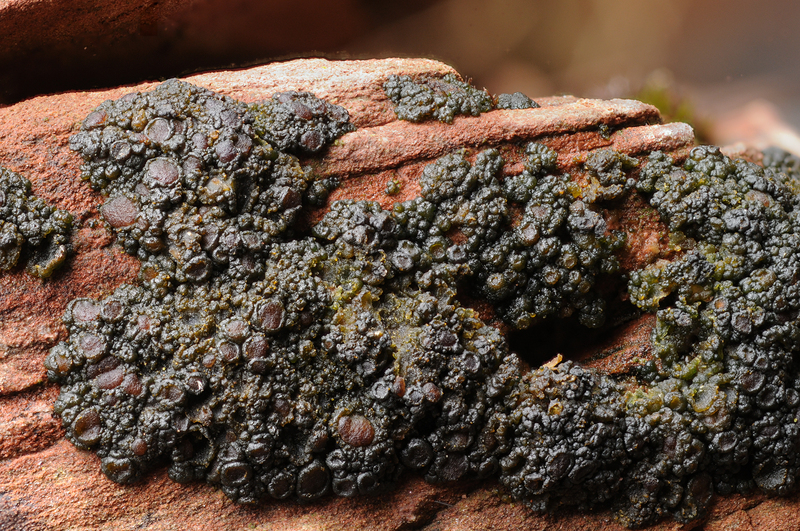
Description: Thallus subcrustose-lobulate or crustose, gelatinous when wet, usually forming up to 5 mm wide and up to 1.5 mm thick, scutelliform, subumbilicate cushions attached by a central holdfast and easily detached. Lobes few, usually repeatedly branched, 0.1-0.2 mm thick when dry, 0.2-0.45 mm thick when wet, up to 0.5 mm long and to 0.2 mm wide, contiguous, adnate or ascending, dark olive-green to black, dull, smooth to granulose. Upper and lower pseudocortex sometimes poorly evident, or formed by 1-more layers of isodiametrical cells, the layer inbetween partly paraplectenchymatous, partly of loosely arranged hyphae. Apothecia rare, lecanorine, at first globose, later flattened and disciform, semi-immersed to sessile, 0.3-0.7 mm across, with a concave to flat, red-brown to black disc and a thin, finally sometimes excluded thalline margin. Thalline exciple ecorticate or patchily pseudocorticate; proper exciple rather thick, eupara- or subparaplectenchymatous, to 110 µm wide; epithecium brownish; hymenium colourless, 90-150 µm high, I+ blue; paraphyses simple or sparingly branched in upper part, 1-5-2 µm thick at mid-level, the apical cells more or less swollen. Asci 8-spored, narrowly clavate to subcylindrical, the apex strongly thickened, the apical dome K/I+ pale blue, with a downwardly projecting K/I+ deep blue tubular structure. Ascospores variable, submuriform to rarely muriform, with 3-4 transverse septa and 1(-2) longitudinal septa, rarely with 3 transverse septa only, hyaline, ellipsoid, (13-)17-26(-45) x 8-12(-15) µm, thin-walled. Pycnidia laminal, immersed, paler than thallus. Conidia bacilliform, slightly swollen at both ends, 4-5 x 1-1.5(-2) µm. Photobiont cyanobacterial (Nostoc, the cells in short to long chains). Spot tests: all negative. Chemistry: without lichen substances.
Growth form: Foliose, narrow lobed
Substrata: rocks
Photobiont: cyanobacteria, filamentous (e.g. Nostoc, Scytonema)
Reproductive strategy: mainly sexual
On otherwise dry surfaces with short periods of water seepage after rain
Commonnes-rarity: (info)
Alpine belt: absent
Subalpine belt: absent
Montane belt: extremely rare
Dry submediterranean belt: very rare
Humid submediterranean belt: very rare
Padanian area: extremely rare
pH of the substrata:
1 2 3 4 5

Solar irradiation:
1 2 3 4 5
Aridity:
1 2 3 4 5
Eutrophication:
1 2 3 4 5
Poleotolerance:
0 1 2 3
Altitudinal distribution:
1 2 3 4 5 6
Rarity
absent
extremely rare
very rare
rare
rather rare
rather common
common
very common
extremely common
Loading data...
Occurrence data
Predictive map
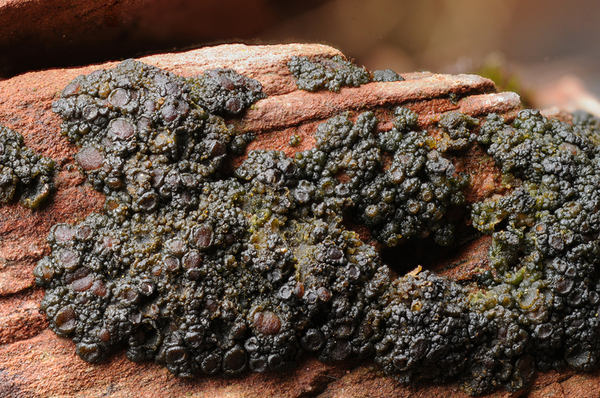
Einar Timdal - Source: http://nhm2.uio.no/lav/web/index.html - CC BY-NC
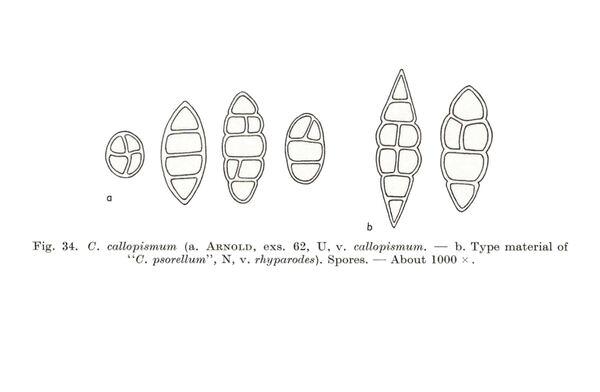
Degelius G. 1954. The lichen genus Collema in Europe: Morphology, Taxonomy, Ecology. Symbolae Bot. Upsal. 13, 2: 1-499.
Growth form: Foliose, narrow lobed
Substrata: rocks
Photobiont: cyanobacteria, filamentous (e.g. Nostoc, Scytonema)
Reproductive strategy: mainly sexual
On otherwise dry surfaces with short periods of water seepage after rain
Commonnes-rarity: (info)
Alpine belt: absent
Subalpine belt: absent
Montane belt: extremely rare
Dry submediterranean belt: very rare
Humid submediterranean belt: very rare
Padanian area: extremely rare
pH of the substrata:
| 1 | 2 | 3 | 4 | 5 |
Solar irradiation:
| 1 | 2 | 3 | 4 | 5 |
Aridity:
| 1 | 2 | 3 | 4 | 5 |
Eutrophication:
| 1 | 2 | 3 | 4 | 5 |
Poleotolerance:
| 0 | 1 | 2 | 3 |
Altitudinal distribution:
| 1 | 2 | 3 | 4 | 5 | 6 |
Rarity
absent
extremely rare
very rare
rare
rather rare
rather common
common
very common
extremely common
Loading data...
Occurrence data
Predictive map
Einar Timdal - Source: http://nhm2.uio.no/lav/web/index.html - CC BY-NC