Bacidia absistens (Nyl.) Arnold
Flora, 53: 472, 1870. Basionym: Lecidea absistens Nyl. - Flora, 52: 295, 1869.
Synonyms: Bacidia intermissa (Nyl.) Malme; Lecidea intermissa Nyl.
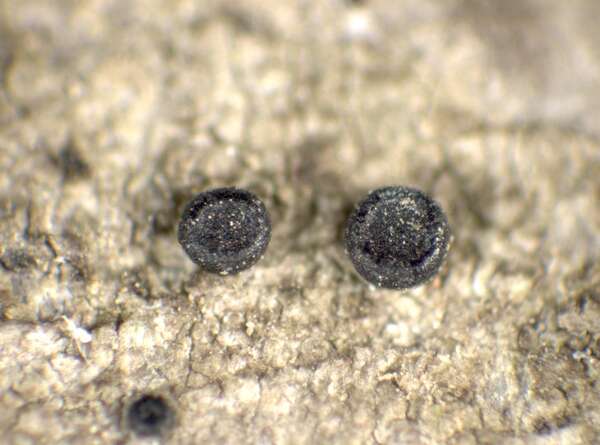
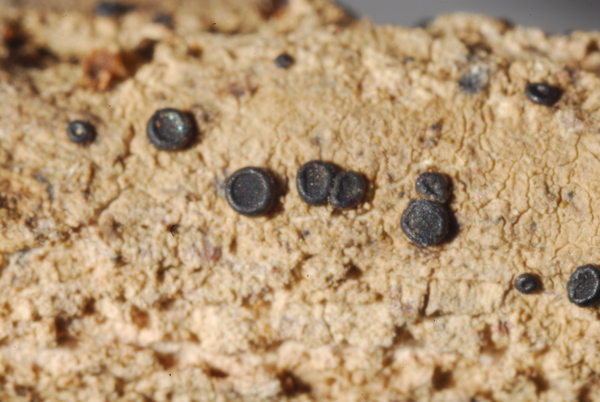
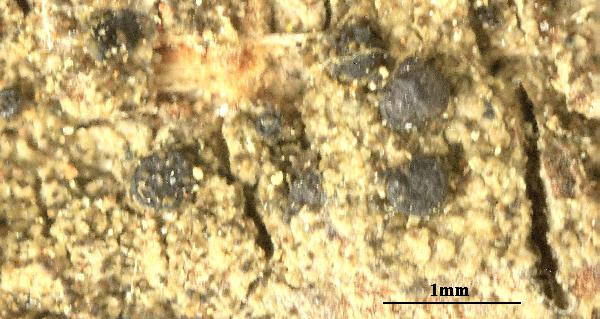
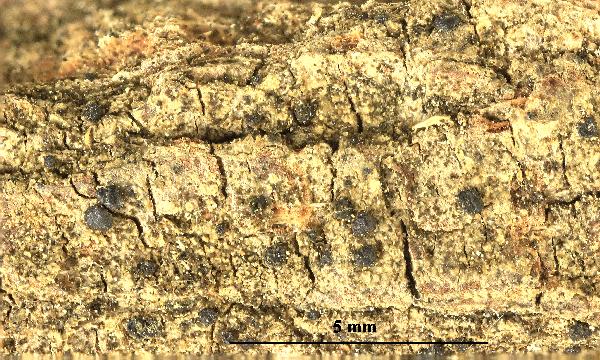
Description: Thallus crustose, thinly episubstratic, white to grey, continuous, smooth or granular-warted. Apothecia lecideine, 0.3-0.6(-1) mm across, black to grey in shade-forms, with a flat to rarely convex disc, and a thin, usually persistent proper margin. Proper exciple dark green and K+ intensifying green in outer part, pale red-brown and K- or K+ purple within, with abundant small crystals dissolving in K, visible under polarized light; epithecium blue-violet or purple-brown, rarely green, K+ green N+ purple-violet (with the precipitation of small blue crystals); hymenium colourless, 60-95 μm high; paraphyses simple or forked, 1-1.5 μm thick at mid-level, the apical cells up to 4 μm wide; hypothecium colourless or pale yellowish brown in lower part. Asci 8-spored, clavate to cylindrical-clavate, the apical dome K/I+ dark blue with a pale, conical-pointed apical cushion (axial mass), the wall I-, but the thin outer gel I+ blue, Bacidia-type. Ascospores 7-16-septate, hyaline, needle-like, 45-80 x 2-3(-4) μm. Pycnidia very small, immersed. Conidia thread-like, curved, 7-32 x c. 0.5 μm. Photobiont chlorococcoid, the cells 5-12(-14) μm in diam. Spot tests: thallus K, C-, KC-, P-, UV-. Chemistry: unidentified orcinol meta-depsides.
Growth form: Crustose
Substrata: bark
Photobiont: green algae other than Trentepohlia
Reproductive strategy: mainly sexual
Most common in areas with a humid-warm climate (e.g. most of Tyrrenian Italy)
Commonnes-rarity: (info)
Alpine belt: absent
Subalpine belt: absent
Montane belt: absent
Dry submediterranean belt: extremely rare
Humid submediterranean belt: extremely rare
Padanian area: absent
pH of the substrata:
1 2 3 4 5

Solar irradiation:
1 2 3 4 5
Aridity:
1 2 3 4 5
Eutrophication:
1 2 3 4 5
Poleotolerance:
0 1 2 3
Altitudinal distribution:
1 2 3 4 5 6
Rarity
absent
extremely rare
very rare
rare
rather rare
rather common
common
very common
extremely common
Loading data...
Occurrence data
Predictive map
P.L. Nimis; Owner: Department of Life Sciences, University of Trieste
Herbarium: TSB (31868)
2001/12/12
Domenico Puntillo; Owner: Domenico Puntillo
Italy
Felix Schumm - CC BY-SA 4.0
[VZ1645], Suecia. Värmland: Östra Ämtervik, Eldebecksberget, 180
m. Ad corticem Salicis. Leg. S. W. Sundell (no. 12773), 18.9.1978. EX
A. VEZDA: LICHENES SELECTI EXSICCATI NR. 1645.
Felix Schumm - CC BY-SA 4.0
[VZ1645], Suecia. Värmland: Östra Ämtervik, Eldebecksberget, 180
m. Ad corticem Salicis. Leg. S. W. Sundell (no. 12773), 18.9.1978. EX
A. VEZDA: LICHENES SELECTI EXSICCATI NR. 1645.
Growth form: Crustose
Substrata: bark
Photobiont: green algae other than Trentepohlia
Reproductive strategy: mainly sexual
Most common in areas with a humid-warm climate (e.g. most of Tyrrenian Italy)
Commonnes-rarity: (info)
Alpine belt: absent
Subalpine belt: absent
Montane belt: absent
Dry submediterranean belt: extremely rare
Humid submediterranean belt: extremely rare
Padanian area: absent
pH of the substrata:
| 1 | 2 | 3 | 4 | 5 |
Solar irradiation:
| 1 | 2 | 3 | 4 | 5 |
Aridity:
| 1 | 2 | 3 | 4 | 5 |
Eutrophication:
| 1 | 2 | 3 | 4 | 5 |
Poleotolerance:
| 0 | 1 | 2 | 3 |
Altitudinal distribution:
| 1 | 2 | 3 | 4 | 5 | 6 |
Rarity
absent
extremely rare
very rare
rare
rather rare
rather common
common
very common
extremely common
Loading data...
Occurrence data
Predictive map
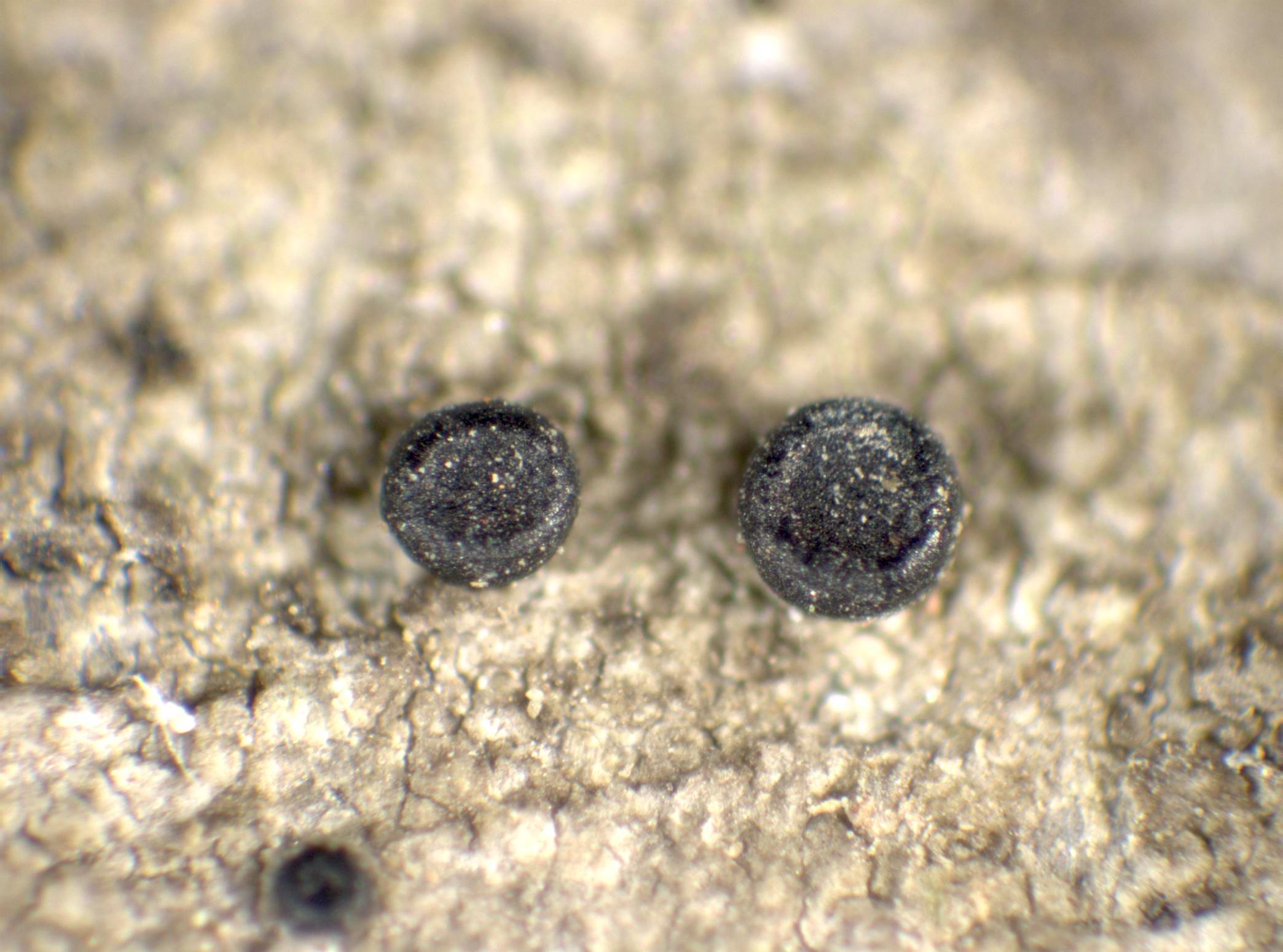
P.L. Nimis; Owner: Department of Life Sciences, University of Trieste
Herbarium: TSB (31868)
2001/12/12
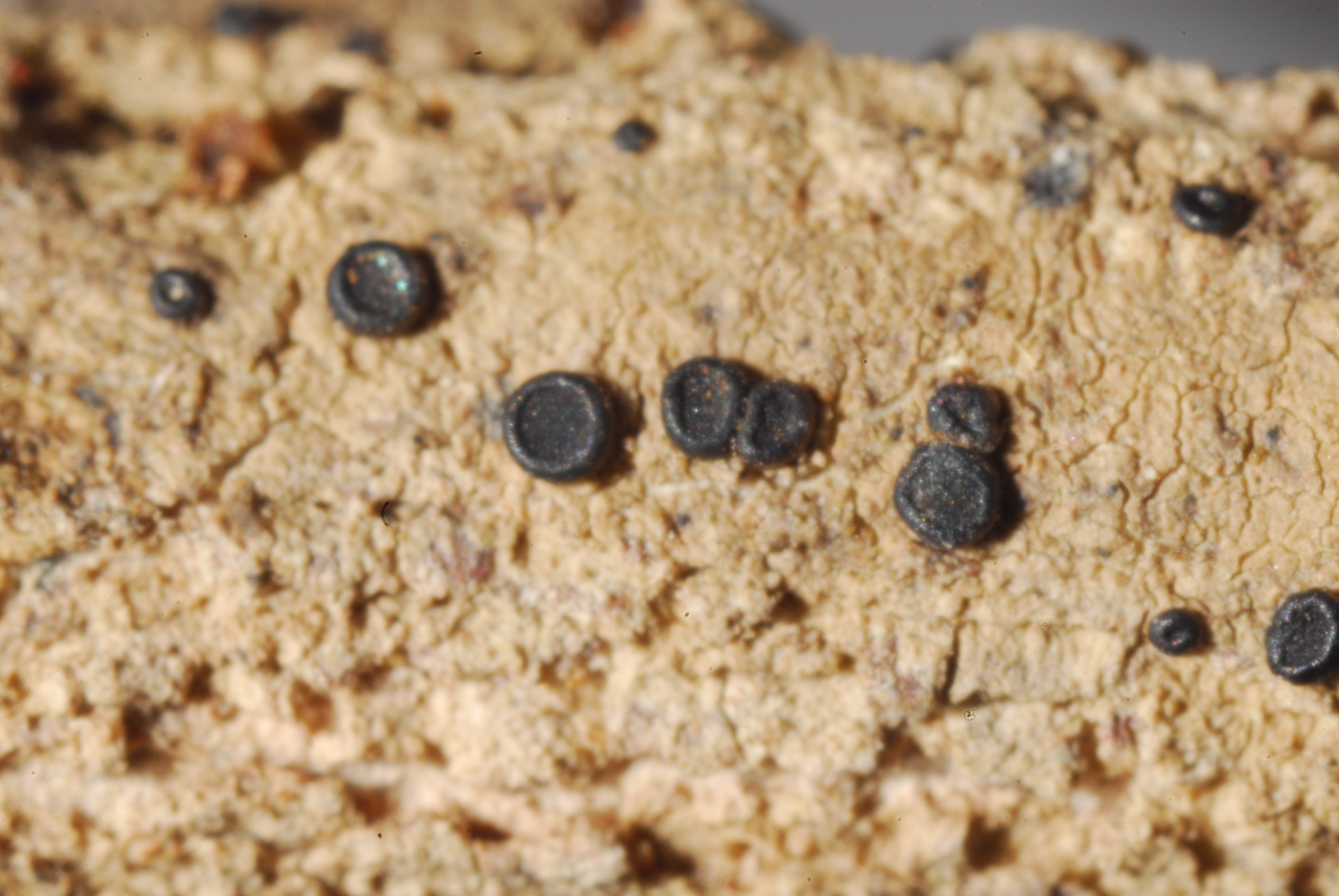
Domenico Puntillo; Owner: Domenico Puntillo
Italy

Felix Schumm - CC BY-SA 4.0
[VZ1645], Suecia. Värmland: Östra Ämtervik, Eldebecksberget, 180 m. Ad corticem Salicis. Leg. S. W. Sundell (no. 12773), 18.9.1978. EX A. VEZDA: LICHENES SELECTI EXSICCATI NR. 1645.