Tetramelas pulverulentus (Anzi) A. Nordin & Tibell
Lichenologist, 37: 497, 2005. Basionym: Abrothallus pulverulentus Anzi - Cat. Lich. Sondr.: 116, 1860.
Synonyms: Arthonia muscigenae (Anzi) Jatta; Buellia convexa Th. Fr.; Buellia pulverulenta (Anzi) Jatta; Diplotomma pulverulentum (Anzi) D. Hawksw.; Karschia pulverulenta (Anzi) Körb.; Leciographa muscigenae (Anzi) Rehm
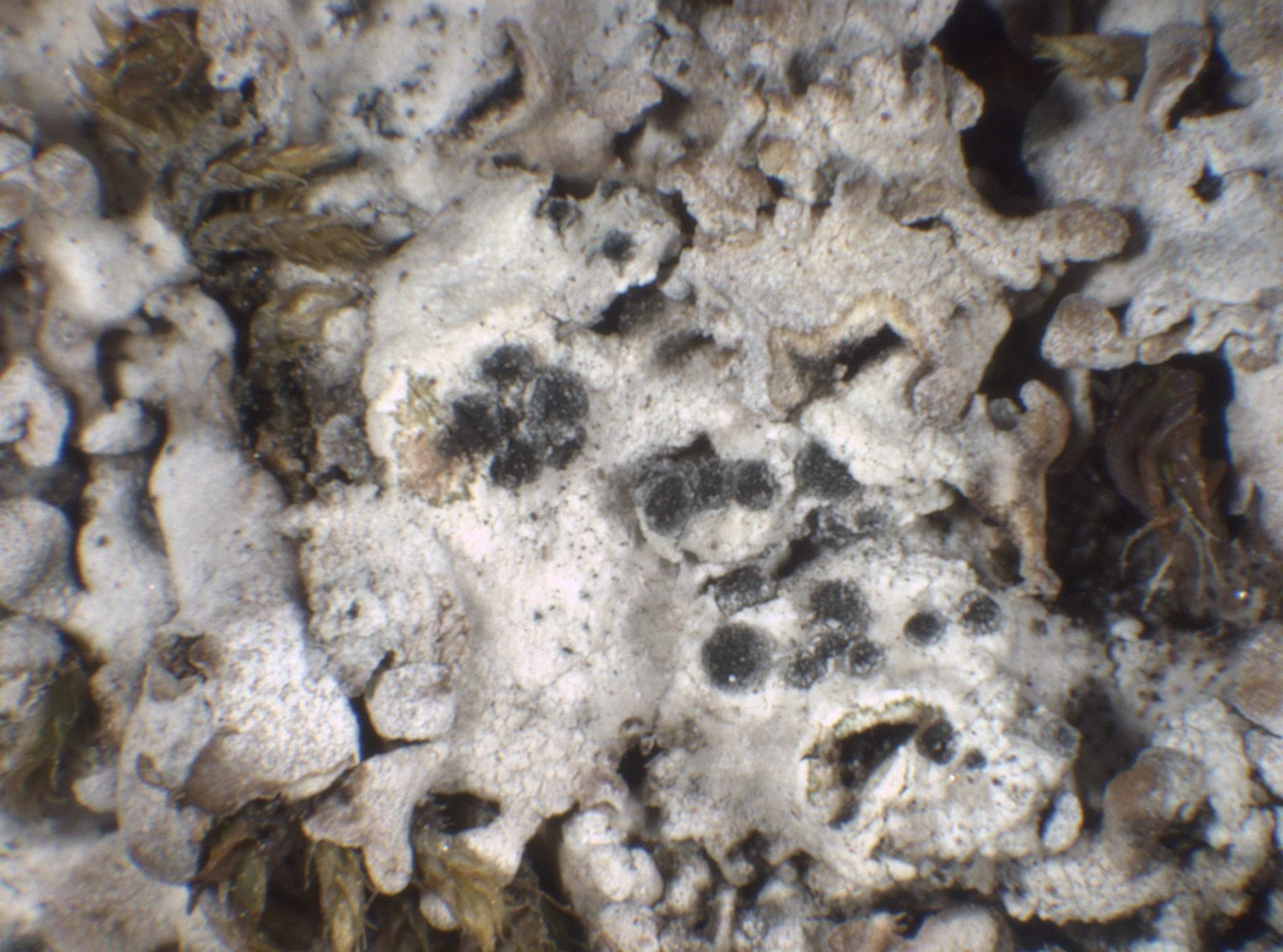
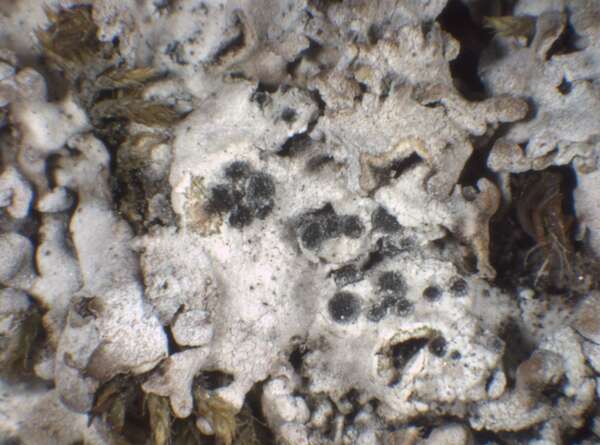
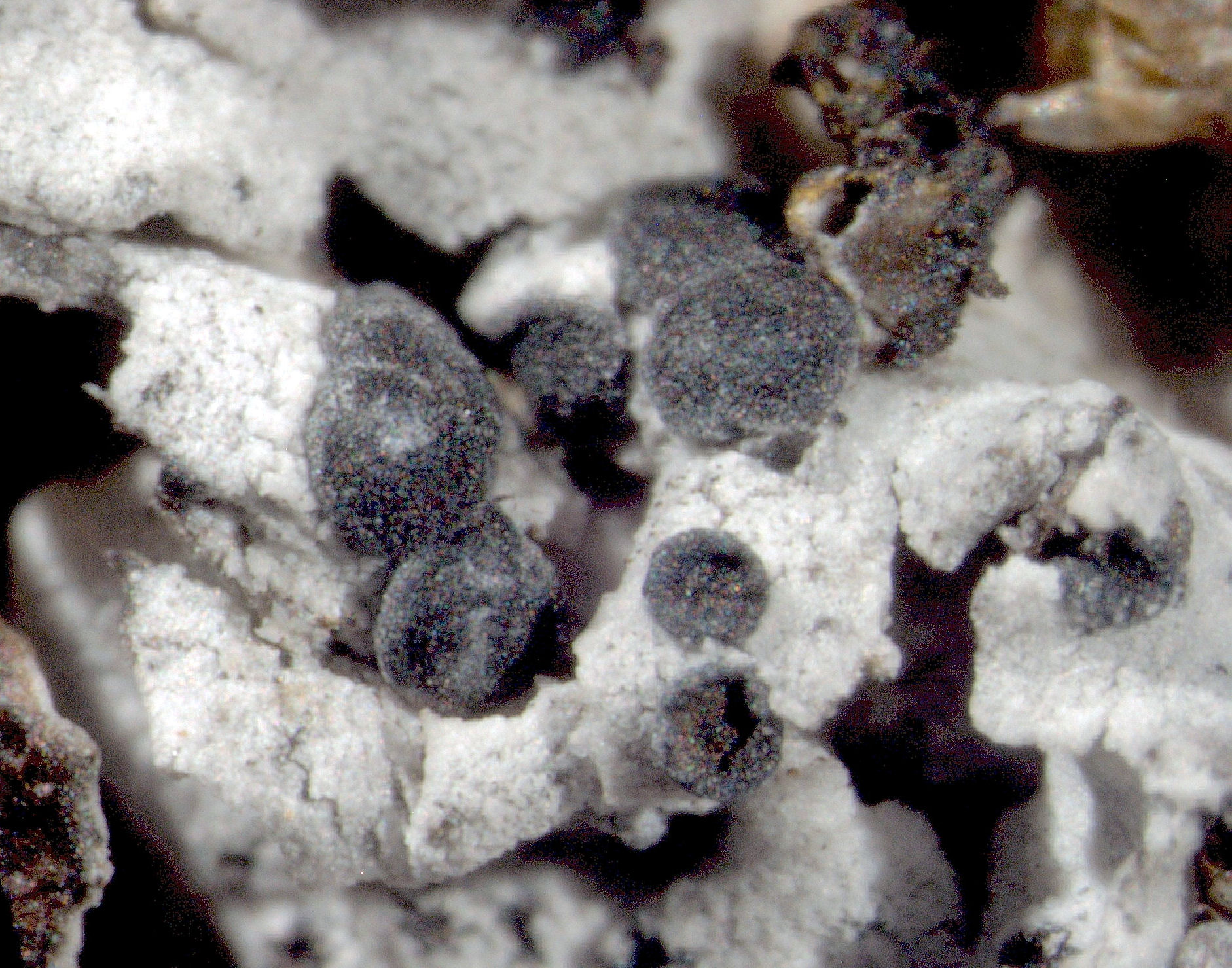
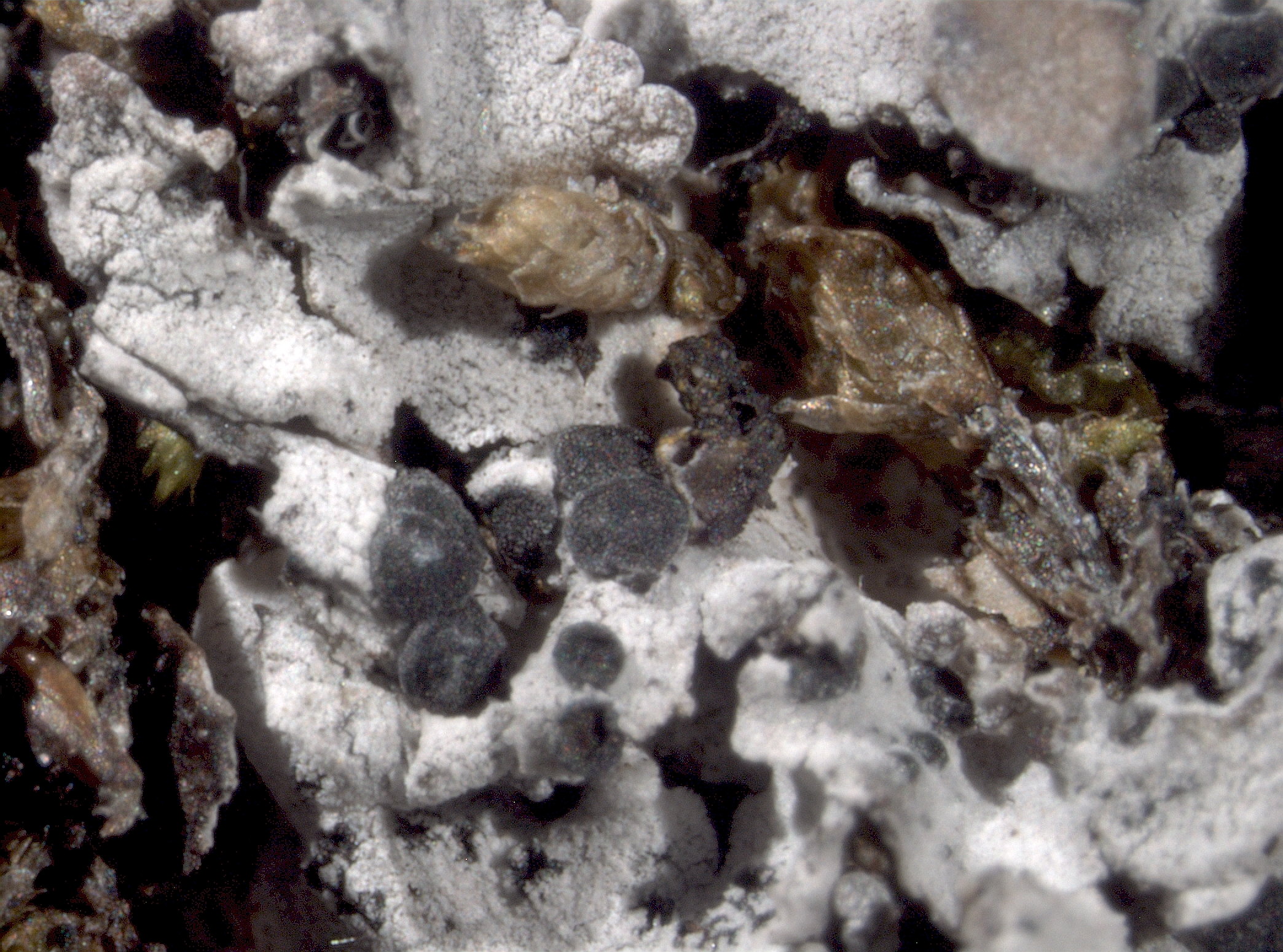
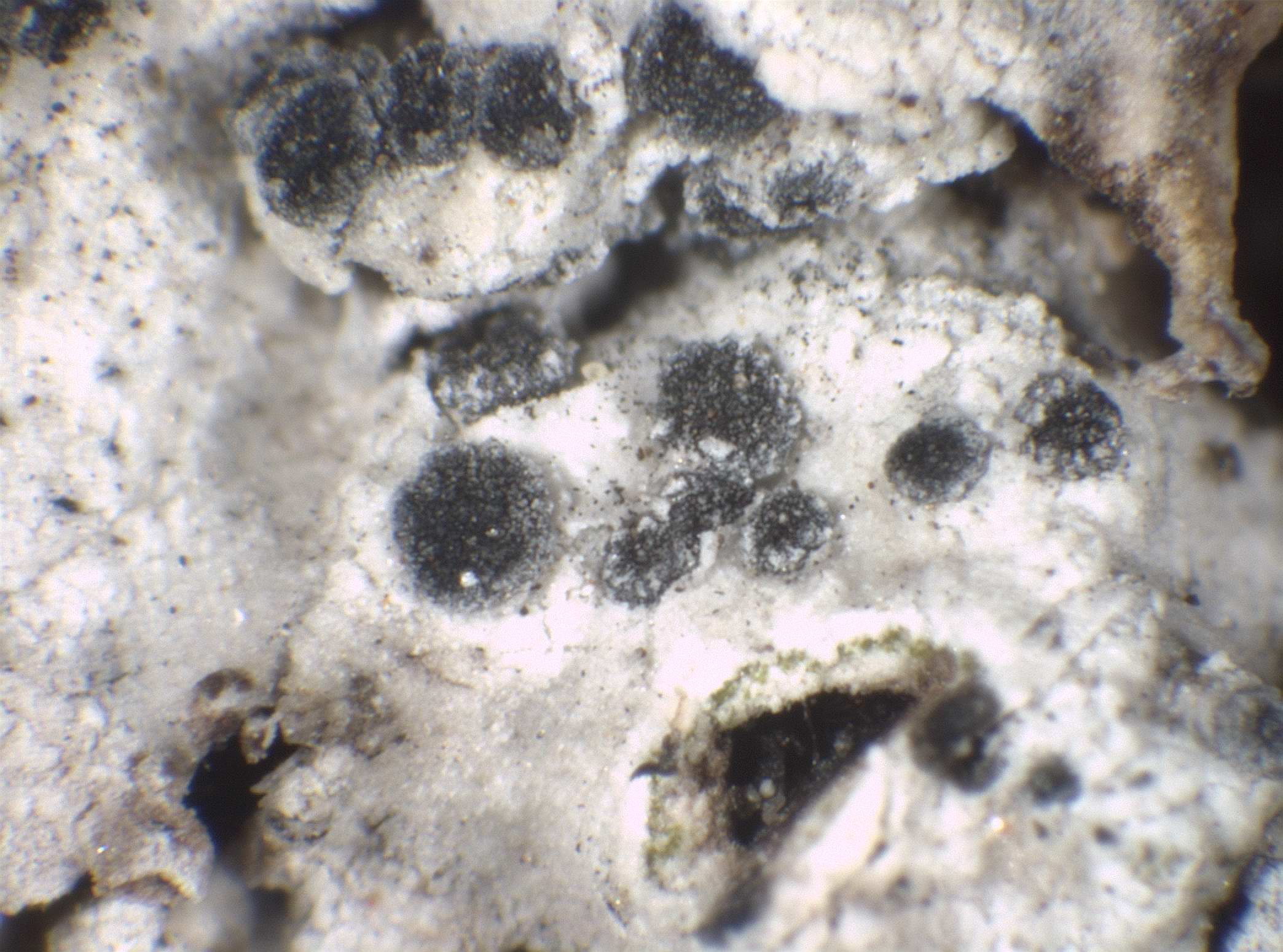
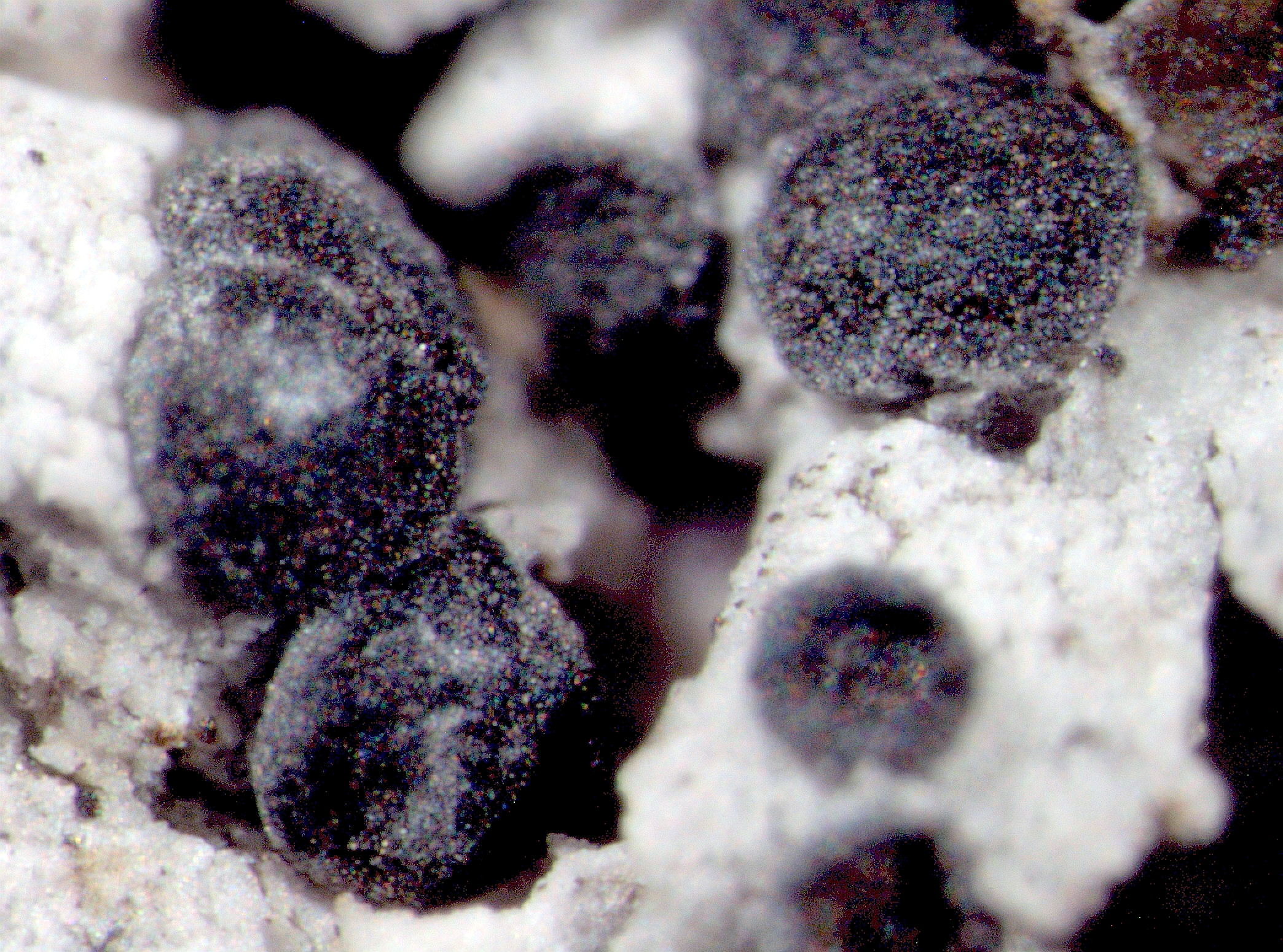
Description: Thallus crustose, endokapylic, developing parasitically within species of Physconia, Physcia, and Anaptychia, mostly on Physconia muscigena, causing a necral discolouration on the host, but distinct within, of more dense and smaller cells than those of the host. Apothecia lecideine, black, (0.1-)0.3-0.7 mm across, at first immersed, then adnate, with a soon convex, sometimes pruinose disc and a soon excluded proper margin which, in young apothecia, is often grey-pruinose due to residues of the host's epinecral layer. Proper exciple dark brown throughout, paraplectenchymatous, often with inclusions of crystals; epithecium dark brown, N-; hymenium colourless, 55-77 μm high, not inspersed with oil droplets, I+ blue; paraphyses branched in upper part, the apical cell swollen, to 6 µm wide, with a brown cap; hypothecium brown to dark brown. Asci 8-spored, clavate to cylindrical-clavate, the apical dome K/I+ dark blue with a pale, conical-pointed apical cushion (axial mass), the wall I-, but the thin outer gel I+ blue, Bacidia-type. Ascospores (1-)3-septate, brown, ellipsoid, straight or slightly curved, with rounded ends, (14-)16-21(-23) x 6-9 μm, the wall slightly rugulate. Pycnidia rare, black, unilocular. Conidia bacilliform, 5-6 x c. 1 μm. Photobiont chlorococcoid. Spot tests: K-, C-, KC-, P-. Chemistry: without lichen substances.
Growth form: Crustose
Photobiont: green algae other than Trentepohlia
Reproductive strategy: mainly sexual
paras crustose and foliose lichens
Commonnes-rarity: (info)
Alpine belt: rather common
Subalpine belt: rather rare
Montane belt: extremely rare
Dry submediterranean belt: absent
Humid submediterranean belt: absent
Padanian area: absent
pH of the substrata:
1 2 3 4 5

Solar irradiation:
1 2 3 4 5
Aridity:
1 2 3 4 5
Eutrophication:
1 2 3 4 5
Poleotolerance:
0 1 2 3
Altitudinal distribution:
1 2 3 4 5 6
Rarity
absent
extremely rare
very rare
rare
rather rare
rather common
common
very common
extremely common
Loading data...
Occurrence data
Predictive map
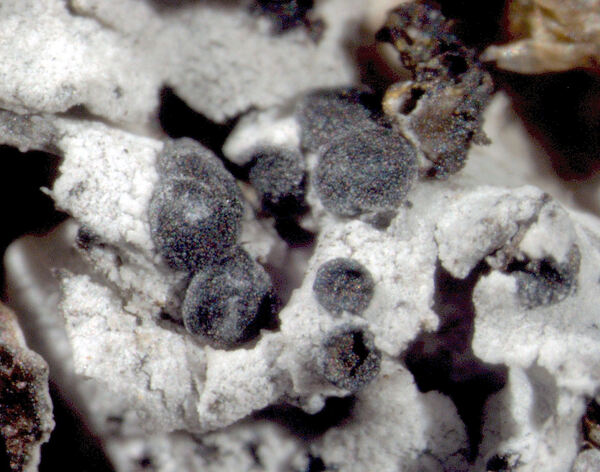
P.L. Nimis CC BY-SA 4.0
TSB 42466
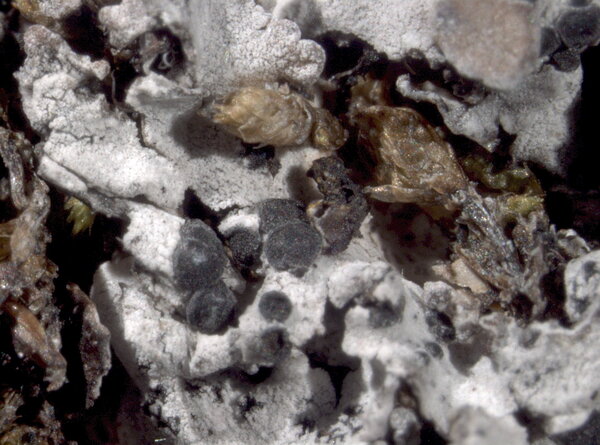
Pier Luigi Nimis - CC BY-SA 4.0
TSB 42446
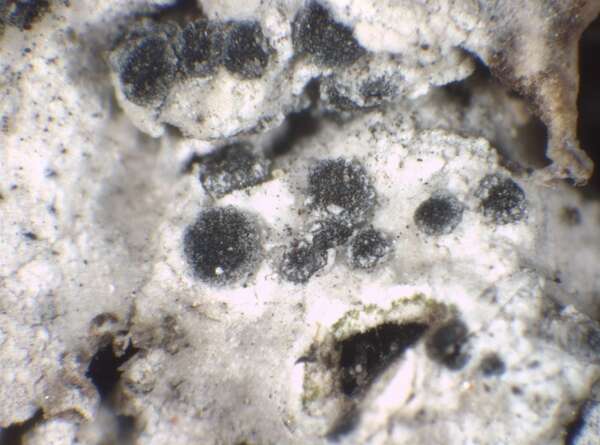
P.L. Nimis; Owner: Department of Life Sciences, University of Trieste
Herbarium: TSB (23708)
2003/03/06
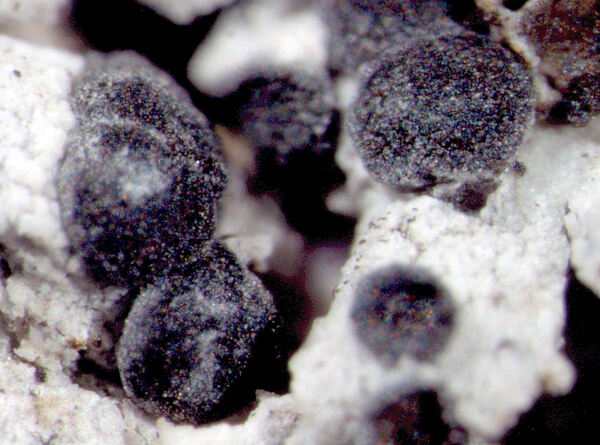
P.L. Nimis CC BY-SA 4.0
TSB 42466
P.L. Nimis; Owner: Department of Life Sciences, University of Trieste
Herbarium: TSB (23708)
2003/03/06
on the host, Physconia muscigena
Growth form: Crustose
Photobiont: green algae other than Trentepohlia
Reproductive strategy: mainly sexual
paras crustose and foliose lichens
Commonnes-rarity: (info)
Alpine belt: rather common
Subalpine belt: rather rare
Montane belt: extremely rare
Dry submediterranean belt: absent
Humid submediterranean belt: absent
Padanian area: absent
pH of the substrata:
| 1 | 2 | 3 | 4 | 5 |
Solar irradiation:
| 1 | 2 | 3 | 4 | 5 |
Aridity:
| 1 | 2 | 3 | 4 | 5 |
Eutrophication:
| 1 | 2 | 3 | 4 | 5 |
Poleotolerance:
| 0 | 1 | 2 | 3 |
Altitudinal distribution:
| 1 | 2 | 3 | 4 | 5 | 6 |
Rarity
absent
extremely rare
very rare
rare
rather rare
rather common
common
very common
extremely common
Loading data...
Occurrence data
Predictive map
P.L. Nimis CC BY-SA 4.0
TSB 42466
Pier Luigi Nimis - CC BY-SA 4.0
TSB 42446
P.L. Nimis; Owner: Department of Life Sciences, University of Trieste
Herbarium: TSB (23708)
2003/03/06
P.L. Nimis CC BY-SA 4.0
TSB 42466