Kiliasia tristis (Müll. Arg.) Hafellner
Beih. Nova Hedwigia, 79: 265, 1984. Basionym: Patellaria tristis Müll. Arg. - Mém. Soc. Phys. Hist. nat. Genève, 16, 2: 398, 1862
Synonyms: Catillaria subnitida Hellb.; Catillaria tristis (Müll. Arg.) Arnold; Lecidea platycarpiza Nyl.; Patellaria tristis Müll. Arg.; Toninia subnitida (Hellb.) Hafellner & Türk
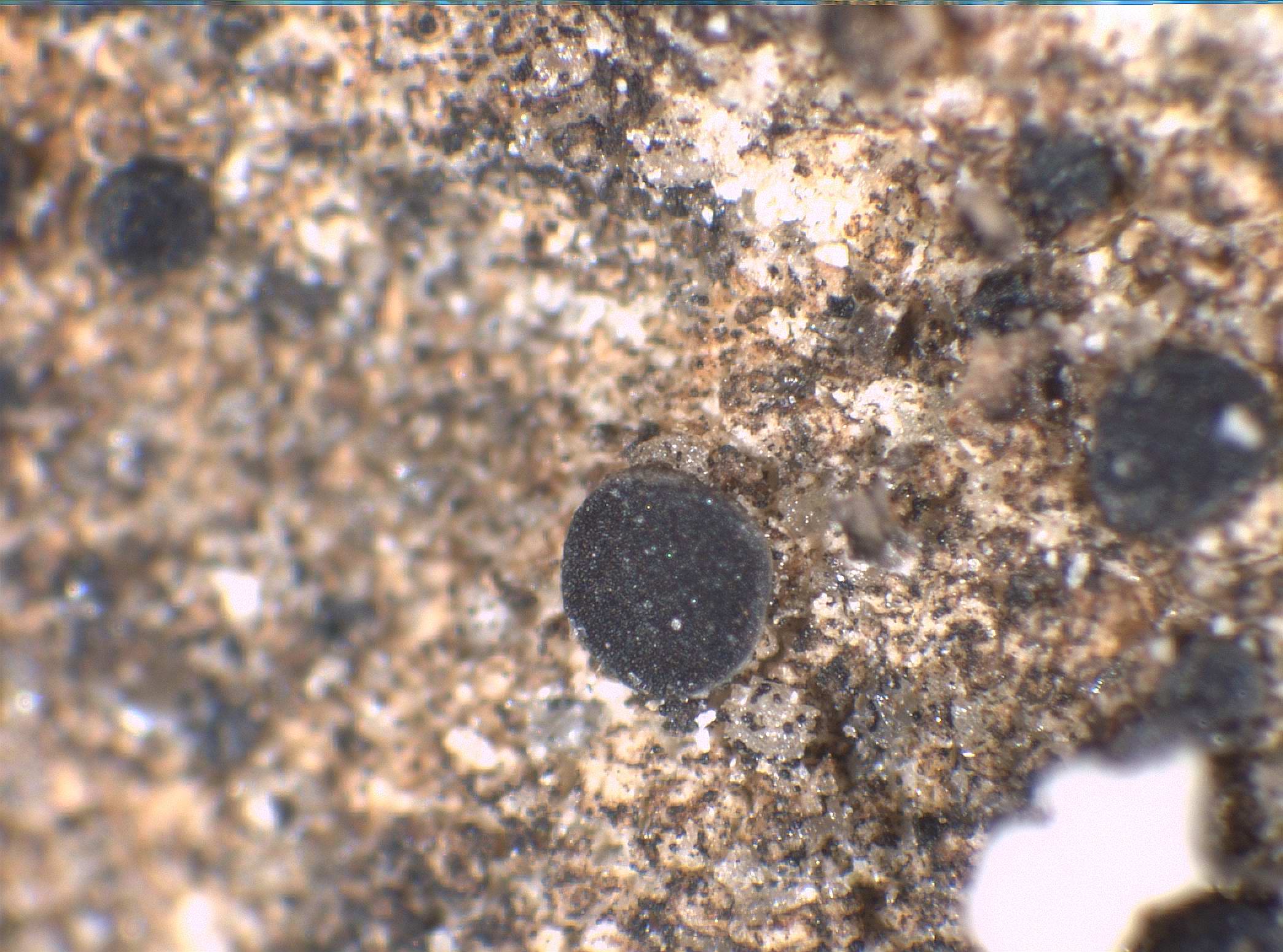
Description: Thallus crustose, endosubstratic and poorly evident to episubstratic and areolate, whitish to ochre-coloured, forming 1-3 cm wide patches. Apothecia lecideine, black, somehow glossy, 0.3-0.9(-1.5) mm across, sessile and more or less constricted at base, with a flat to slightly convex, epruinose disc, and a smooth, finally excluded proper margin. Proper exciple violet-black, with a paler outer rim, K+ and N+ purple; epithecium dark blue-green, K+ and N+ purple; hymenium greenish, rarely colourless, 50-75 μm high, I+ reddish; paraphyses 1.5-2 μm thick at mid-level, the apical cells to 6-8 μm wide, surrounded by a pigmented gel; hypothecium coloured as the exciple 110-250 μm high, K+ and N+ purple. Asci 8-spored, subcylindrical, surrounded by a gelatinous I+ blue coat, with a well-developed I+ blue tholus with a I+ darker blue tube and a well-developed ocular chamber, Bacidia-type. Ascospores 1-septate, hyaline, sometimes slightly constricted at septum, oblong-ellipsoid, (8-)9-12(-13.5) x 3.5-5.5 μm. Pycnidia black, globose to pyriform. Conidia thread-like to sickle-shaped, 5.5-15.5 x 0.5-1.2 μm. Photobiont chlorococcoid. Spot tests: thallus K-, C-, KC-, P-, UV-. Chemistry: without lichen substances.
Growth form: Crustose
Substrata: rocks
Photobiont: green algae other than Trentepohlia
Reproductive strategy: mainly sexual
Commonnes-rarity: (info)
Alpine belt: rare
Subalpine belt: rather rare
Montane belt: very rare
Dry submediterranean belt: absent
Humid submediterranean belt: absent
Padanian area: absent
pH of the substrata:
1 2 3 4 5

Solar irradiation:
1 2 3 4 5
Aridity:
1 2 3 4 5
Eutrophication:
1 2 3 4 5
Poleotolerance:
0 1 2 3
Altitudinal distribution:
1 2 3 4 5 6
Rarity
absent
extremely rare
very rare
rare
rather rare
rather common
common
very common
extremely common
Loading data...
Occurrence data
Predictive map
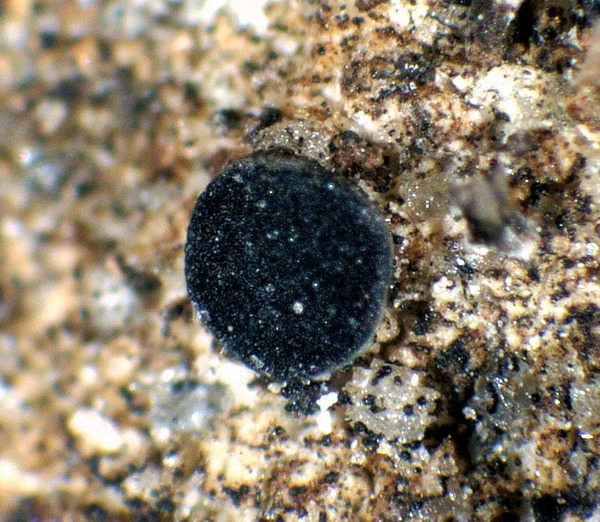
P.L. Nimis CC BY-SA 04
TSB 33968
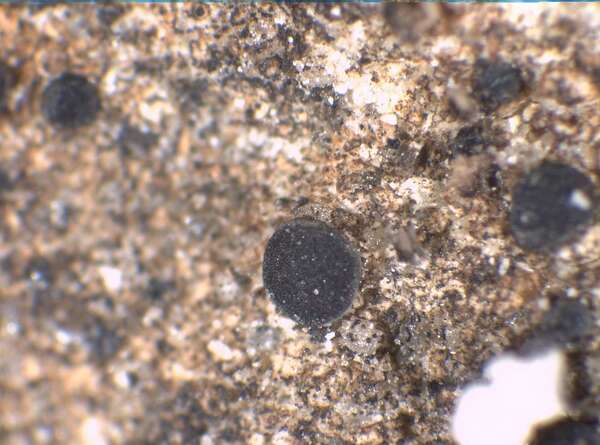
P.L. Nimis; Owner: Department of Life Sciences, University of Trieste
Herbarium: TSB (33968)
2002/12/13
Growth form: Crustose
Substrata: rocks
Photobiont: green algae other than Trentepohlia
Reproductive strategy: mainly sexual
Commonnes-rarity: (info)
Alpine belt: rare
Subalpine belt: rather rare
Montane belt: very rare
Dry submediterranean belt: absent
Humid submediterranean belt: absent
Padanian area: absent
pH of the substrata:
| 1 | 2 | 3 | 4 | 5 |
Solar irradiation:
| 1 | 2 | 3 | 4 | 5 |
Aridity:
| 1 | 2 | 3 | 4 | 5 |
Eutrophication:
| 1 | 2 | 3 | 4 | 5 |
Poleotolerance:
| 0 | 1 | 2 | 3 |
Altitudinal distribution:
| 1 | 2 | 3 | 4 | 5 | 6 |
Rarity
absent
extremely rare
very rare
rare
rather rare
rather common
common
very common
extremely common
Loading data...
Occurrence data
Predictive map
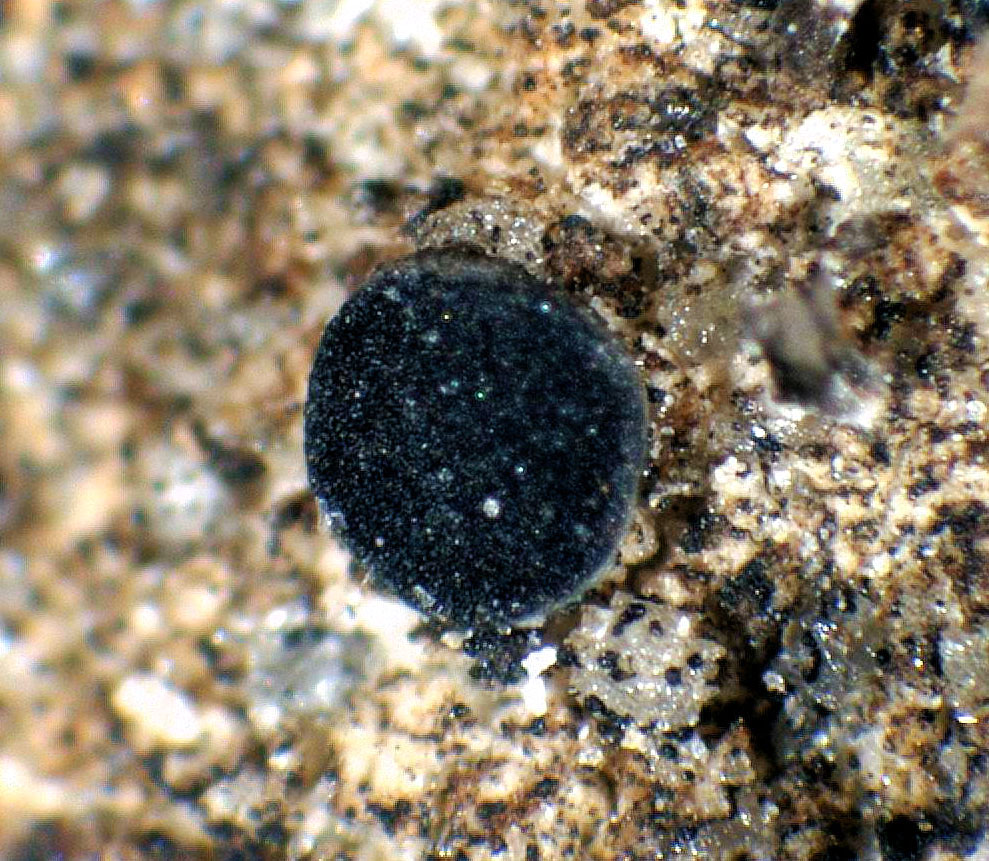
P.L. Nimis CC BY-SA 04
TSB 33968