Umbilicaria meizospora (Harm.) E.A. Davydov & D. Masson
Lichenologist, 54: 3, 2022. Basionym: Umbilicaria hirsuta var. meizospora Harm. - Lich. Fr., 4: 697, 1910 (1909)
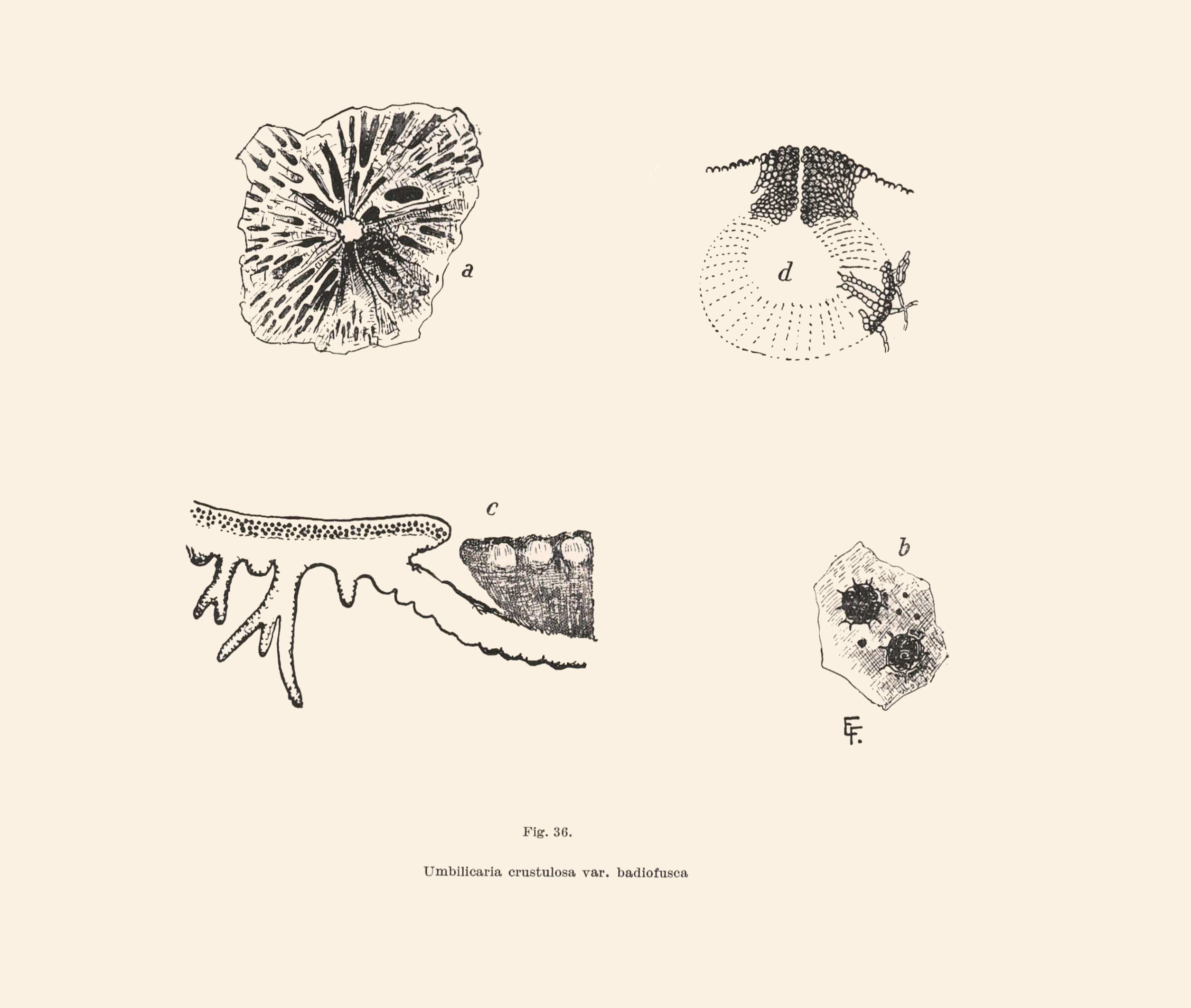
Synonyms: Gyrophora hirsuta var. meizospora (Harm.) H. Olivier; Gyrophoropsis meizospora (Harm.) M. Choisy; Umbilicaria crustulosa subsp. crustulosa var. badiofusca Frey
Description: Thallus foliose-umbilicate, heteromerous, dorsiventral, monophyllous, sometimes deeply dissected and appearing polyphyllous, orbicular in outline, 3-8(-15) cm wide, 0.2-0.4 mm thick, attached by a central holdfast. Upper surface grey with a violet hue, darker toward margins, dull, even or slightly radially wrinkled and distinctly areolate around the umbo, scabrous and rimose at margin, which are often down-turned, and sometimes deeply incised. Lower surface brown-black to black, areolate-papillose toward the margins, trabeculate near the umbilicus, with numerous elongate to wart-like, dark, 1.5–2(–3)mm long rhizinomorphs, which usually are lacking around the umbilicus; thalloconidia absent. Upper cortex c. 30 µm thick; medulla white; lower cortex c. 40 µm thick. Apothecia common, omphalodisc, sessile to sunken in deep depressions of the upper surface, black, to 4(-5) mm across, with a central sterile button, occasionally appearing subgyrose, often separated from thallus by a thin crack. Epithecium brown, 15–30 μm high; hymenium colourless, 75-100 μm high; paraphyses septate, branched, 1.5-1.8 μm thick, the apical cells sometimes slightly swollen; hypothecium pale brown, 25–50 μm high. Asci 8-spored, clavate, thick-walled, with an amyloid apical dome, Umbilicaria-type. Ascospores at first simple and hyaline, then muriform and brown (15-)18-21(-22) x (9-)11-13(-17) µm. Pycnidia numerous in the marginal zone of upper surface, immersed, bottled-shaped, with a dark brown wall and a black ostiole. Conidia bacilliform, c. (3-)4-6 x 0.8-1 µm. Photobiont chlorococcoid. Spot tests: cortex K- C-, KC-, P-; medulla K-, C+ red, KC+ red, P-. Chemistry: medulla with crustinic acid (major), gyrophoric acid (minor), and small amounts of lecanoric and hiascic acids.
Growth form: Foliose, umbilicate
Substrata: rocks
Photobiont: green algae other than Trentepohlia
Reproductive strategy: mainly sexual
Poorly known taxon in need of further study
Commonnes-rarity: (info)
Alpine belt: rare
Subalpine belt: rather rare
Montane belt: absent
Dry submediterranean belt: absent
Humid submediterranean belt: absent
Padanian area: absent
pH of the substrata:
1 2 3 4 5

Solar irradiation:
1 2 3 4 5
Aridity:
1 2 3 4 5
Eutrophication:
1 2 3 4 5
Poleotolerance:
0 1 2 3
Altitudinal distribution:
1 2 3 4 5 6
Rarity
absent
extremely rare
very rare
rare
rather rare
rather common
common
very common
extremely common
Loading data...
Occurrence data
Predictive map
Frey E. 1933. Cladoniaceae (unter Ausschluß ded Gattung Cladonia) und Umbilicariaceae. In: Rabenhrst’s Kryptogamenflora von Deutschland, Österreich und der Schweiz. 15: 1-208.
Growth form: Foliose, umbilicate
Substrata: rocks
Photobiont: green algae other than Trentepohlia
Reproductive strategy: mainly sexual
Poorly known taxon in need of further study
Commonnes-rarity: (info)
Alpine belt: rare
Subalpine belt: rather rare
Montane belt: absent
Dry submediterranean belt: absent
Humid submediterranean belt: absent
Padanian area: absent
pH of the substrata:
| 1 | 2 | 3 | 4 | 5 |
Solar irradiation:
| 1 | 2 | 3 | 4 | 5 |
Aridity:
| 1 | 2 | 3 | 4 | 5 |
Eutrophication:
| 1 | 2 | 3 | 4 | 5 |
Poleotolerance:
| 0 | 1 | 2 | 3 |
Altitudinal distribution:
| 1 | 2 | 3 | 4 | 5 | 6 |
Rarity
absent
extremely rare
very rare
rare
rather rare
rather common
common
very common
extremely common
Loading data...
Occurrence data
Predictive map