Bacidia killiasii (Hepp) D. Hawksw.
Lichenologist, 15: 22, 1983. Basionym: Biatora killiasii Hepp - Jahresber. Naturf. Ges. Graubündens, N.F. 6: 246, 1861.
Synonyms: Bilimbia hypnophila f. killiasii (Hepp) Szatala; Bilimbia killiasii (Hepp) H. Olivier; Mycobilimbia killiasii (Hepp) Rehm
Description: Thallus inapparent, developing inside the thalli of Peltigera-species and staining their surface grey-green, not lichenized. Apothecia biatorine, sessile, reddish yellow to blackish, 0.4-0.7 mm across, with an initially flat, soon convex disc, and a thin, soon excluded proper margin. Epithecium yellowish brown; hymenium colourless; paraphyses simple, coherent, the apical cells slightly thickened; hypothecium pale yellowish brown. Asci 8-spored, clavate to cylindrical-clavate, the apical dome K/I+ dark blue with a pale, conical-pointed apical cushion (axial mass), the wall K/I-, but the thin outer gel K/I+ blue, Bacidia-type. Ascospores (1-)3-5(-7)-septate, hyaline, often curved, 18-40 x 5-8 μm. Photobiont absent. Spot tests: thallus K-, C-, KC-, P-. Chemistry: without lichen substances.
Growth form: Lichenicolous fungus
Substrata: soil, terricolous mosses, and plant debris
Reproductive strategy: mainly sexual
paras Peltigera spp.
Poorly known taxon in need of further study
Commonnes-rarity: (info)
Alpine belt: absent
Subalpine belt: extremely rare
Montane belt: extremely rare
Dry submediterranean belt: extremely rare
Humid submediterranean belt: absent
Padanian area: absent
pH of the substrata:
1 2 3 4 5

Solar irradiation:
1 2 3 4 5
Aridity:
1 2 3 4 5
Eutrophication:
1 2 3 4 5
Poleotolerance:
0 1 2 3
Altitudinal distribution:
1 2 3 4 5 6
Rarity
absent
extremely rare
very rare
rare
rather rare
rather common
common
very common
extremely common
Loading data...
Occurrence data
Predictive map
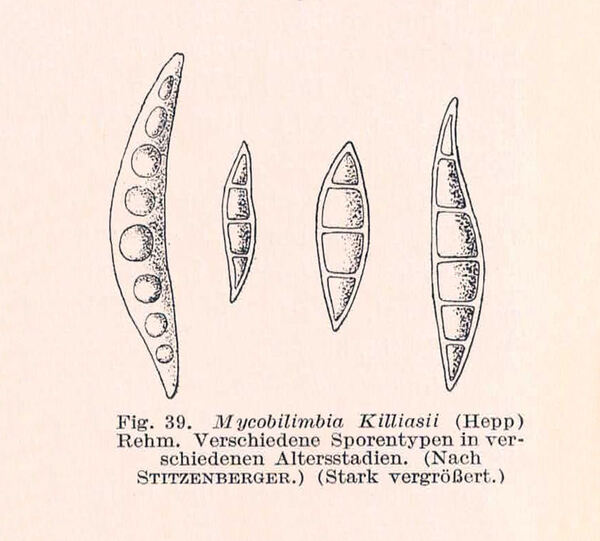
Zschacke, H. (1934) Epigloeaceae, Verrucariaceae und Dermatocarpaceae. In: Dr. L. Rabenhorst‘s Kryptogamen-Flora, Band 9, Abt. 1, Teil 1. Akademische Verlagsgesellschaft, Leipzig, 695 pp. - Public Domain
Growth form: Lichenicolous fungus
Substrata: soil, terricolous mosses, and plant debris
Reproductive strategy: mainly sexual
paras Peltigera spp.
Poorly known taxon in need of further study
Commonnes-rarity: (info)
Alpine belt: absent
Subalpine belt: extremely rare
Montane belt: extremely rare
Dry submediterranean belt: extremely rare
Humid submediterranean belt: absent
Padanian area: absent
pH of the substrata:
| 1 | 2 | 3 | 4 | 5 |
Solar irradiation:
| 1 | 2 | 3 | 4 | 5 |
Aridity:
| 1 | 2 | 3 | 4 | 5 |
Eutrophication:
| 1 | 2 | 3 | 4 | 5 |
Poleotolerance:
| 0 | 1 | 2 | 3 |
Altitudinal distribution:
| 1 | 2 | 3 | 4 | 5 | 6 |
Rarity
absent
extremely rare
very rare
rare
rather rare
rather common
common
very common
extremely common
Loading data...
Occurrence data
Predictive map