Usnea fulvoreagens (Räsänen) Räsänen
Lich. Fenn. Exs.: no. 13, 1935. Basionym: Usnea glabrescens var. fulvoreagens Räsänen - Ann. Acad. Sci. Fenn., A, 34, 4: 20, 1931.
Synonyms:
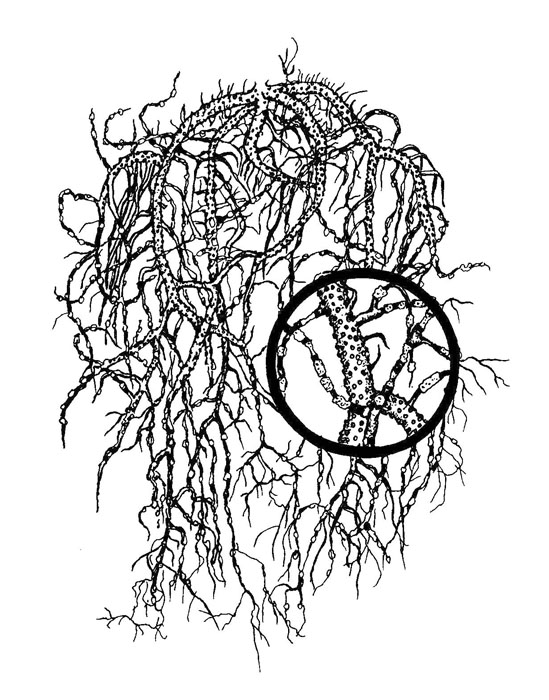
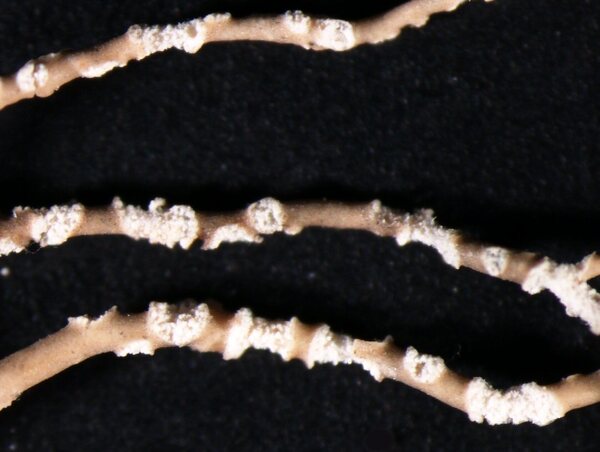
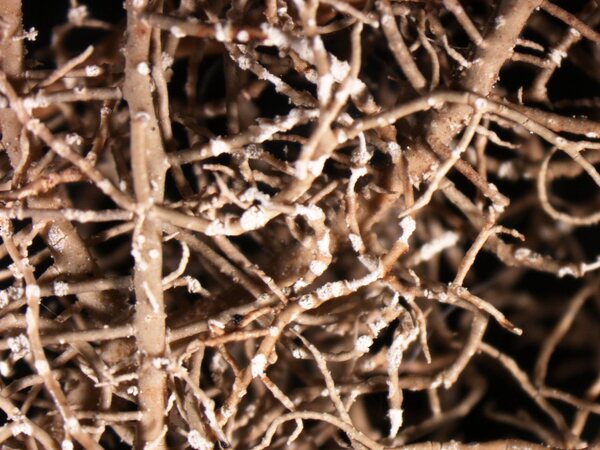
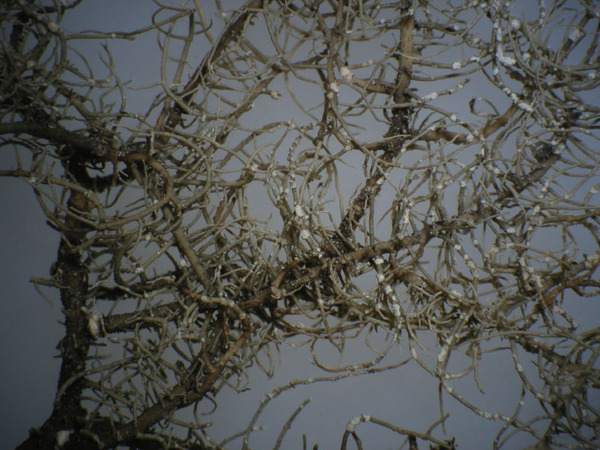
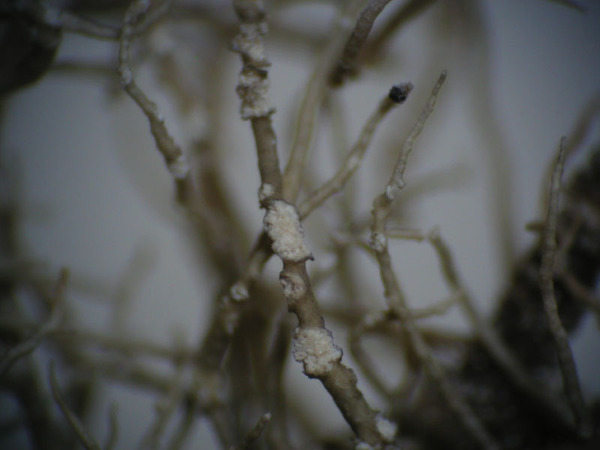
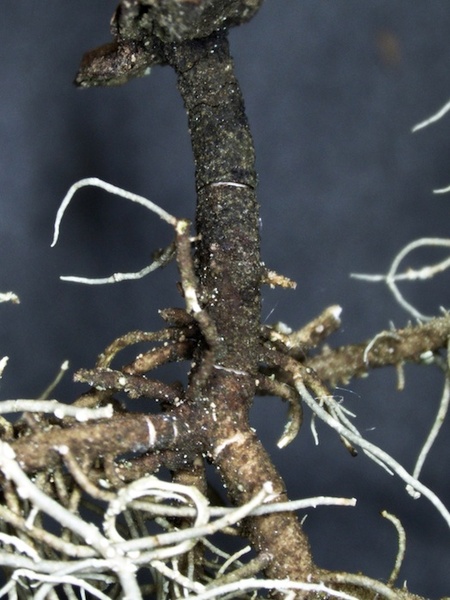
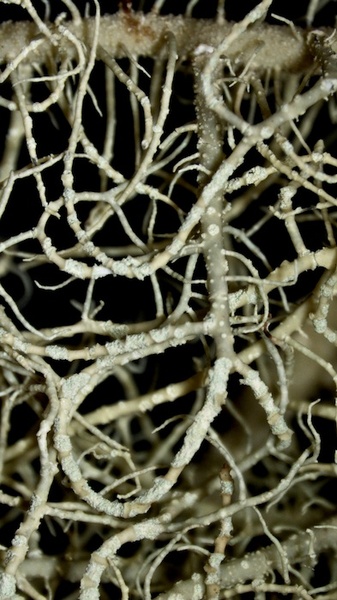
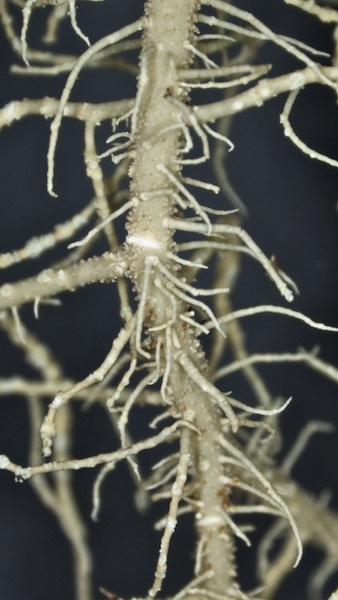
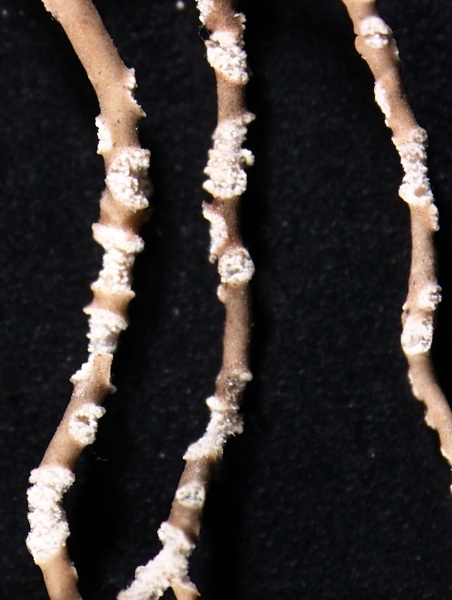
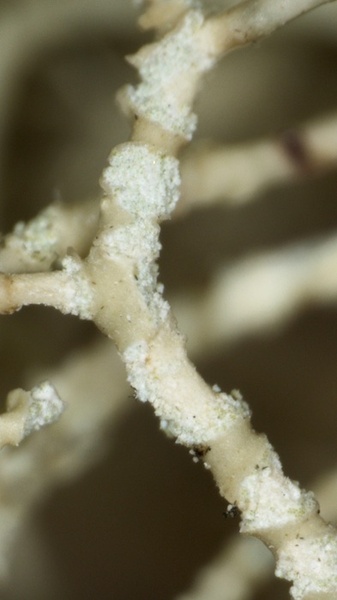
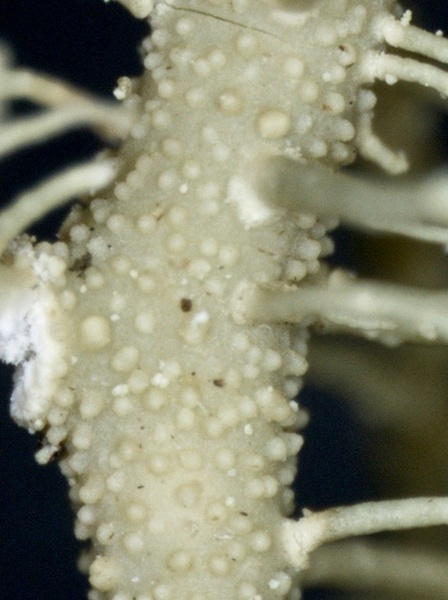
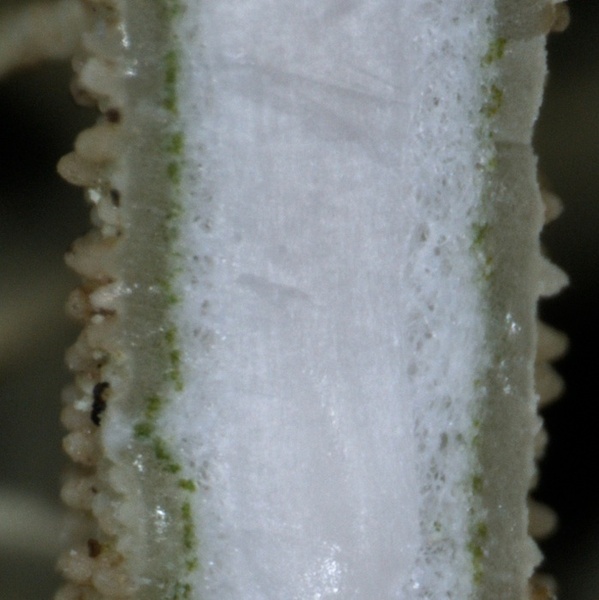
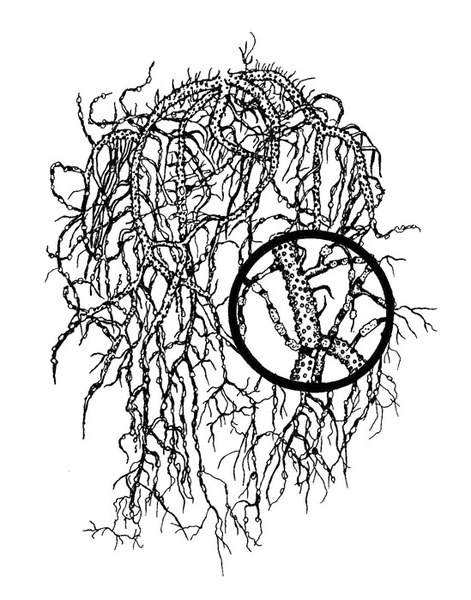
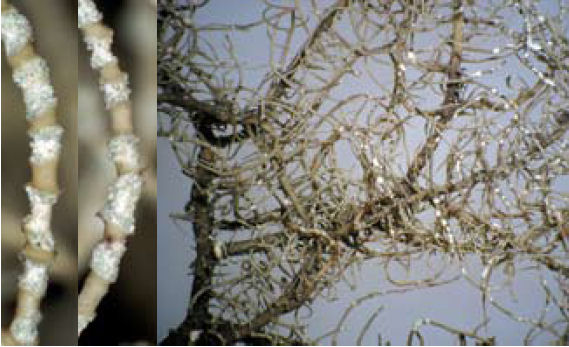
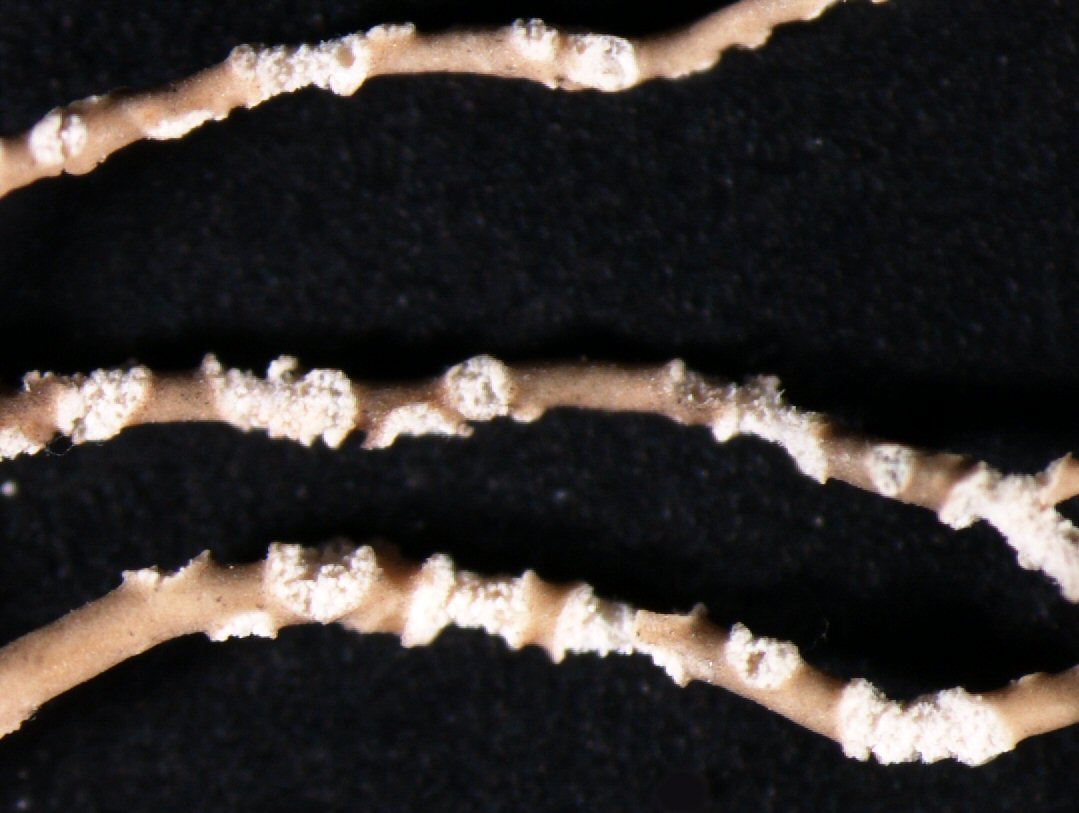
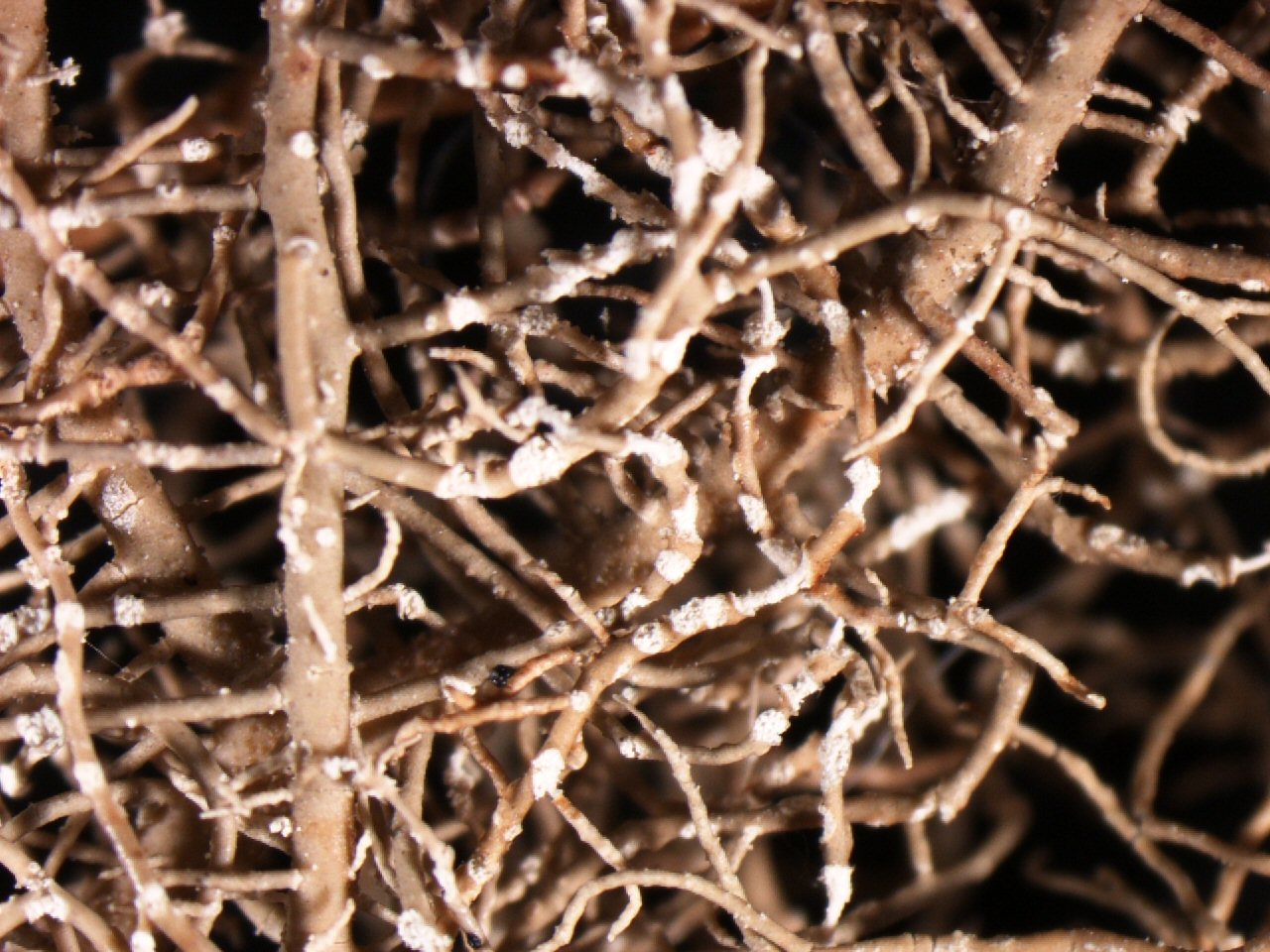
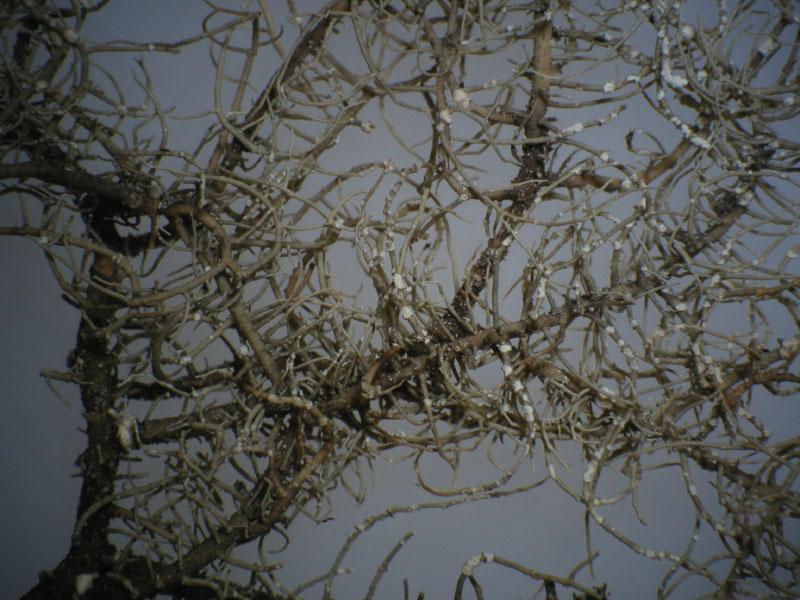
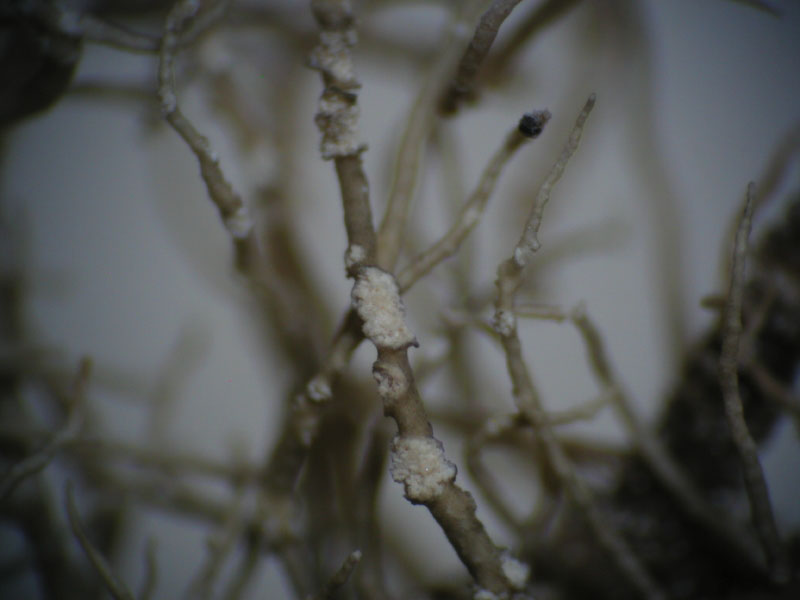
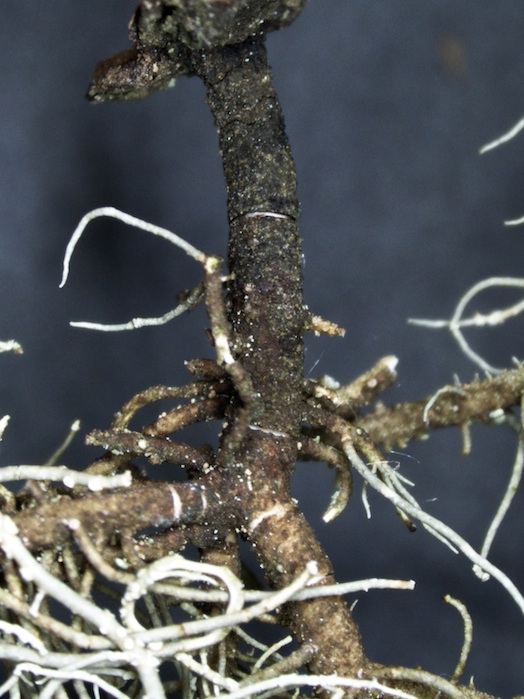
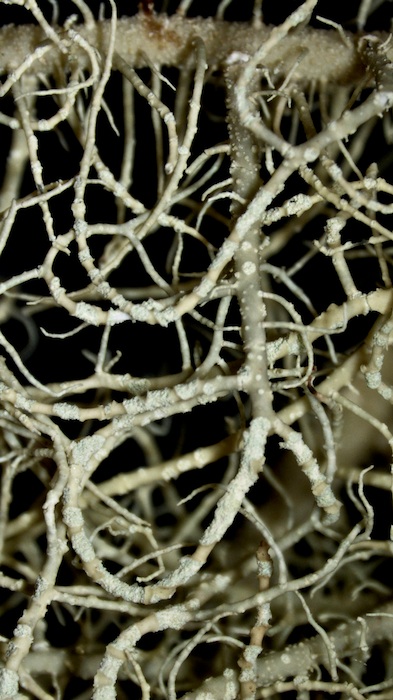
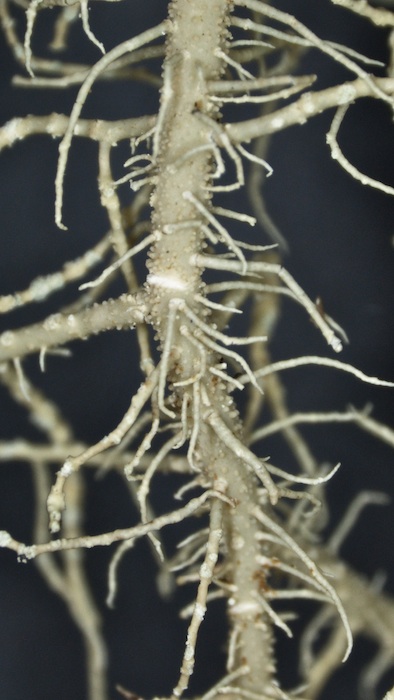
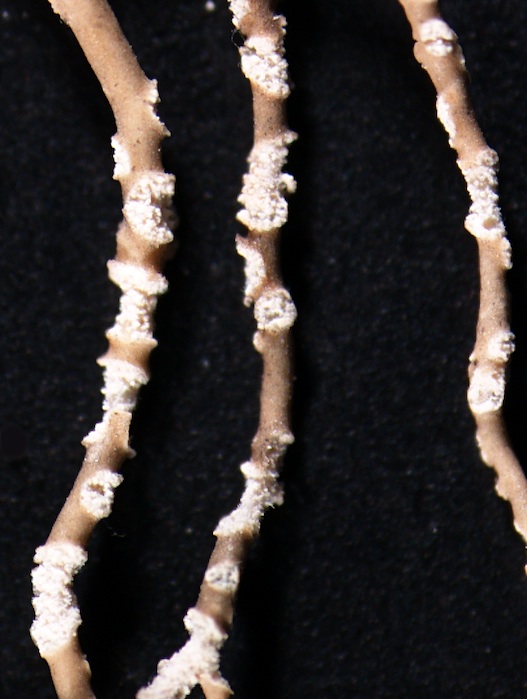
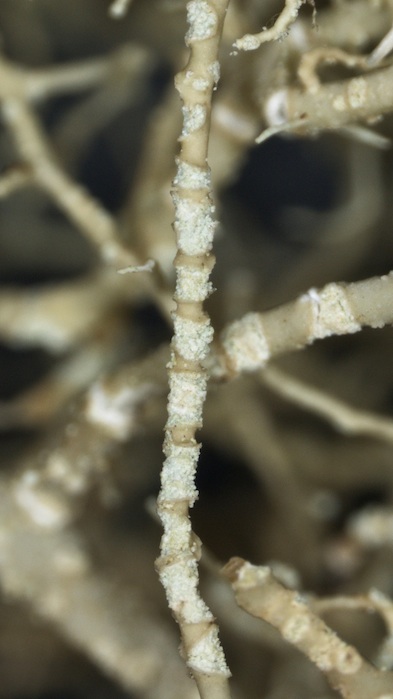
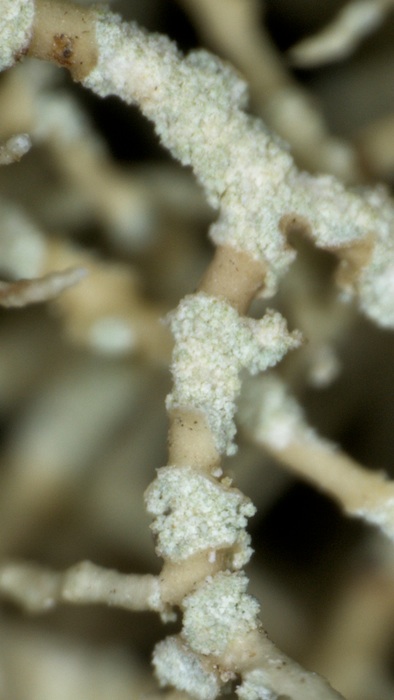
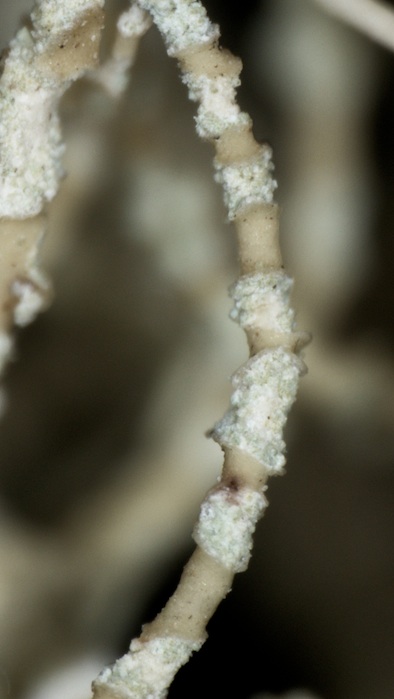
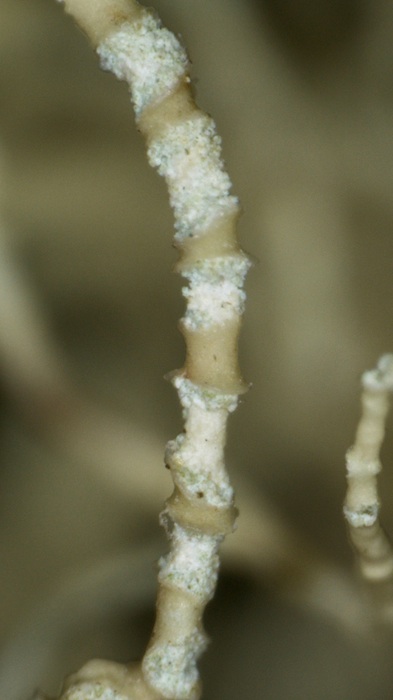
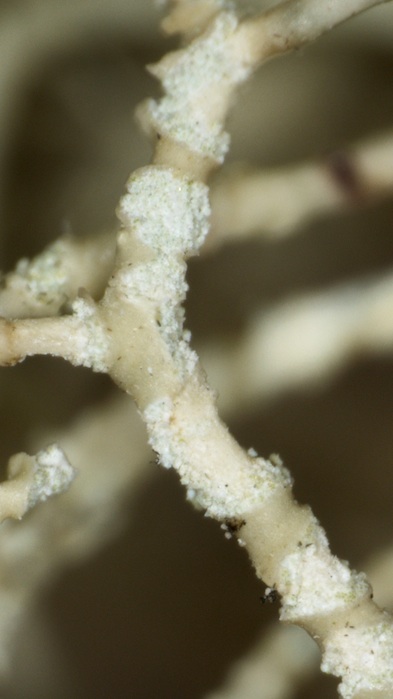
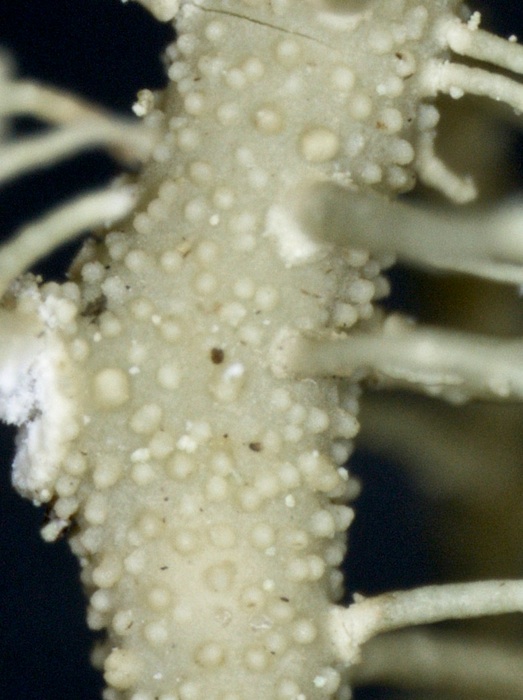
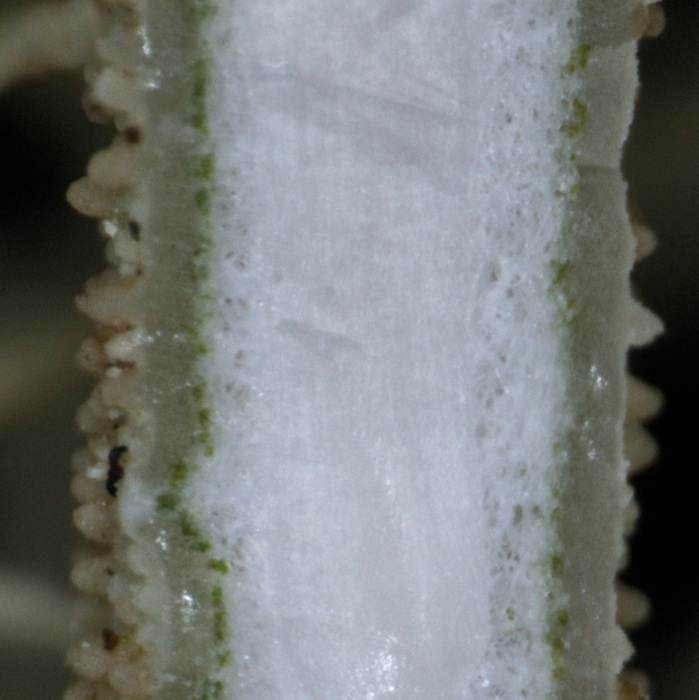
Description: Thallus fruticose-filamentous, greenish, shrubby, branching mainly isotomic-dichotomously with divergent branches, 3-7(-10) cm long. Main branches with many ramifications along their whole length, cylindrical, <1 mm thick (rarely up to 1.5 mm), with conspicuous annular cracks exposing the medulla, not constricted at ramification points, the base black, without longitudinal cracks. Lateral branches not constricted at attachment point. Papillae and tubercles rare to numerous, most frequent on the main branches; fibrils usually numerous, arranged in a fishbone-like pattern, most frequent in the basal parts, 2-4(-10) mm long. Soralia rounded and discrete, deeply excavate, often reaching down to the central axis, occupying more than half the diameter of the branch, originating from the cortex; isidiomorphs always absent. Cortex thick (10-13% of total thickness); medulla homogeneous, loose to compact, thin (12-26%), white; central axis white, rather thick (30-50%). Apothecia usually absent. Photobiont chlorococcoid. Spot tests and chemistry: cortex with usnic acid, K-, C-, KC-, P; medulla with different chemotypes: 1) K+ yellow turning red, P+ yellow to orange, with norstictic and stictic acids, and variable amounts of diffractaic acid, by far the most frequent chemotype; 2) K+ yellow slowly turning orange, P+ deep orange, with norstictic and squamatic acids; 3) K-, P-, without medullary substances. A further chemotype with salazinic and norstictic acid (K+ red, P+ yellow to orange), plus different accessory substances, has been reported from Scandinavia.
Growth form: Fruticose filamentous
Substrata: bark
Photobiont: green algae other than Trentepohlia
Reproductive strategy: mainly asexual, by soredia, or soredia-like structures (e.g. blastidia)
Commonnes-rarity: (info)
Alpine belt: absent
Subalpine belt: rare
Montane belt: very rare
Dry submediterranean belt: absent
Humid submediterranean belt: absent
Padanian area: absent
pH of the substrata:
1 2 3 4 5

Solar irradiation:
1 2 3 4 5
Aridity:
1 2 3 4 5
Eutrophication:
1 2 3 4 5
Poleotolerance:
0 1 2 3
Altitudinal distribution:
1 2 3 4 5 6
Rarity
absent
extremely rare
very rare
rare
rather rare
rather common
common
very common
extremely common
Loading data...
Occurrence data
Predictive map
Tiiu Tõrra; Owner: Tiiu Tõrra - Institute of Ecology and Earth Sciences, University of Tartu, Estonia
Tiiu Tõrra; Owner: University of Tartu
Estonia.
Herbarium: TU (31444)
2007/04/26
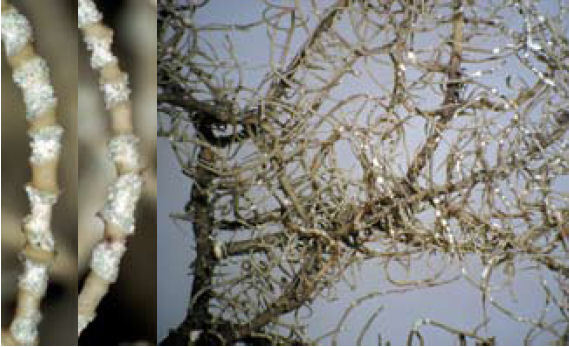
Bracelet-like soralia of U. fulvoreagens
Tiiu Tõrra; Owner: University of Tartu
Estonia.
Herbarium: TU (31444)
2007/04/26
Branches of U. fulvoreagens
Andres Saag; Owner: University of Tartu
Andres Saag; Owner: University of Tartu
Tiiu Tõrra; Owner: Tiiu Tõrra - Institute of Ecology and Earth Sciences, University of Tartu, Estonia
Tiiu Tõrra; Owner: Tiiu Tõrra - Institute of Ecology and Earth Sciences, University of Tartu, Estonia
Tiiu Tõrra; Owner: Tiiu Tõrra - Institute of Ecology and Earth Sciences, University of Tartu, Estonia
Tiiu Tõrra; Owner: Tiiu Tõrra - Institute of Ecology and Earth Sciences, University of Tartu, Estonia
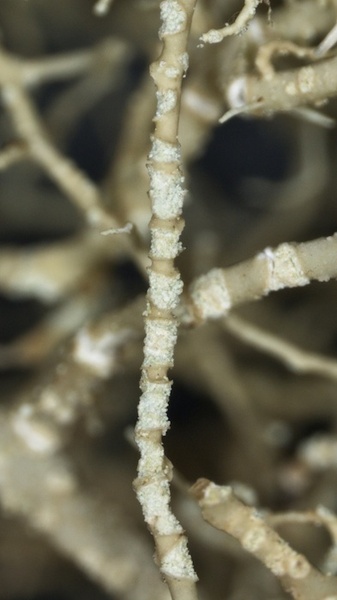
Tiiu Tõrra; Owner: Tiiu Tõrra - Institute of Ecology and Earth Sciences, University of Tartu, Estonia
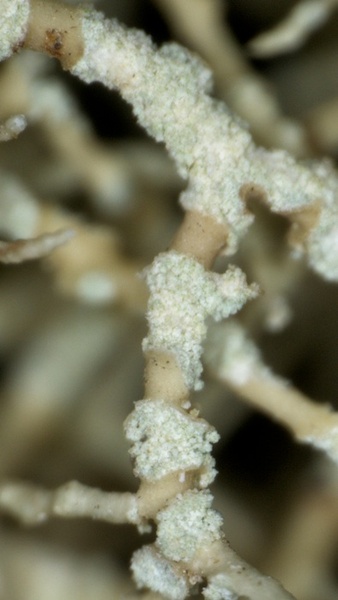
Tiiu Tõrra; Owner: Tiiu Tõrra - Institute of Ecology and Earth Sciences, University of Tartu, Estonia
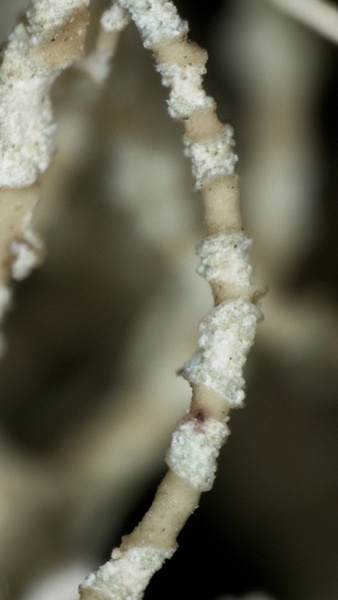
Tiiu Tõrra; Owner: Tiiu Tõrra - Institute of Ecology and Earth Sciences, University of Tartu, Estonia
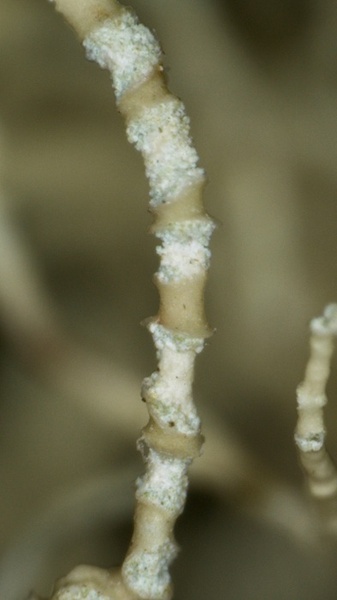
Tiiu Tõrra; Owner: Tiiu Tõrra - Institute of Ecology and Earth Sciences, University of Tartu, Estonia
Tiiu Tõrra; Owner: Tiiu Tõrra - Institute of Ecology and Earth Sciences, University of Tartu, Estonia
Tiiu Tõrra; Owner: Tiiu Tõrra - Institute of Ecology and Earth Sciences, University of Tartu, Estonia
Tiiu Tõrra; Owner: Tiiu Tõrra - Institute of Ecology and Earth Sciences, University of Tartu, Estonia
Triin Aimla; Owner: University of Tartu
Growth form: Fruticose filamentous
Substrata: bark
Photobiont: green algae other than Trentepohlia
Reproductive strategy: mainly asexual, by soredia, or soredia-like structures (e.g. blastidia)
Commonnes-rarity: (info)
Alpine belt: absent
Subalpine belt: rare
Montane belt: very rare
Dry submediterranean belt: absent
Humid submediterranean belt: absent
Padanian area: absent
pH of the substrata:
| 1 | 2 | 3 | 4 | 5 |
Solar irradiation:
| 1 | 2 | 3 | 4 | 5 |
Aridity:
| 1 | 2 | 3 | 4 | 5 |
Eutrophication:
| 1 | 2 | 3 | 4 | 5 |
Poleotolerance:
| 0 | 1 | 2 | 3 |
Altitudinal distribution:
| 1 | 2 | 3 | 4 | 5 | 6 |
Rarity
absent
extremely rare
very rare
rare
rather rare
rather common
common
very common
extremely common
Loading data...
Occurrence data
Predictive map
Tiiu Tõrra; Owner: Tiiu Tõrra - Institute of Ecology and Earth Sciences, University of Tartu, Estonia
Tiiu Tõrra; Owner: University of Tartu
Estonia.
Herbarium: TU (31444)
2007/04/26
Bracelet-like soralia of U. fulvoreagens
Tiiu Tõrra; Owner: University of Tartu
Estonia.
Herbarium: TU (31444)
2007/04/26
Branches of U. fulvoreagens
Andres Saag; Owner: University of Tartu
Andres Saag; Owner: University of Tartu
Tiiu Tõrra; Owner: Tiiu Tõrra - Institute of Ecology and Earth Sciences, University of Tartu, Estonia
Tiiu Tõrra; Owner: Tiiu Tõrra - Institute of Ecology and Earth Sciences, University of Tartu, Estonia
Tiiu Tõrra; Owner: Tiiu Tõrra - Institute of Ecology and Earth Sciences, University of Tartu, Estonia
Tiiu Tõrra; Owner: Tiiu Tõrra - Institute of Ecology and Earth Sciences, University of Tartu, Estonia
Tiiu Tõrra; Owner: Tiiu Tõrra - Institute of Ecology and Earth Sciences, University of Tartu, Estonia
Tiiu Tõrra; Owner: Tiiu Tõrra - Institute of Ecology and Earth Sciences, University of Tartu, Estonia
Tiiu Tõrra; Owner: Tiiu Tõrra - Institute of Ecology and Earth Sciences, University of Tartu, Estonia
Tiiu Tõrra; Owner: Tiiu Tõrra - Institute of Ecology and Earth Sciences, University of Tartu, Estonia
Tiiu Tõrra; Owner: Tiiu Tõrra - Institute of Ecology and Earth Sciences, University of Tartu, Estonia
Tiiu Tõrra; Owner: Tiiu Tõrra - Institute of Ecology and Earth Sciences, University of Tartu, Estonia
Tiiu Tõrra; Owner: Tiiu Tõrra - Institute of Ecology and Earth Sciences, University of Tartu, Estonia