Bacidia notarisiana (A. Massal.) Zahlbr.
Cat. Lich. Univ., 4: 131, 1926. Basionym: Bilimbia notarisiana A. Massal. - Framm. Lichenogr.: 21, 1855.
Synonyms:
Description: Thallus crustose, thinly episubstratic, pale green to grey-green, finely warted-areolate. Apothecia lecideine, 0.2-0.5 mm across, round to irregular in outline, with a flat to convex, epruinose, beige-brown to black, often piebald disc, and a concolorous or darker, often shiny, finally sometimes excluded proper margin. Proper exciple 34-60 μm thick, without crystals, dark red-brown or blackish green, with a mixture of a red-brown (K+ purplish, N+ orange-red) and a sordid green pigment (K+ intensifying green, N+ purple, with the precipitation of blue crystals), consisting of radiating hyphae with thick gelatinous walls, the terminal cells up to 5 μm wide; hymenium 45-65 μm high, colourless in lower part, the upper part with varying amounts of a green pigment often concentrated into vertical streaks; paraphyses abundant, 1.2-1.7 μm thick at mid-level, simple or sparingly branched in upper part, rarely anastomosing, the apical cells to 4.7 μm wide; hypothecium coloured like the exciple, but much paler. Asci 8-spored, clavate to cylindrical-clavate, the apical dome K/I+ dark blue with a pale, conical-pointed apical cushion (axial mass), the wall K/I-, but the thin outer gel K/I+ blue, Bacidia-type. Ascospores 3-septate, hyaline, short-bacilliform to fusiform, straight or slightly curved, 11-19 x 2.5-4 μm. Pycnidia semi-immersed, the wall with a red-brown (K+ purplish, N+ orange-red) pigment around the ostiole. Conidia simple, more or less curved, 8-16 x c. 1 μm, the cells 5-12 μm in diam. Photobiont chlorococcoid. Spot tests: thallus K-, C-, KC-, P-. Chemistry: thallus without lichen substances.
Growth form: Crustose
Substrata: rocks
Photobiont: green algae other than Trentepohlia
Reproductive strategy: mainly sexual
Commonnes-rarity: (info)
Alpine belt: absent
Subalpine belt: absent
Montane belt: absent
Dry submediterranean belt: rare
Humid submediterranean belt: rare
Padanian area: extremely rare
pH of the substrata:
1 2 3 4 5

Solar irradiation:
1 2 3 4 5
Aridity:
1 2 3 4 5
Eutrophication:
1 2 3 4 5
Poleotolerance:
0 1 2 3
Altitudinal distribution:
1 2 3 4 5 6
Rarity
absent
extremely rare
very rare
rare
rather rare
rather common
common
very common
extremely common
Loading data...
Occurrence data
Predictive map
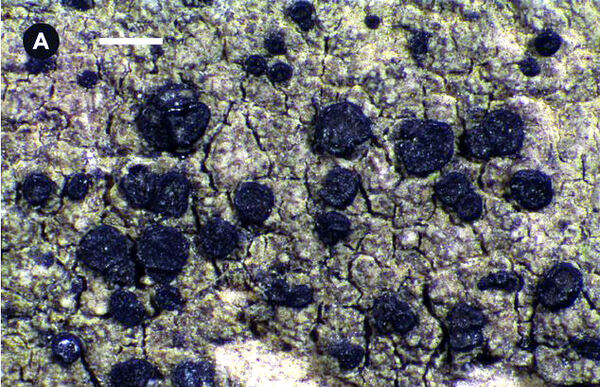
Stefan Ekman Phytotaxa 191(1):66-80, 2014
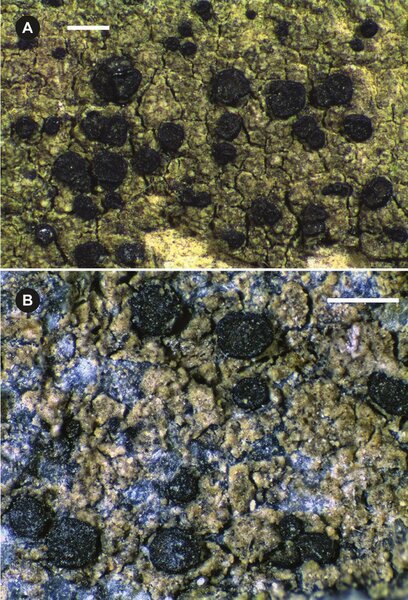
Stefan Ekman - Source:Phytotaxa 191(1):66-80, 2014
Growth form: Crustose
Substrata: rocks
Photobiont: green algae other than Trentepohlia
Reproductive strategy: mainly sexual
Commonnes-rarity: (info)
Alpine belt: absent
Subalpine belt: absent
Montane belt: absent
Dry submediterranean belt: rare
Humid submediterranean belt: rare
Padanian area: extremely rare
pH of the substrata:
| 1 | 2 | 3 | 4 | 5 |
Solar irradiation:
| 1 | 2 | 3 | 4 | 5 |
Aridity:
| 1 | 2 | 3 | 4 | 5 |
Eutrophication:
| 1 | 2 | 3 | 4 | 5 |
Poleotolerance:
| 0 | 1 | 2 | 3 |
Altitudinal distribution:
| 1 | 2 | 3 | 4 | 5 | 6 |
Rarity
absent
extremely rare
very rare
rare
rather rare
rather common
common
very common
extremely common
Loading data...
Occurrence data
Predictive map

Stefan Ekman Phytotaxa 191(1):66-80, 2014