Variospora dalmatica (A. Massal.) Cl. Roux
Bull. Ass. Fr. Lichénologie, 47, 1: 30, 2022. Basionym: Callopisma dalmaticum A. Massal. - Symmicta Lich. Nov. 3031, 1855.
Synonyms: Callopisma aurantiacum var. diffractum A. Massal.; Callopisma aurantiacum var. leucotis A. Massal.; Callopisma aurantiacum var. ochroleucum A. Massal.; Callopisma dalmaticum A. Massal.; Caloplaca aurantiaca var. ochroleuca (A. Massal.) Jatta; Caloplaca velana var. dalmatica (A. Massal.) Clauzade & Cl. Roux; Placodium aurantiacum var. diffractum (A. Massal.) Anzi
Description: Thallus crustose, episubstratic, ochraceous yellow to ochraceous orange, epruinose, smooth and subcontinuous or sometimes finely cracked, usually well-delimited, forming up to 3 cm wide patches. Apothecia frequent, 0.3-0.8(-1) mm across, persistently immersed in the thallus, with an initially flat, then sometimes convex, orange to brownish orange disc and a usually slightly paler, smooth, persistent margin. Epithecium orange, granular, K+ purple-red; hymenium colourless, 50-80 μm high; paraphyses sparingly branched in upper part, the apical cells swollen, up to 4-6 μm wide; hypothecium colourless. Asci 8-spored, clavate, functionally unitunicate, apically thickened with a broad internal beak, the inner part of apex and external cap I+ blue, Teloschistes-type. Ascospores 2-celled, polarilocular, hyaline, ellipsoid to broadly ellipsoid, 9-15 x 5-10 μm, the equatorial thickening (“septum”) 3-5 μm (1/4-1/2 of spore length). Photobiont chlorococcoid. Spot tests: thallus and apothecia K+ purple-red, C-, KC-, P-. Chemistry: thallus and apothecia with parietin (major), fallacinal, emodin, teloschistin and parietinic acid (minor), corresponding with chemosyndrome A of Søchting (1997).
Growth form: Crustose
Substrata: rocks
Photobiont: green algae other than Trentepohlia
Reproductive strategy: mainly sexual
Poorly known taxon in need of further study
Commonnes-rarity: (info)
Alpine belt: rather rare
Subalpine belt: rather common
Montane belt: common
Dry submediterranean belt: very common
Humid submediterranean belt: very common
Padanian area: rare
pH of the substrata:
1 2 3 4 5

Solar irradiation:
1 2 3 4 5
Aridity:
1 2 3 4 5
Eutrophication:
1 2 3 4 5
Poleotolerance:
0 1 2 3
Altitudinal distribution:
1 2 3 4 5 6
Rarity
absent
extremely rare
very rare
rare
rather rare
rather common
common
very common
extremely common
Loading data...
Occurrence data
Predictive map
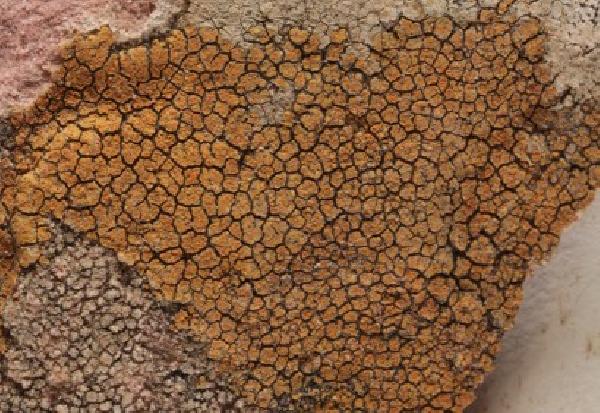
CC BY-NC 4.0 - Fondazione Musei Civici di Venezia - Collezione A. Massalongo Source: https://dryades.units.it/MUVE_Massalongo/it/index.html
Italia, VEN, VR, Tregnago
As Callopisma aurantiacum v. diffractum Massal.
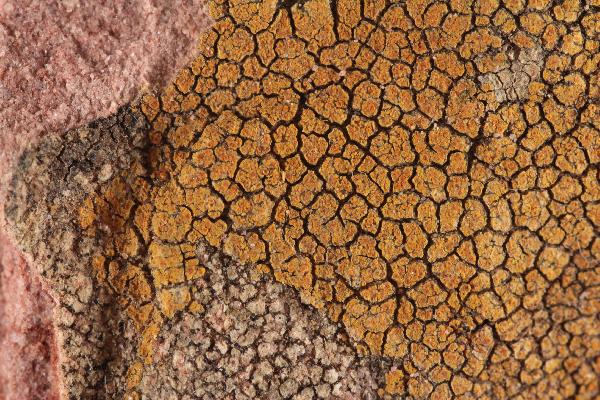
Collezione lichenologica Abramo Massalongo del Museo di Storia Naturale G. Ligabue di Venezia - Autori: Seggi, Linda; Trabucco, Raffaella Proprietà: Fondazione Musei Civici di Venezia - CC BY-NC
Italy, Veneto, in op. Tregnago 1855
ISOTYPE
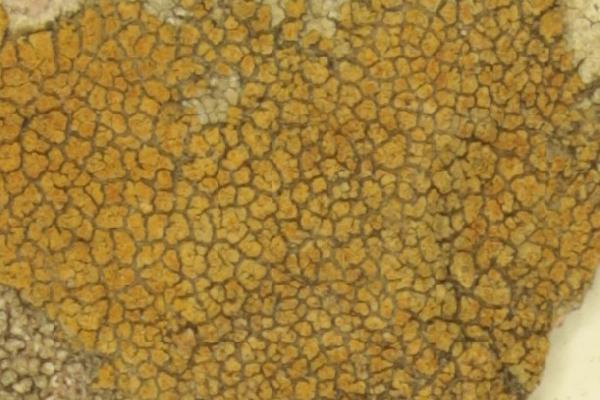
CC BY-NC 4.0 - Fondazione Musei Civici di Venezia - Collezione A. Massalongo Source: https://dryades.units.it/MUVE_Massalongo/it/index.html
Italia, VEN, VR, Tregnago
As Callopisma aurantiacum v. diffractum Massal.
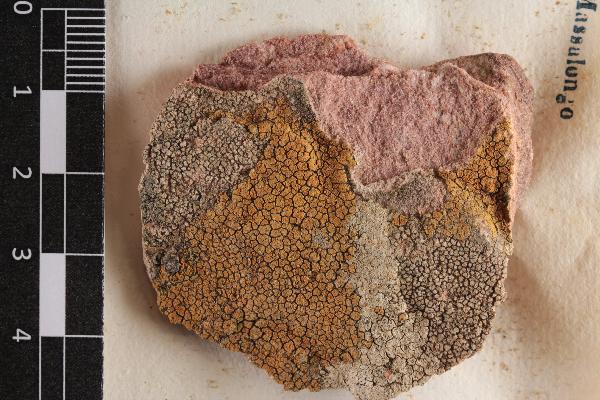
Collezione lichenologica Abramo Massalongo del Museo di Storia Naturale G. Ligabue di Venezia - Autori: Seggi, Linda; Trabucco, Raffaella Proprietà: Fondazione Musei Civici di Venezia - CC BY-NC
Italy, Veneto, in op. Tregnago 1855
ISOTYPE
Growth form: Crustose
Substrata: rocks
Photobiont: green algae other than Trentepohlia
Reproductive strategy: mainly sexual
Poorly known taxon in need of further study
Commonnes-rarity: (info)
Alpine belt: rather rare
Subalpine belt: rather common
Montane belt: common
Dry submediterranean belt: very common
Humid submediterranean belt: very common
Padanian area: rare
pH of the substrata:
| 1 | 2 | 3 | 4 | 5 |
Solar irradiation:
| 1 | 2 | 3 | 4 | 5 |
Aridity:
| 1 | 2 | 3 | 4 | 5 |
Eutrophication:
| 1 | 2 | 3 | 4 | 5 |
Poleotolerance:
| 0 | 1 | 2 | 3 |
Altitudinal distribution:
| 1 | 2 | 3 | 4 | 5 | 6 |
Rarity
absent
extremely rare
very rare
rare
rather rare
rather common
common
very common
extremely common
Loading data...
Occurrence data
Predictive map

CC BY-NC 4.0 - Fondazione Musei Civici di Venezia - Collezione A. Massalongo Source: https://dryades.units.it/MUVE_Massalongo/it/index.html
Italia, VEN, VR, Tregnago
As Callopisma aurantiacum v. diffractum Massal.

Collezione lichenologica Abramo Massalongo del Museo di Storia Naturale G. Ligabue di Venezia - Autori: Seggi, Linda; Trabucco, Raffaella Proprietà: Fondazione Musei Civici di Venezia - CC BY-NC
Italy, Veneto, in op. Tregnago 1855
ISOTYPE

CC BY-NC 4.0 - Fondazione Musei Civici di Venezia - Collezione A. Massalongo Source: https://dryades.units.it/MUVE_Massalongo/it/index.html
Italia, VEN, VR, Tregnago
As Callopisma aurantiacum v. diffractum Massal.