Verrucaria poeltii (Servít) Breuss
Linzer biol. Beitr., 22: 721, 1990. Basionym: Involucrocarpon poeltii Servít in Poelt - Feddes Repert., 58: 168, 1955.
Synonyms:
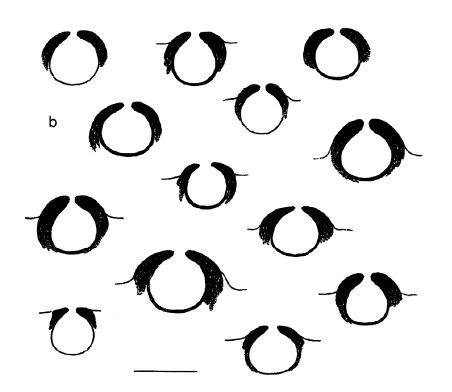
Description: Thallus crustose, episubstratic, rimose-areolate, dark brown when dry, dark olive-brown when wet, 0.2-0.5 mm thick, sharply delimited, often with a black prothallus, forming 5-20 mm wide patches, the areoles 0.2-1 mm wide, polygonal with sharp angles, separated by thin fissures. Cortex 20-35 μm thick, of thick-walled cells with small lumina, without an epinecral layer; algal layer compact, 100-350 μm thick; medulla white, containing rock particles, often blackening near the perithecia, but without a black basal layer. Perithecia black, rather sparse, c. 20/cm², 1-3 per areole, 1/2-3/4 immersed in the thallus, the upper part projecting, conical to hemispherical, 0.3-0.5 mm across, with a narrow ostiole (c. 0.1 mm). Involucrellum appressed to exciple, reaching down 1/2-3/4 of the perithecium, 50-80(-100) μm thick in upper part, becoming progressively thinner downwards: exciple 0.25-0.4(-0.5) mm across, the wall 20-30 μm thick, at first colourless, then soon brown to black; hamathecium of 25-30 μm long periphysoids, interascal filaments absent; hymenial gel hemiamyloid, I+ red (I+ blue at very low concentrations of I), K/I+ blue. Asci 8-spored, clavate, I-, fissitunicate, the wall thickened above, with an ocular chamber, dehiscent by extrusion of an endotunica to form a delicate rostrum, Verrucaria-type. Ascospores 1-celled, hyaline, broadly ellipsoid to globose, (9-)10-13(-14) x 7-9 μm. Pycnidia rare, fully immersed, with a colourless wall, 100-150 μm across. Conidia bacilliform, straight to slightly curved, 6-8 x c. 1 μm. Photobiont chlorococcoid. Spot tests: K-, C-, KC-, P-, UV-. Chemistry: without lichen substances.
Growth form: Crustose
Substrata: rocks
Photobiont: green algae other than Trentepohlia
Reproductive strategy: mainly sexual
Commonnes-rarity: (info)
Alpine belt: very rare
Subalpine belt: very rare
Montane belt: absent
Dry submediterranean belt: absent
Humid submediterranean belt: absent
Padanian area: absent
pH of the substrata:
1 2 3 4 5

Solar irradiation:
1 2 3 4 5
Aridity:
1 2 3 4 5
Eutrophication:
1 2 3 4 5
Poleotolerance:
0 1 2 3
Altitudinal distribution:
1 2 3 4 5 6
Rarity
absent
extremely rare
very rare
rare
rather rare
rather common
common
very common
extremely common
Loading data...
Occurrence data
Predictive map
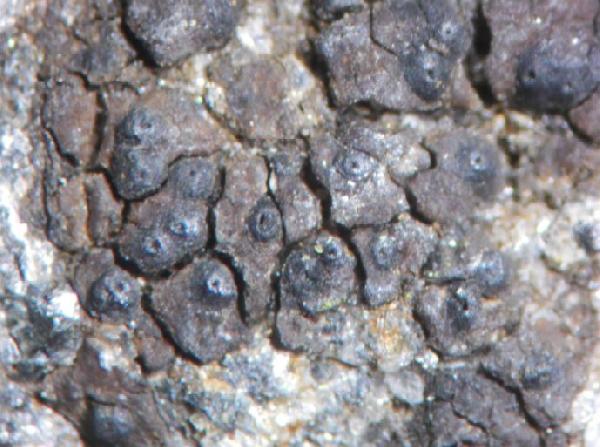
O. Breuss - Source: BREUSS, O., 2022: Bemerkenswerte Flechtenfunde aus Österreich. – Österr. Z. Pilzk. 30: 11–21.
TÜRK 50.571. Bildbreite 5 mm.
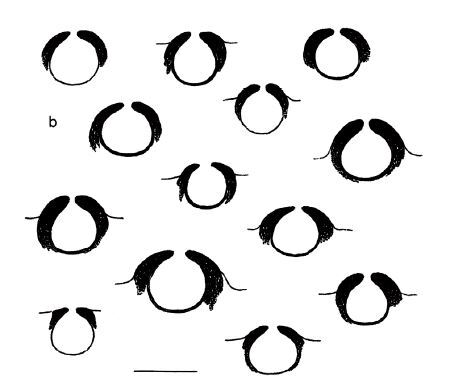
Source: • Breuss O., Berger F. 2012. Die Validierung von Verrucaria finitima und Bemerkungen über den Formenkreis von Verrucaria tristis (lichenisierte Ascomyceten, Verrucariaceae). Öst. Z. Pilzk., 21: 117-126.
Growth form: Crustose
Substrata: rocks
Photobiont: green algae other than Trentepohlia
Reproductive strategy: mainly sexual
Commonnes-rarity: (info)
Alpine belt: very rare
Subalpine belt: very rare
Montane belt: absent
Dry submediterranean belt: absent
Humid submediterranean belt: absent
Padanian area: absent
pH of the substrata:
| 1 | 2 | 3 | 4 | 5 |
Solar irradiation:
| 1 | 2 | 3 | 4 | 5 |
Aridity:
| 1 | 2 | 3 | 4 | 5 |
Eutrophication:
| 1 | 2 | 3 | 4 | 5 |
Poleotolerance:
| 0 | 1 | 2 | 3 |
Altitudinal distribution:
| 1 | 2 | 3 | 4 | 5 | 6 |
Rarity
absent
extremely rare
very rare
rare
rather rare
rather common
common
very common
extremely common
Loading data...
Occurrence data
Predictive map
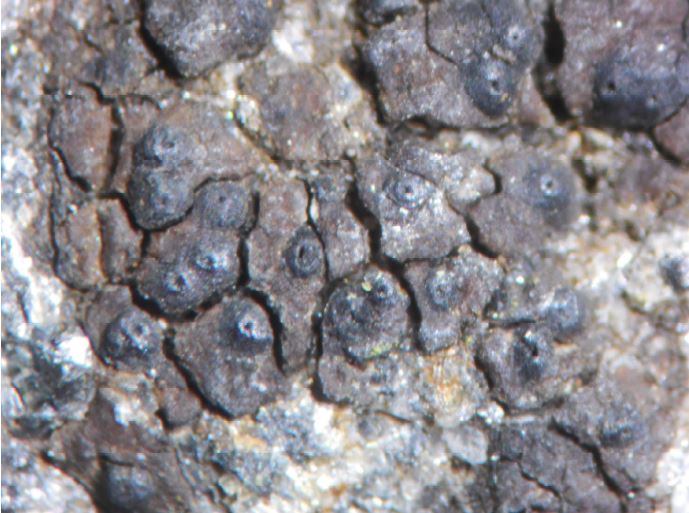
O. Breuss - Source: BREUSS, O., 2022: Bemerkenswerte Flechtenfunde aus Österreich. – Österr. Z. Pilzk. 30: 11–21.
TÜRK 50.571. Bildbreite 5 mm.