Verrucaria ruderum DC.
in Lamarck & de Candolle, Fl. Franç., 3 éd., 2: 318, 1805.
Synonyms: Amphoridium ruderum (DC.) Servít
Description: Thallus crustose, thinly episubstratic, rimose-areolate, whitish to pale grey. Perithecia black, almost completely immersed in the thallus, the apical part visible as an hemispherical, up to 0.2 mm wide projection. Involucrellum black, limited to the region around the ostiole, appressed to exciple; exciple pear-shaped, up to 0.25 mm across, the wall dark brown in upper part, pale brown to colourless in lower part; hamathecium of periphysoids, interascal filaments absent; hymenial gel hemiamyloid, I+ red (I+ blue at very low concentrations of I), K/I+ blue. Asci 8-spored, clavate, I-, fissitunicate, the wall thickened above, with an ocular chamber, dehiscent by extrusion of an endotunica to form a delicate rostrum, Verrucaria-type, c. 120 x 30 μm. Ascospores 1-celled, hyaline, ellipsoid, 23-30(-34) x 13-18(-23) μm. Photobiont chlorococcoid. Spot tests: K-, C-, KC-, P-, UV-. Chemistry: without lichen substances.
Growth form: Crustose
Substrata: rocks
Photobiont: green algae other than Trentepohlia
Reproductive strategy: mainly sexual
Most common in areas with a humid-warm climate (e.g. most of Tyrrenian Italy)
Poorly known taxon in need of further study
Commonnes-rarity: (info)
Alpine belt: absent
Subalpine belt: absent
Montane belt: very rare
Dry submediterranean belt: rather rare
Humid submediterranean belt: rather rare
Padanian area: extremely rare
pH of the substrata:
1 2 3 4 5

Solar irradiation:
1 2 3 4 5
Aridity:
1 2 3 4 5
Eutrophication:
1 2 3 4 5
Poleotolerance:
0 1 2 3
Altitudinal distribution:
1 2 3 4 5 6
Rarity
absent
extremely rare
very rare
rare
rather rare
rather common
common
very common
extremely common
Loading data...
Occurrence data
Predictive map
Source: Nascimbene & al. 2023
Italy, Sardiniia
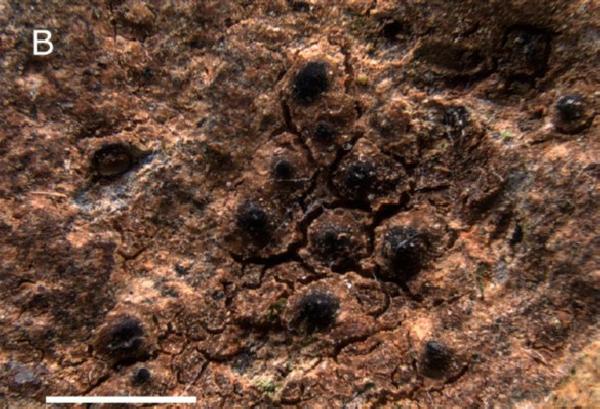
Verrucaria ruderum from Sardinia BOLO-Herb. Nascimbene 4375. (B) Outer morphology. Scale bar = 100 µm
Source: Nascimbene & al. 2023
Italy, Sardinia
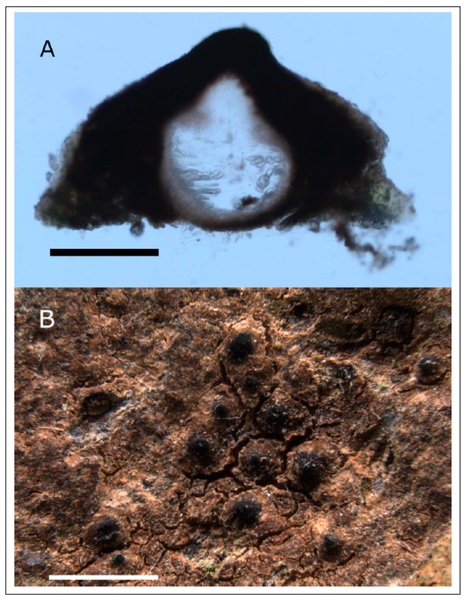
Verrucaria ruderum from Sardinia BOLO-Herb. Nascimbene 4375. (A) Section of a perithecium with elongated ostiolum and surrounding thallus. (B) Outer morphology. Scale bars in (A) = 1 mm, in (B) = 100 µm.
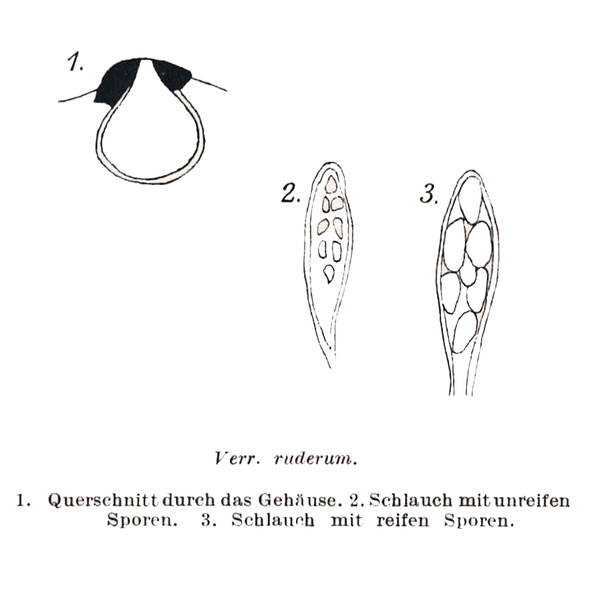
Zschacke, H. (1934) Epigloeaceae, Verrucariaceae und Dermatocarpaceae. In: Dr. L. Rabenhorst‘s Kryptogamen-Flora, Band 9, Abt. 1, Teil 1. Akademische Verlagsgesellschaft, Leipzig, 695 pp. - Public Domain
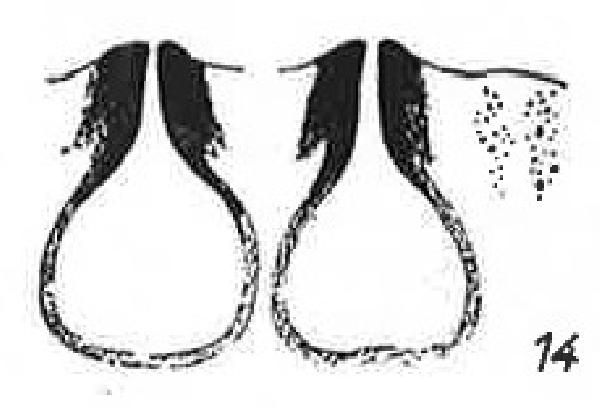
Source: Servít M. 1954a. Lichenes familiae Verrucariacearum. Prag, 249 pp.
as Amphoridium ruderum
Growth form: Crustose
Substrata: rocks
Photobiont: green algae other than Trentepohlia
Reproductive strategy: mainly sexual
Most common in areas with a humid-warm climate (e.g. most of Tyrrenian Italy)
Poorly known taxon in need of further study
Commonnes-rarity: (info)
Alpine belt: absent
Subalpine belt: absent
Montane belt: very rare
Dry submediterranean belt: rather rare
Humid submediterranean belt: rather rare
Padanian area: extremely rare
pH of the substrata:
| 1 | 2 | 3 | 4 | 5 |
Solar irradiation:
| 1 | 2 | 3 | 4 | 5 |
Aridity:
| 1 | 2 | 3 | 4 | 5 |
Eutrophication:
| 1 | 2 | 3 | 4 | 5 |
Poleotolerance:
| 0 | 1 | 2 | 3 |
Altitudinal distribution:
| 1 | 2 | 3 | 4 | 5 | 6 |
Rarity
absent
extremely rare
very rare
rare
rather rare
rather common
common
very common
extremely common
Loading data...
Occurrence data
Predictive map

Source: Nascimbene & al. 2023
Italy, Sardiniia
Verrucaria ruderum from Sardinia BOLO-Herb. Nascimbene 4375. (B) Outer morphology. Scale bar = 100 µm
Source: Nascimbene & al. 2023
Italy, Sardinia
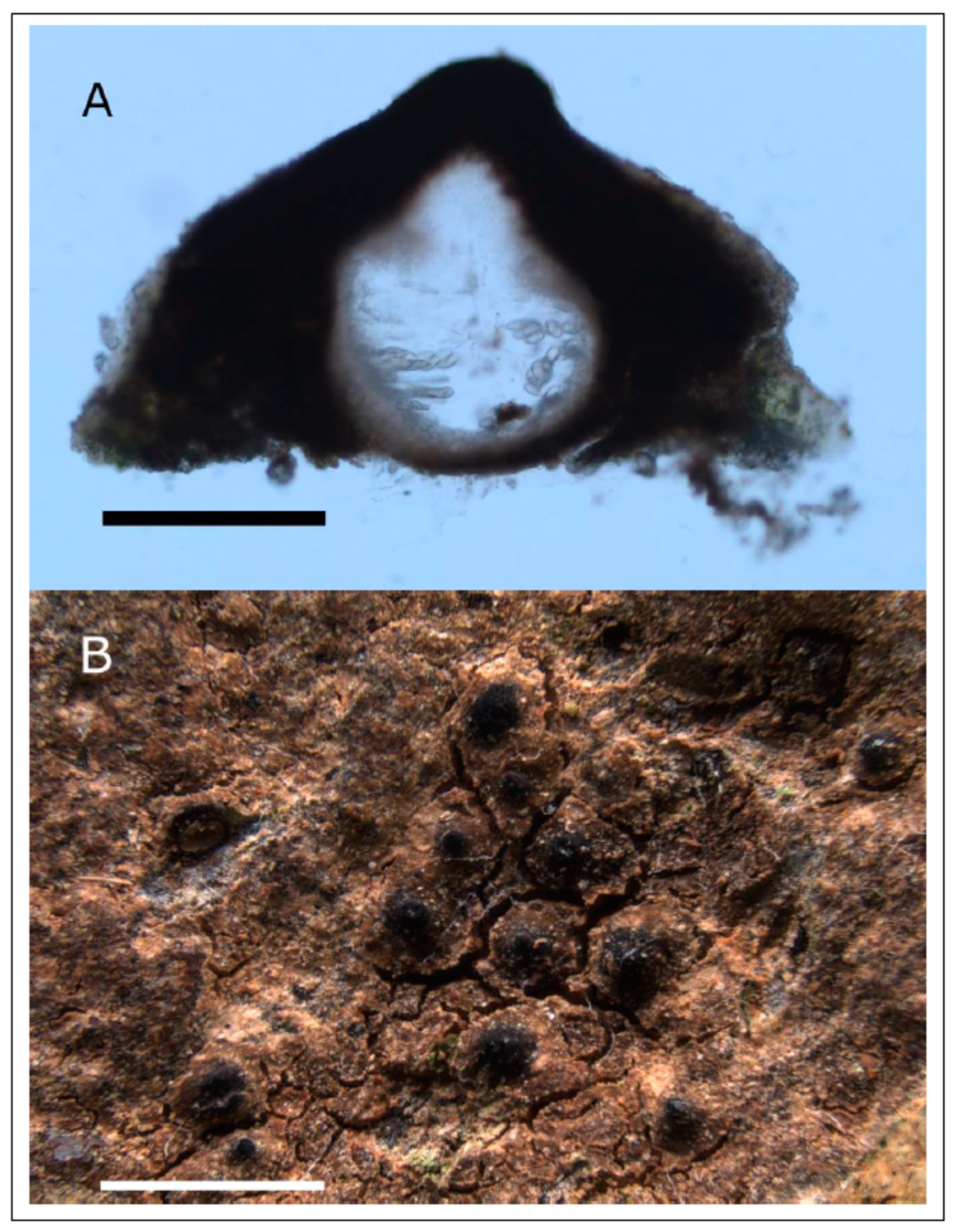
Verrucaria ruderum from Sardinia BOLO-Herb. Nascimbene 4375. (A) Section of a perithecium with elongated ostiolum and surrounding thallus. (B) Outer morphology. Scale bars in (A) = 1 mm, in (B) = 100 µm.
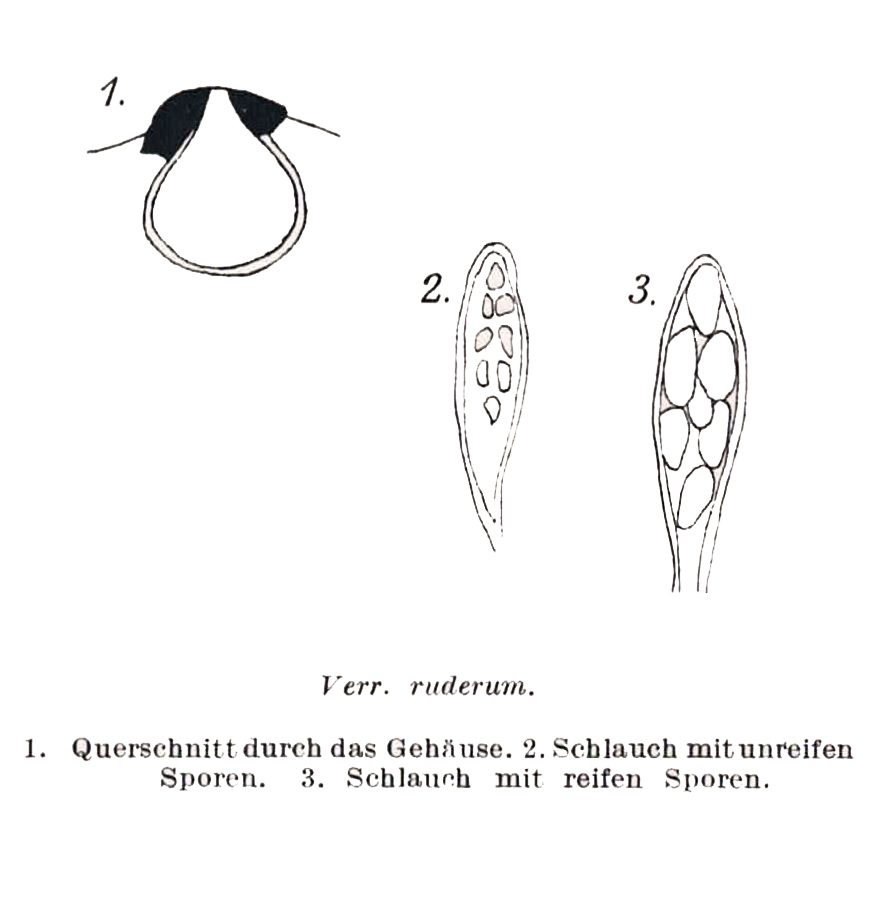
Zschacke, H. (1934) Epigloeaceae, Verrucariaceae und Dermatocarpaceae. In: Dr. L. Rabenhorst‘s Kryptogamen-Flora, Band 9, Abt. 1, Teil 1. Akademische Verlagsgesellschaft, Leipzig, 695 pp. - Public Domain