Xylographa pallens (Nyl.) Malmgren
Not. Sällsk. Fauna Fl. Fenn. Förh., Ny Ser. 6: 84, 1861. Basionym: Xylographa parallela var. pallens Nyl. - Act. Soc. Linn. Bordeaux, 21: 393, 1857.
Synonyms:
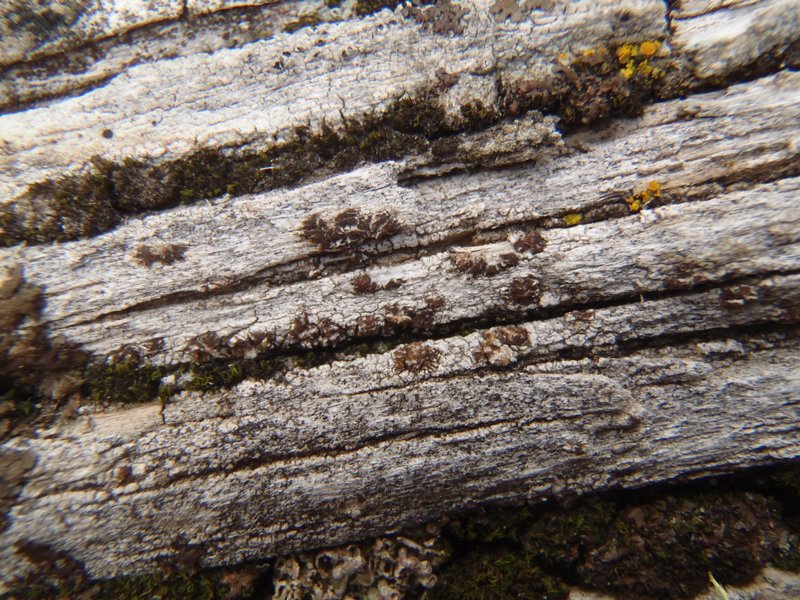
Description: Thallus thin, of small, lens-like areoles, sometimes appearing rimose, scurfy, or granular, with 35-90 μm wide, corticate goniocysts. Apothecia linear, 0.5-2.8 x 0.09-0.33 mm, growing linearly in two to many directions, forming star-shaped clusters, with a flat to concave, pale to dark brown, matt disc, and a thin, brownish, finally excluded proper margin. Exciple of laterally interwoven hyphae, appearing paraplectenchymatous in vertical sections, 15-35(-50) μm wide, brown in outer part, colourless within; hymenium colourless to brown, 40-120 μm high, hemiamyloid, I+ blue-green turning rust-red; paraphyses slender, branched and anastomosing, 1.5-2 μm thick at mid-level, the apical cells 4-6 μm thick, continuing laterally in knot-like tangles over surface of disc, with brown wall pigments; hypothecium colourless, 80-140(-200) μm high. Asci 8-spored, clavate-cylindrical, unitunicate, the gelatinous sheaths covering the walls amyloid, the tholus lacking internal amyloid structures, similar to that in Trapelia. Ascospores 1-celled, hyaline, ellipsoid, (10-)12-16(-18.5) x 5-7.5(-10) μm. Pycnidia rare, formed in lines at the periphery of individual thalli, globular to cupular. Conidia filiform, curved, (10-)12–13(-18.5) x c. 0.5 μm. Photobiont chlorococcoid. Spot tests: thallus K+ yellowish (microscopic section!), C-, KC-, P+ yellow. Chemistry: stictic acid (major), norstictic acid (usually trace, rarely major), often with an unidentified fatty acid (trace).
Growth form: Crustose
Substrata: lignum
Photobiont: green algae other than Trentepohlia
Reproductive strategy: mainly sexual
Commonnes-rarity: (info)
Alpine belt: absent
Subalpine belt: rare
Montane belt: rare
Dry submediterranean belt: absent
Humid submediterranean belt: absent
Padanian area: absent
pH of the substrata:
1 2 3 4 5

Solar irradiation:
1 2 3 4 5
Aridity:
1 2 3 4 5
Eutrophication:
1 2 3 4 5
Poleotolerance:
0 1 2 3
Altitudinal distribution:
1 2 3 4 5 6
Rarity
absent
extremely rare
very rare
rare
rather rare
rather common
common
very common
extremely common
Loading data...
Occurrence data
Predictive map
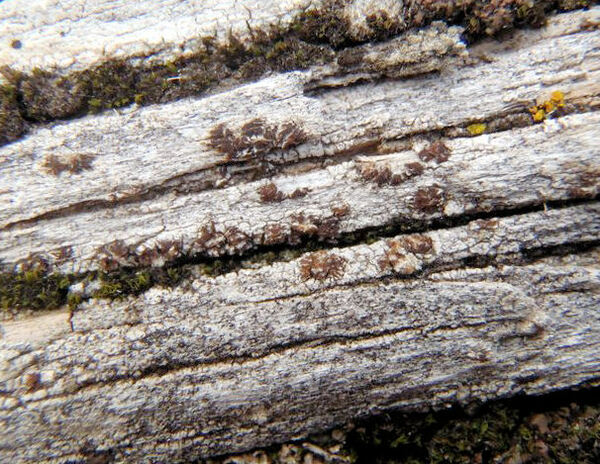
Curtis Randall Björk CC BY-SA 4.0
Idaho, Custer County, Red Hills. Lignicolous on Pseudotsuga logs in Juniperus-Pseudotsuga grove in high-elevation sagebrush steppe
2012-05-09
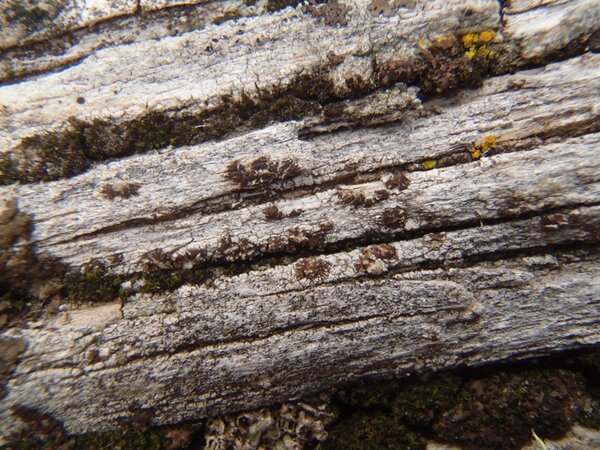
Curtis Randall Björk – CC BY-SA 4.0
Idaho, Custer County, Red Hills. Lignicolous on Pseudotsuga logs in Juniperus-Pseudotsuga grove in high-elevation sagebrush steppe 2012-05-09
Growth form: Crustose
Substrata: lignum
Photobiont: green algae other than Trentepohlia
Reproductive strategy: mainly sexual
Commonnes-rarity: (info)
Alpine belt: absent
Subalpine belt: rare
Montane belt: rare
Dry submediterranean belt: absent
Humid submediterranean belt: absent
Padanian area: absent
pH of the substrata:
| 1 | 2 | 3 | 4 | 5 |
Solar irradiation:
| 1 | 2 | 3 | 4 | 5 |
Aridity:
| 1 | 2 | 3 | 4 | 5 |
Eutrophication:
| 1 | 2 | 3 | 4 | 5 |
Poleotolerance:
| 0 | 1 | 2 | 3 |
Altitudinal distribution:
| 1 | 2 | 3 | 4 | 5 | 6 |
Rarity
absent
extremely rare
very rare
rare
rather rare
rather common
common
very common
extremely common
Loading data...
Occurrence data
Predictive map
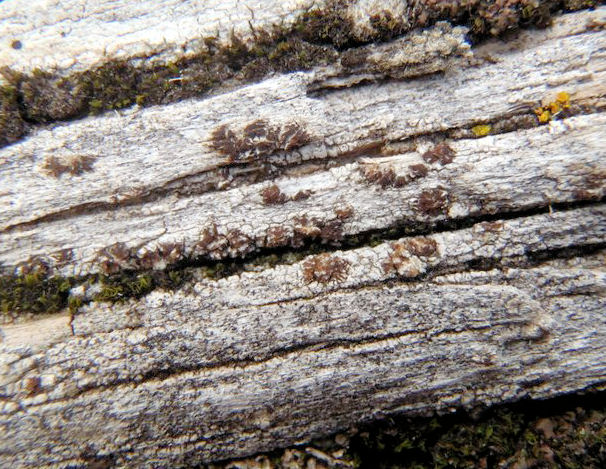
Curtis Randall Björk CC BY-SA 4.0
Idaho, Custer County, Red Hills. Lignicolous on Pseudotsuga logs in Juniperus-Pseudotsuga grove in high-elevation sagebrush steppe
2012-05-09