Chaenothecopsis viridireagens (Nádv.) A.F.W. Schmidt
Mitt. Staatsinst. allg. Bot. Hamburg, 13: 153, 1970. Basionym: Calicium viridireagens Nádv. - Preslia, 18/19: 129, 1940.
Synonyms:
Description: Thallus not evident, not lichenized. Apothecia long-stalked, pin-like, 0.5-1.4 mm high, the stalk 0.04-0.07 mm thick, black, sometimes with a reddish tinge in upper part, the central part of hyaline, strongly swollen, periclinally arranged hyphae, the outer part of reddish brown, intricately interwoven hyphae, often containing droplets of a red pigment. Capitulum black or with a reddish tinge in lower part, hemi- to subspherical, 0.1-0.3 mm across; mazaedium absent. Exciple of reddish brown hyphae; epithecium brownish, thin; hypothecium reddish to yellowish brown, with dark red granules and numerous oil droplets. Asci 8-spored, cylindrical, with a thickened apex penetrated by a narrow canal, formed singly, persisting until the spores are mature. Ascospores 1-septate, pale brown, narrowly ellipsoid, 5-7 x 1.5-2.5 µm, with a poorly pigmented septum and a smooth wall. Pycnidia not rare, stalked, the stalk often branched and forming a tree-like structure with up to 30 pycnidia containing a reddish pigment. Conidia simple, hyaline, with a slightly truncate proximal end, 2-2.5 x c. 1 µm. Photobiont absent. Spot tests: all red-pigmented parts of thee ascomata and pycnidia K+ persistently green. Chemistry: an unidentified red pigment.
Growth form: Lichenicolous fungus
Reproductive strategy: mainly sexual
In underhangs rarely wetted by rain
paras Chaenotheca and Calicium spp.?
Commonnes-rarity: (info)
Alpine belt: absent
Subalpine belt: extremely rare
Montane belt: very rare
Dry submediterranean belt: absent
Humid submediterranean belt: absent
Padanian area: absent
pH of the substrata:
1 2 3 4 5

Solar irradiation:
1 2 3 4 5
Aridity:
1 2 3 4 5
Eutrophication:
1 2 3 4 5
Poleotolerance:
0 1 2 3
Altitudinal distribution:
1 2 3 4 5 6
Rarity
absent
extremely rare
very rare
rare
rather rare
rather common
common
very common
extremely common
Loading data...
Occurrence data
Predictive map
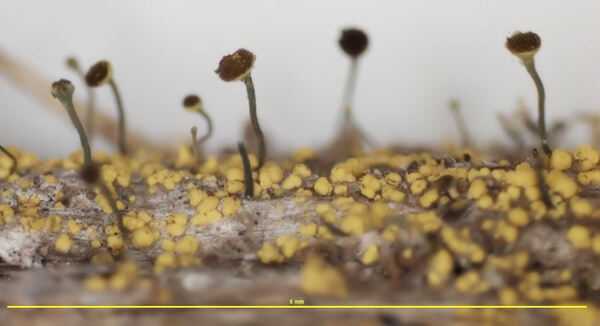
United States National Herbarium - Smithsonian – CC BY-SA NC 3.0
Growth form: Lichenicolous fungus
Reproductive strategy: mainly sexual
In underhangs rarely wetted by rain
paras Chaenotheca and Calicium spp.?
Commonnes-rarity: (info)
Alpine belt: absent
Subalpine belt: extremely rare
Montane belt: very rare
Dry submediterranean belt: absent
Humid submediterranean belt: absent
Padanian area: absent
pH of the substrata:
| 1 | 2 | 3 | 4 | 5 |
Solar irradiation:
| 1 | 2 | 3 | 4 | 5 |
Aridity:
| 1 | 2 | 3 | 4 | 5 |
Eutrophication:
| 1 | 2 | 3 | 4 | 5 |
Poleotolerance:
| 0 | 1 | 2 | 3 |
Altitudinal distribution:
| 1 | 2 | 3 | 4 | 5 | 6 |
Rarity
absent
extremely rare
very rare
rare
rather rare
rather common
common
very common
extremely common
Loading data...
Occurrence data
Predictive map