Lecanora dispersoareolata (Schaer.) Lamy
Bull. Soc. Bot. France, 30: 370, 1883. Basionym: Lecanora muralis var. dispersoareolata Schaer. - Lich. Helv. Spicil., 9: 418, 1840.
Synonyms: Placodium dispersoareolatum (Schaer.) Körb.; Protoparmeliopsis dispersoareolata (Schaer.) S.Y. Kondr.; Squamaria dispersoareolata (Schaer.) Anzi
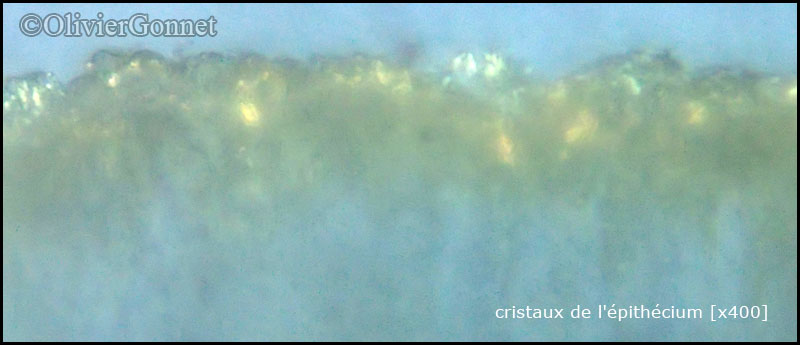
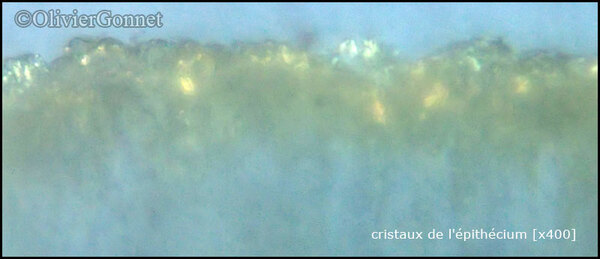
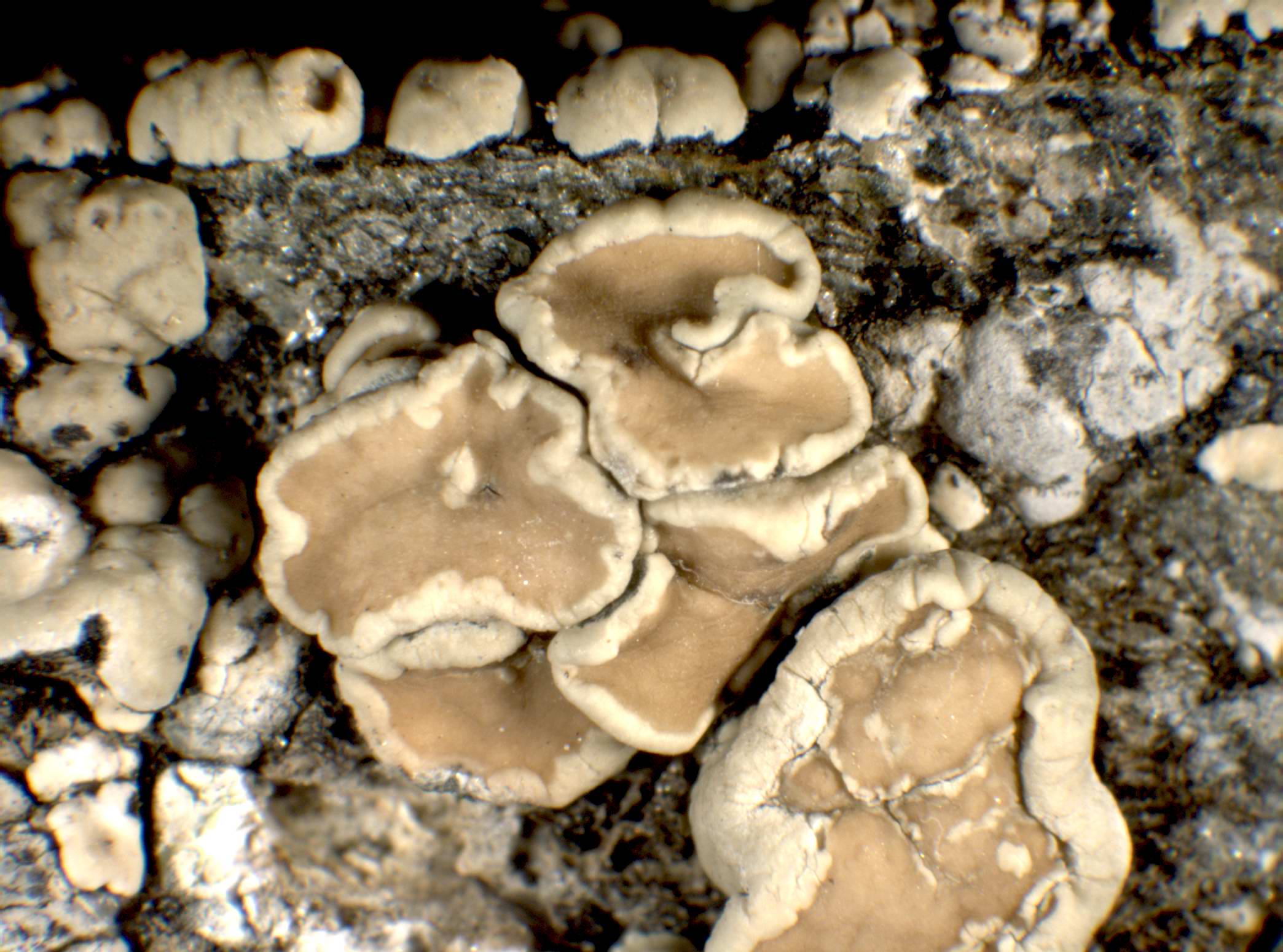
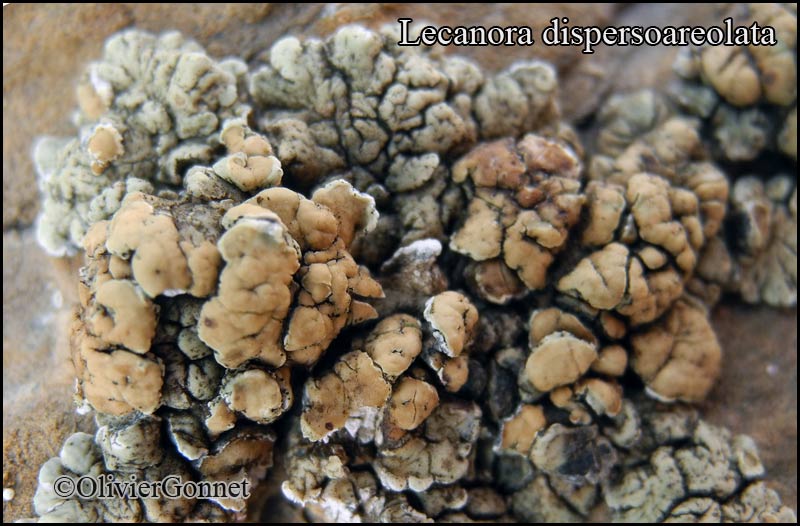
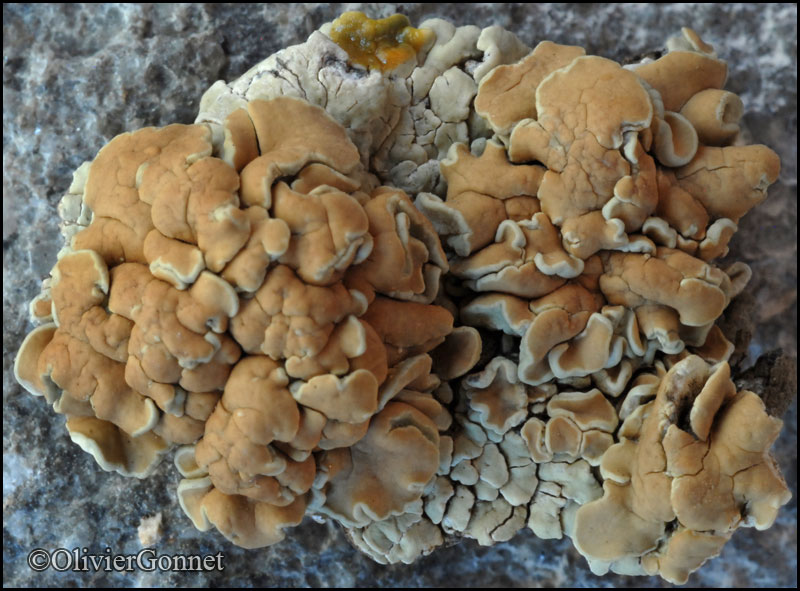
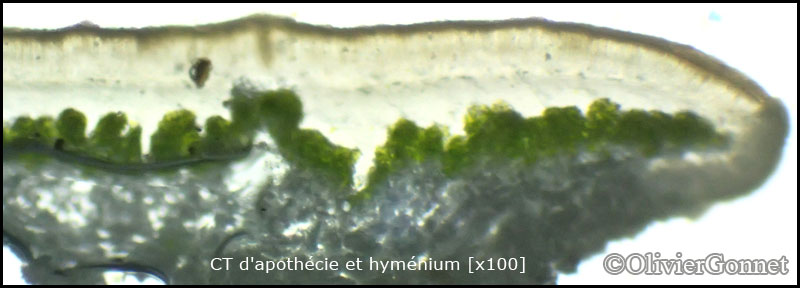
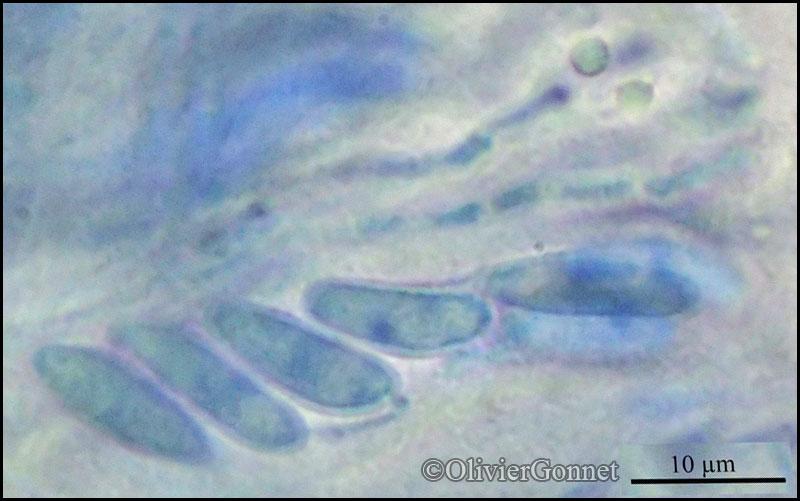
Description: Thallus crustose to subsquamulose, episubstratic, yellowish green, somehow shiny, rarely pruinose, very variable in shape and size, without a black hypo-/prothallus, the areoles flat to convex, often clustered in small groups, the marginal ones usually lobulate, rarely forming up to 5 cm wide, irregular rosettes; marginal lobules to 1-2 mm long and wide, flat to slightly convex, often with a thick, blue-grey margin of medullary hyphae. Cortex thick, strongly inspersed with yellowish crystals; medulla white, rather lax. Apothecia lecanorine, at first immersed, then sessile, 1 to several per areole, round or deformed by mutual compression, 2-5(-6) mm across, finally often larger than the areoles, with a flat to strongly convex, pale to medium red-brown, usually epruinose disc, and an entire to crenulate, sometimes blue-black-spotted thalline margin. Thalline exciple very thick in lower part; epithecium brownish; hymenium colourless, c. 70 µm high, the upper 20 µm inspersed with oil droplets; hypothecium colourless. Asci 8-spored, clavate, very thin-walled, with a K/I+ blue, tall tholus penetrated by a faintly amyloid apical cushion, the wall K/I-, surrounded by a blue outer layer, Lecanora-type. Ascospores 1-celled, hyaline, narrowly ellipsoid, 12-18 x 4-7 µm. Photobiont chlorococcoid. Spot tests: thallus (and apothecial margin) K- or K+ brownish yellow, C-, KC+ pale yellow, P- or P+ orange-red. Chemistry: usnic acid, rangiformic acid, sometimes low amounts of protocetraric and psoromic acids.
Growth form: Crustose
Substrata: rocks
Photobiont: green algae other than Trentepohlia
Reproductive strategy: mainly sexual
Commonnes-rarity: (info)
Alpine belt: rather rare
Subalpine belt: rare
Montane belt: very rare
Dry submediterranean belt: absent
Humid submediterranean belt: absent
Padanian area: absent
pH of the substrata:
1 2 3 4 5

Solar irradiation:
1 2 3 4 5
Aridity:
1 2 3 4 5
Eutrophication:
1 2 3 4 5
Poleotolerance:
0 1 2 3
Altitudinal distribution:
1 2 3 4 5 6
Rarity
absent
extremely rare
very rare
rare
rather rare
rather common
common
very common
extremely common
Loading data...
Occurrence data
Predictive map
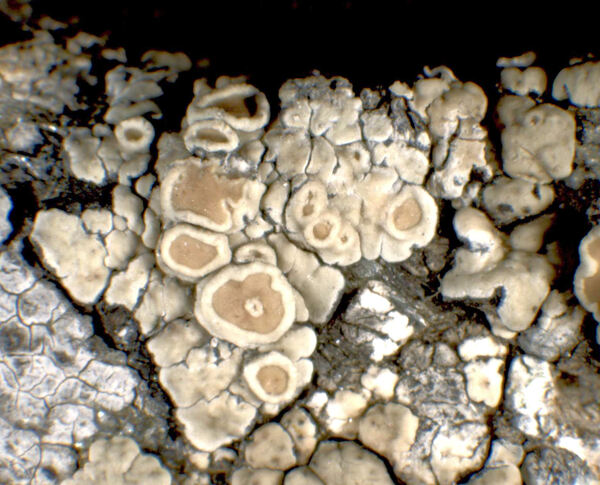
P.L. Nimis CC BY-SA 4.0
TSB 32851
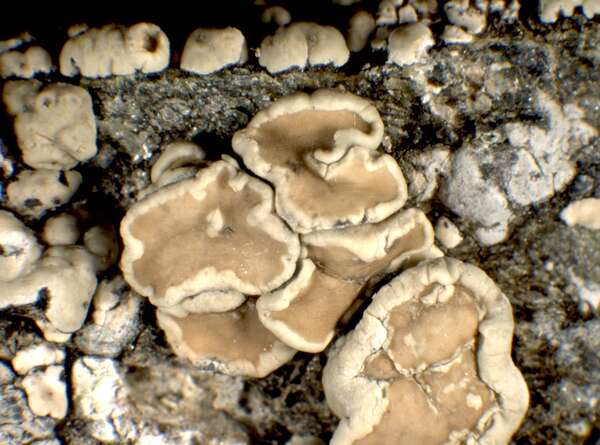
P.L. Nimis; Owner: Department of Life Sciences, University of Trieste
Herbarium: TSB (32851)
2001/12/08
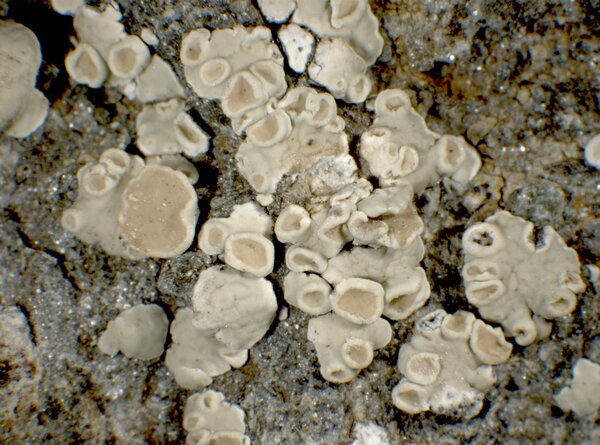
P.L. Nimis; Owner: Department of Life Sciences, University of Trieste
Herbarium: TSB (34818)
2002/02/06
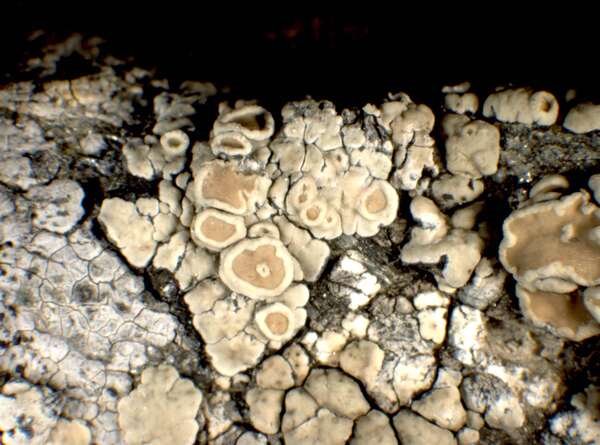
P.L. Nimis; Owner: Department of Life Sciences, University of Trieste
Herbarium: TSB (32851)
2001/12/08
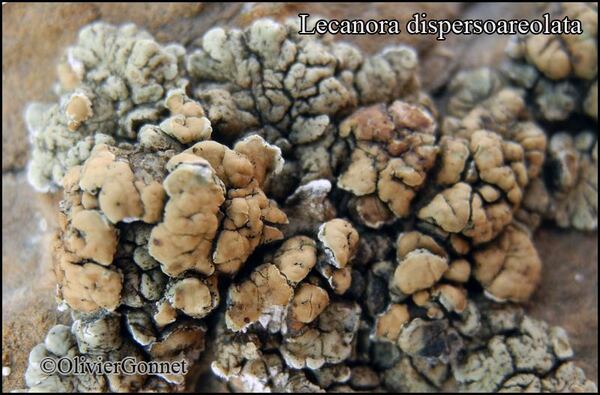
Courtesy Danièle et Olivier Gonnet - Source: https://www.afl-lichenologie.fr/Photos_AFL/Photos_AFL_L/Texte_L_3/Lecanora_dispersoareolata.htm
France, session AFL 2014 - Alpes de Haute-Provence
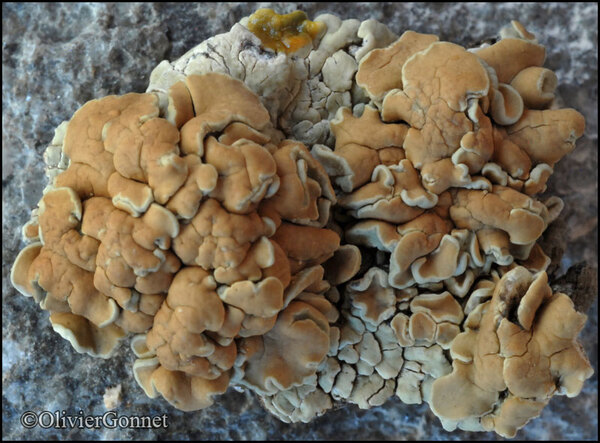
Courtesy Danièle et Olivier Gonnet - Source: https://www.afl-lichenologie.fr/Photos_AFL/Photos_AFL_L/Texte_L_3/Lecanora_dispersoareolata.htm
France, session AFL 2014 - Alpes de Haute-Provence
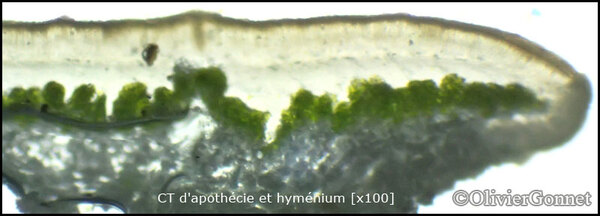
Courtesy Danièle et Olivier Gonnet - Source: https://www.afl-lichenologie.fr/Photos_AFL/Photos_AFL_L/Texte_L_3/Lecanora_dispersoareolata.htm
France, session AFL 2014 - Alpes de Haute-Provence
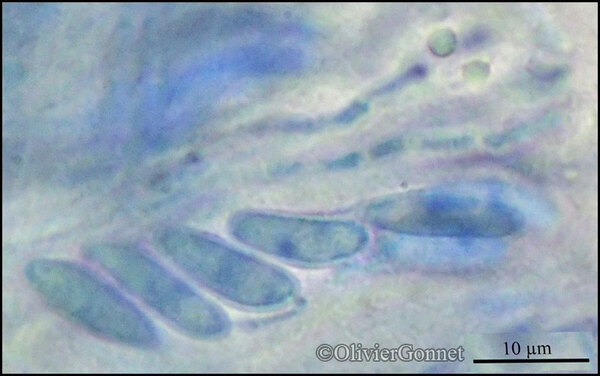
Courtesy Danièle et Olivier Gonnet - Source: https://www.afl-lichenologie.fr/Photos_AFL/Photos_AFL_L/Texte_L_3/Lecanora_dispersoareolata.htm
France, session AFL 2014 - Alpes de Haute-Provence
Courtesy Danièle et Olivier Gonnet - Source: https://www.afl-lichenologie.fr/Photos_AFL/Photos_AFL_L/Texte_L_3/Lecanora_dispersoareolata.htm
France, session AFL 2014 - Alpes de Haute-Provence
Growth form: Crustose
Substrata: rocks
Photobiont: green algae other than Trentepohlia
Reproductive strategy: mainly sexual
Commonnes-rarity: (info)
Alpine belt: rather rare
Subalpine belt: rare
Montane belt: very rare
Dry submediterranean belt: absent
Humid submediterranean belt: absent
Padanian area: absent
pH of the substrata:
| 1 | 2 | 3 | 4 | 5 |
Solar irradiation:
| 1 | 2 | 3 | 4 | 5 |
Aridity:
| 1 | 2 | 3 | 4 | 5 |
Eutrophication:
| 1 | 2 | 3 | 4 | 5 |
Poleotolerance:
| 0 | 1 | 2 | 3 |
Altitudinal distribution:
| 1 | 2 | 3 | 4 | 5 | 6 |
Rarity
absent
extremely rare
very rare
rare
rather rare
rather common
common
very common
extremely common
Loading data...
Occurrence data
Predictive map

P.L. Nimis CC BY-SA 4.0
TSB 32851
P.L. Nimis; Owner: Department of Life Sciences, University of Trieste
Herbarium: TSB (32851)
2001/12/08

P.L. Nimis; Owner: Department of Life Sciences, University of Trieste
Herbarium: TSB (34818)
2002/02/06

P.L. Nimis; Owner: Department of Life Sciences, University of Trieste
Herbarium: TSB (32851)
2001/12/08
Courtesy Danièle et Olivier Gonnet - Source: https://www.afl-lichenologie.fr/Photos_AFL/Photos_AFL_L/Texte_L_3/Lecanora_dispersoareolata.htm
France, session AFL 2014 - Alpes de Haute-Provence
Courtesy Danièle et Olivier Gonnet - Source: https://www.afl-lichenologie.fr/Photos_AFL/Photos_AFL_L/Texte_L_3/Lecanora_dispersoareolata.htm
France, session AFL 2014 - Alpes de Haute-Provence
Courtesy Danièle et Olivier Gonnet - Source: https://www.afl-lichenologie.fr/Photos_AFL/Photos_AFL_L/Texte_L_3/Lecanora_dispersoareolata.htm
France, session AFL 2014 - Alpes de Haute-Provence
Courtesy Danièle et Olivier Gonnet - Source: https://www.afl-lichenologie.fr/Photos_AFL/Photos_AFL_L/Texte_L_3/Lecanora_dispersoareolata.htm
France, session AFL 2014 - Alpes de Haute-Provence