Aspicilia spermatomanes (Nyl.) Maheu & Gillet
Lichens de l'est de la Corse; 51, 1926.. Basionym: Lecanora cinerea var. spermatomanes Nyl. - Bull. Soc. linn. Normandie, sér. 2, 6 : 256-328, 1873.
Synonyms:
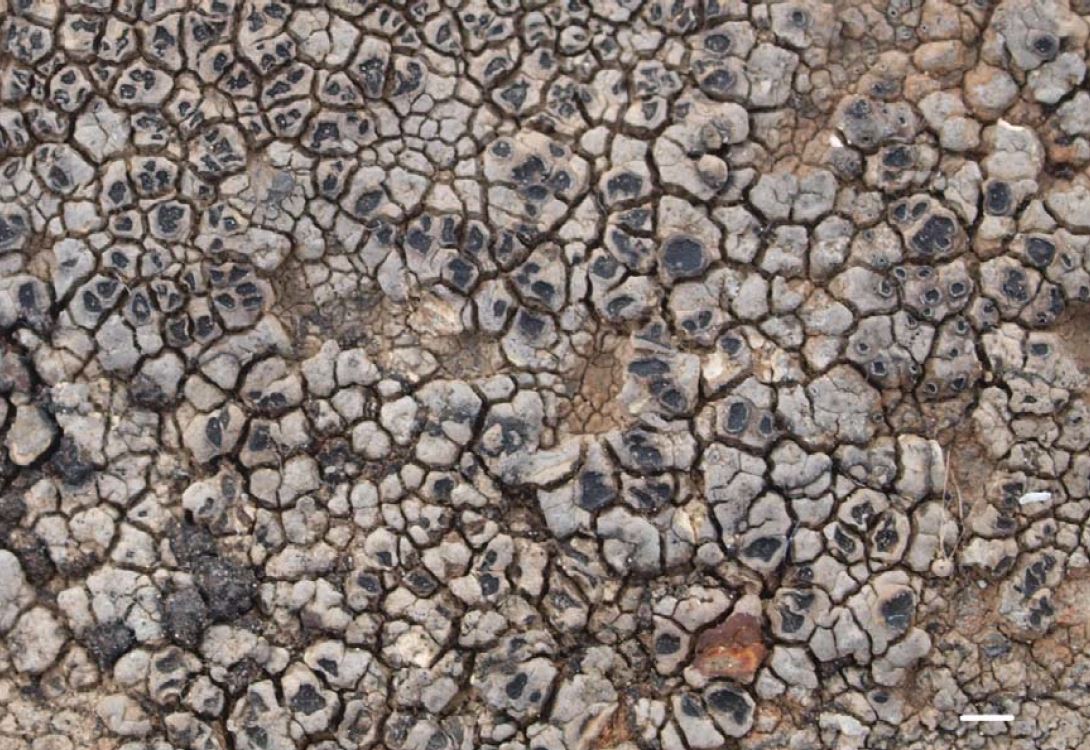
Description: Thallus crustose, episubstratic, 0.4-1.9 mm thick, whitish grey to dark grey, areolate to glebulose-areolate, the areoles usually subdivided by thin fissures into flat to convex, obtuse isidioid papillae, delimited by a dark grey to black prothalline line. Cortex paraplectenchymatous, overlain by a variably thick or discontinuous epinecral layer, the upper part brown (Subdepressa-brown pigment, K-, disappearing in N); algal layer 50-150 μm thick, interrupted by columnal aggregations of hyphae; medulla white, dense, 0.3-1.9 mm thick, filled by crystals insoluble in K and in N. Apothecia aspicilioid, round to irregular in outline, 0.2-1.2 mm across, immersed in the areoles (1-5 per areole), with a more or less flat, blackish, pruinose or epruinose disc, and a slightly raised thalline margin, sometimes with a darker annular zone. Epithecium brown, N+ greenish to emerald green (Caesiocinerea-green pigment), with minute crystals visible under polarized light, which are insoluble in N and soluble in K; hymenium colourless, 100-150 μm high; paraphyses 1.5-2 μm thick at base, non moniliform or moniliform in upper part, the apical cells 2.5-5 μm wide; hypothecium colourless; subhypothecial medulla rich in crystals, with glomerules of algae. Asci 8-spored, clavate, the thin outer coat K/I+ blue, the wall and apical dome K/I-. Ascospores 1-celled, hyaline, ellipsoid, 17-28 x 11-17(-20) μm. Pycnidia black, immersed, with a colourless wall. Conidia thread-like, straight or slightly curved, (10-)14.5-23(-25) x 1-1.5 μm. Photobiont chlorococcoid. Spot tests: cortex and medulla K+ yellow turning red (needle-like crystals), C-, KC-, P+ orange-yellow. Chemistry: norstictic acid, upper part of cortex with the Subdepressa-brown pigment, epithecium with the Caesiocinerea-green pigment.
Growth form: Crustose
Substrata: rocks
Photobiont: green algae other than Trentepohlia
Reproductive strategy: mainly sexual
Commonnes-rarity: (info)
Alpine belt: very rare
Subalpine belt: very rare
Montane belt: extremely rare
Dry submediterranean belt: absent
Humid submediterranean belt: absent
Padanian area: absent
pH of the substrata:
1 2 3 4 5

Solar irradiation:
1 2 3 4 5
Aridity:
1 2 3 4 5
Eutrophication:
1 2 3 4 5
Poleotolerance:
0 1 2 3
Altitudinal distribution:
1 2 3 4 5 6
Rarity
absent
extremely rare
very rare
rare
rather rare
rather common
common
very common
extremely common
Loading data...
Occurrence data
Predictive map

M. Bertrand. Source: Bertrand M., Roux C. 2013. Aspicilia spermatomanes (Nyl.) Maheu et Gillet en Corse. Bull. Ass. fr. lichénologie, 38, 1: 87-98.
Growth form: Crustose
Substrata: rocks
Photobiont: green algae other than Trentepohlia
Reproductive strategy: mainly sexual
Commonnes-rarity: (info)
Alpine belt: very rare
Subalpine belt: very rare
Montane belt: extremely rare
Dry submediterranean belt: absent
Humid submediterranean belt: absent
Padanian area: absent
pH of the substrata:
| 1 | 2 | 3 | 4 | 5 |
Solar irradiation:
| 1 | 2 | 3 | 4 | 5 |
Aridity:
| 1 | 2 | 3 | 4 | 5 |
Eutrophication:
| 1 | 2 | 3 | 4 | 5 |
Poleotolerance:
| 0 | 1 | 2 | 3 |
Altitudinal distribution:
| 1 | 2 | 3 | 4 | 5 | 6 |
Rarity
absent
extremely rare
very rare
rare
rather rare
rather common
common
very common
extremely common
Loading data...
Occurrence data
Predictive map