Cladonia luteoalba A. Wilson & Wheldon
Flora W. Lancashire: 450, 1907
Synonyms:
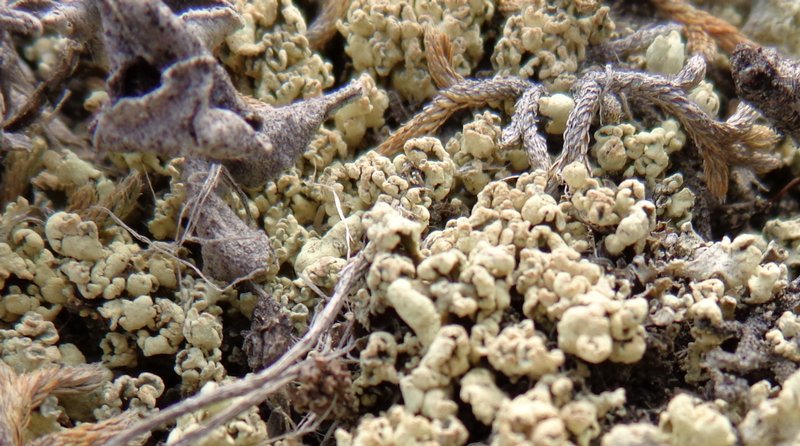
Description: Primary thallus squamulose, persistent, consisting of rounded to elongate, 1-3 cm long, up to 1 cm wide squamules with crenulate to laciniate, incurved margins, yellowish green and pruinose above, cottony and yellow beneath. Podetia very rare, up to 12 mm long and 3 mm wide, subulate or narrowly scyphose, simple or sometimes proliferating from the margins, with an ecorticate, verrucose-arachnoid, esorediate, not squamulose surface. Apothecia red to ochre-yellow, located along the margins of cups, often coalescing. Asci 8-spored, clavate, thickened at apex, with a K/I+ blue tholus and a K/I+ strongly blue outer gelatinous sheath, Cladonia-type. Ascospores 1-celled, hyaline, ellipsoid. Pycnidia mainly at the margins of cups or on the surface of primary squamules. Conidia hyaline, curved. Photobiont chlorococcoid. Spot tests: K-, C-, KC+ yellow, P-, UV-. Chemistry: usnic acid and zeorin.
Growth form: Squamulose
Photobiont: green algae other than Trentepohlia
Reproductive strategy: mainly asexual, by soredia, or soredia-like structures (e.g. blastidia)
Most common in areas with a humid-warm climate (e.g. most of Tyrrenian Italy)
Commonnes-rarity: (info)
Alpine belt: absent
Subalpine belt: extremely rare
Montane belt: absent
Dry submediterranean belt: absent
Humid submediterranean belt: absent
Padanian area: absent
pH of the substrata:
1 2 3 4 5

Solar irradiation:
1 2 3 4 5
Aridity:
1 2 3 4 5
Eutrophication:
1 2 3 4 5
Poleotolerance:
0 1 2 3
Altitudinal distribution:
1 2 3 4 5 6
Rarity
absent
extremely rare
very rare
rare
rather rare
rather common
common
very common
extremely common
Loading data...
Occurrence data
Predictive map
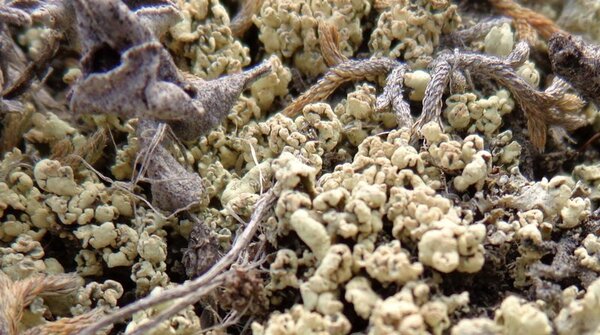
Curtis Randall Björk – CC BY-SA 4.0
British Columbia, Thompson Plateau, near Cache Creek 2013-04-04 Among Selaginella in rocky sagebrush steppe
Growth form: Squamulose
Photobiont: green algae other than Trentepohlia
Reproductive strategy: mainly asexual, by soredia, or soredia-like structures (e.g. blastidia)
Most common in areas with a humid-warm climate (e.g. most of Tyrrenian Italy)
Commonnes-rarity: (info)
Alpine belt: absent
Subalpine belt: extremely rare
Montane belt: absent
Dry submediterranean belt: absent
Humid submediterranean belt: absent
Padanian area: absent
pH of the substrata:
| 1 | 2 | 3 | 4 | 5 |
Solar irradiation:
| 1 | 2 | 3 | 4 | 5 |
Aridity:
| 1 | 2 | 3 | 4 | 5 |
Eutrophication:
| 1 | 2 | 3 | 4 | 5 |
Poleotolerance:
| 0 | 1 | 2 | 3 |
Altitudinal distribution:
| 1 | 2 | 3 | 4 | 5 | 6 |
Rarity
absent
extremely rare
very rare
rare
rather rare
rather common
common
very common
extremely common
Loading data...
Occurrence data
Predictive map