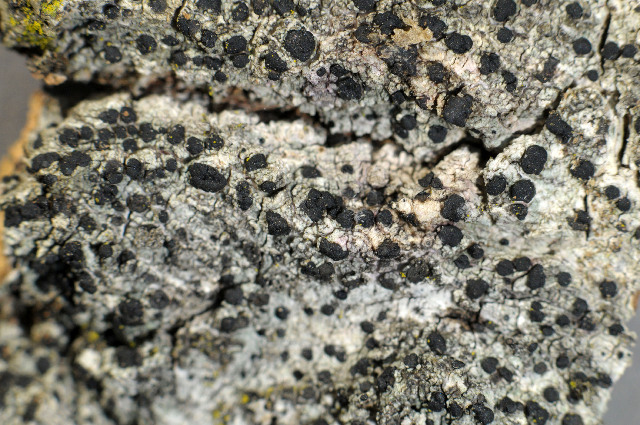
Lecidella tumidula (A. Massal.) Knoph & Leuckert
Bibl. Lichenol., 68: 131, 1997. Basionym: Lecidea tumidula A. Massal. - Ric. Auton. Lich. Crost.: 71, fig. 137, 1852
Synonyms:
Description: Thallus crustose, episubstratic, more or less continuous to rimose-granulose, 0.6-1 mm thick, white, greenish yellow or whitish grey, sometimes delimited by a pale to dark prothallus. Apothecia lecideine, black, semi-immersed to sessile, slightly to strongly constricted at base, 0.8-1.2 mm across, with a flat to finally convex, epruinose disc and a c. 0.075 mm thick, finally often excluded proper margin. Proper exciple bluish to greenish black in outer part, yellowish to reddish brown within, without crystals; epithecium green, blackish green to bluish green; hymenium colourless, 50-90 µm high, not inspersed with oil droplets; paraphyses easily made free in K, mostly simple, rarely sparingly branched and anastomosing, the apical cells not to slightly thickened; hypothecium reddish brown to rarely yellowish brown. Asci 8-spored, clavate, with an intensely K/I+ blue tholus penetrated by a faintly amyloid, broadly cylindrical axial mass, and a poorly developed ocular chamber, the wall K/I-, surrounded by a K/I+ blue outer layer, approaching the Lecanora-type. Ascospores 1-celled, hyaline, broadly ellipsoid to ovoid, 9-14 x 5.5-7.5 µm, thick-walled, not halonate. Photobiont chlorococcoid. Spot tests: thallus K-, C-, KC-, P-, UV-. Chemistry: diploicin and lichexanthone.
Growth form: Crustose
Substrata: bark
Photobiont: green algae other than Trentepohlia
Reproductive strategy: mainly sexual
Poorly known taxon in need of further study
Commonnes-rarity: (info)
Alpine belt: absent
Subalpine belt: absent
Montane belt: absent
Dry submediterranean belt: extremely rare
Humid submediterranean belt: absent
Padanian area: absent
pH of the substrata:
1 2 3 4 5

Solar irradiation:
1 2 3 4 5
Aridity:
1 2 3 4 5
Eutrophication:
1 2 3 4 5
Poleotolerance:
0 1 2 3
Altitudinal distribution:
1 2 3 4 5 6
Rarity
absent
extremely rare
very rare
rare
rather rare
rather common
common
very common
extremely common
Loading data...
Occurrence data
Predictive map
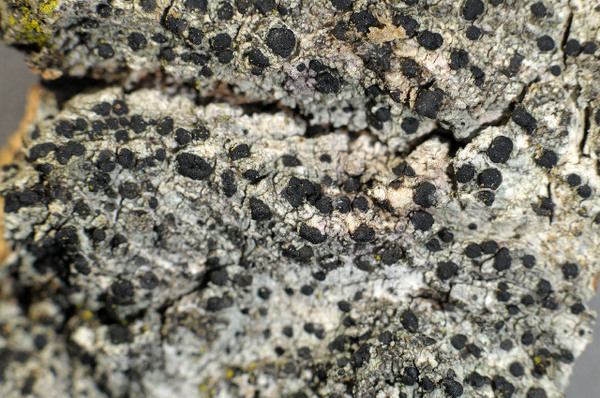
Einar Timdal, Natural History Museum, University of Oslo, Norway - CC BY-NC
Growth form: Crustose
Substrata: bark
Photobiont: green algae other than Trentepohlia
Reproductive strategy: mainly sexual
Poorly known taxon in need of further study
Commonnes-rarity: (info)
Alpine belt: absent
Subalpine belt: absent
Montane belt: absent
Dry submediterranean belt: extremely rare
Humid submediterranean belt: absent
Padanian area: absent
pH of the substrata:
| 1 | 2 | 3 | 4 | 5 |
Solar irradiation:
| 1 | 2 | 3 | 4 | 5 |
Aridity:
| 1 | 2 | 3 | 4 | 5 |
Eutrophication:
| 1 | 2 | 3 | 4 | 5 |
Poleotolerance:
| 0 | 1 | 2 | 3 |
Altitudinal distribution:
| 1 | 2 | 3 | 4 | 5 | 6 |
Rarity
absent
extremely rare
very rare
rare
rather rare
rather common
common
very common
extremely common
Loading data...
Occurrence data
Predictive map