Puttea exsequens (Nyl) Printzen & Davydov
in Davydov & Printzen, Bryologist, 115, 1: 68, 2012. Basionym: Lecidea exsequens Nyl. - Flora, 64: 179, 539, 1881
Synonyms: Lecidea gibberosa sensu Th. Fr. non Ach.
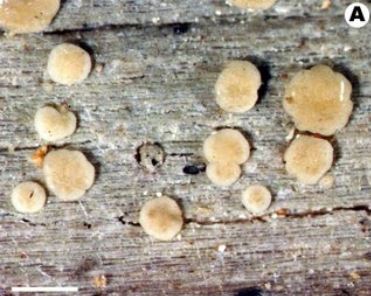
Description: Thallus crustose, very thin, whitish or endosubstratic, inconspicuous. Apothecia biatorine, rounded to slightly irregular in outline, sessile with a weakly constricted base, 0.3-0.7 mm across, with a flat to slightly convex, ochre or orange- to red-brown, matt disc appearing pruinose when wet, and an inapparent to very thin, mostly concolorous or slightly paler proper margin. Proper exciple colourless in outer part, covered in a continuous layer of crystals soluble in K, the hyphae 0.5-1.2 μm thick, richly branched, closely septate with narrow, 0.5-1 μm wide lumina, running parallel and perpendicularly from the medullary exciple of gelatinized textura intricata; epithecium scarcely differentiated from the hymenium, pale yellowish brown, with a layer of hyaline crystals soluble in K and N, 5-10 μm high; hymenium colourless, 45-55 μm high; paraphyses weakly to moderately branched and anastomosing, with 0.8-1 μm thick, with thin lumina, the apical cells up to 1.2 μm wide; hypothecium colourless, 25-175 μm high. Asci 8-spored, clavate, with a K/I+ blue tholus including a thin, darker K/I+ blue tubular ring-structure. Ascospores 1-celled, hyaline, fusiform-ellipsoid, 8-11 x 3-4.5 μm. Photobiont chlorococcoid. Spot tests: thallus K-, C-, KC-, C-, P-, UV-. Chemistry: probably without lichen substances.
Growth form: Crustose
Photobiont: green algae other than Trentepohlia
Reproductive strategy: mainly sexual
Commonnes-rarity: (info)
Alpine belt: absent
Subalpine belt: absent
Montane belt: very rare
Dry submediterranean belt: absent
Humid submediterranean belt: absent
Padanian area: absent
pH of the substrata:
1 2 3 4 5

Solar irradiation:
1 2 3 4 5
Aridity:
1 2 3 4 5
Eutrophication:
1 2 3 4 5
Poleotolerance:
0 1 2 3
Altitudinal distribution:
1 2 3 4 5 6
Rarity
absent
extremely rare
very rare
rare
rather rare
rather common
common
very common
extremely common
Loading data...
Occurrence data
Predictive map
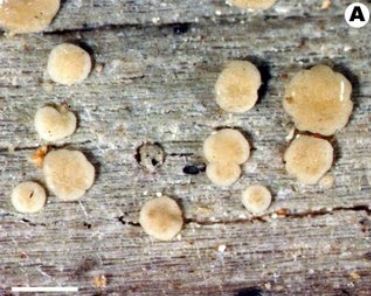
James Lendemer: Source: Buck W.R. & Lendemer J.C. 2012. Puttea (Pilocarpaceae) in eastern North America. Opuscula Philolichenum, 11: 141–144.
Habit of European population of P. exsequens (Malme s.n. = Lich. Suec. Exs. 44, NY).
Growth form: Crustose
Photobiont: green algae other than Trentepohlia
Reproductive strategy: mainly sexual
Commonnes-rarity: (info)
Alpine belt: absent
Subalpine belt: absent
Montane belt: very rare
Dry submediterranean belt: absent
Humid submediterranean belt: absent
Padanian area: absent
pH of the substrata:
| 1 | 2 | 3 | 4 | 5 |
Solar irradiation:
| 1 | 2 | 3 | 4 | 5 |
Aridity:
| 1 | 2 | 3 | 4 | 5 |
Eutrophication:
| 1 | 2 | 3 | 4 | 5 |
Poleotolerance:
| 0 | 1 | 2 | 3 |
Altitudinal distribution:
| 1 | 2 | 3 | 4 | 5 | 6 |
Rarity
absent
extremely rare
very rare
rare
rather rare
rather common
common
very common
extremely common
Loading data...
Occurrence data
Predictive map