Ramalina arsenii Sérus., van den Boom & Magain
Lichenologist, 53: 434, 2021
Synonyms:
Description: Thallus fruticose, pale yellowish green to green, branched, the branches developing from a basal holdfast, erect, ascending or rarely pendulous, 1–2(-3) cm long, starting as erect cushions of dichotomously divided and applanate lobes, the younger parts palmately or dichotomously branching, the surface of tiny branchlets with narrow longitudinal pseudocyphellae, rarely opening with minutely verrucose margins; soralia irregularly lip-shaped, at first forming on dissolving, old, lateral or terminal, flattened branches, then expanding mainly on the lower surface, more rarely on the upper parts of lateral branches, sometimes giving rise to an extensively sorediate underside; smaller branches often esorediate, but often with delicate, phyllidioid-flattened lobes; old lobes sometimes with a helmet-shaped apex. Apothecia extremely rare, known in the immature state only. Photobiont chlorococcoid. Spot tests: cortex and medulla K-, C-, KC-, P-, UV-. Chemistry: cortex with usnic acid; medulla with evernic acid.
Growth form: Fruticose
Photobiont: green algae other than Trentepohlia
Reproductive strategy: mainly asexual, by soredia, or soredia-like structures (e.g. blastidia)
In underhangs rarely wetted by rain
Commonnes-rarity: (info)
Alpine belt: absent
Subalpine belt: absent
Montane belt: very rare
Dry submediterranean belt: very rare
Humid submediterranean belt: very rare
Padanian area: absent
pH of the substrata:
1 2 3 4 5

Solar irradiation:
1 2 3 4 5
Aridity:
1 2 3 4 5
Eutrophication:
1 2 3 4 5
Poleotolerance:
0 1 2 3
Altitudinal distribution:
1 2 3 4 5 6
Rarity
absent
extremely rare
very rare
rare
rather rare
rather common
common
very common
extremely common
Loading data...
Occurrence data
Predictive map
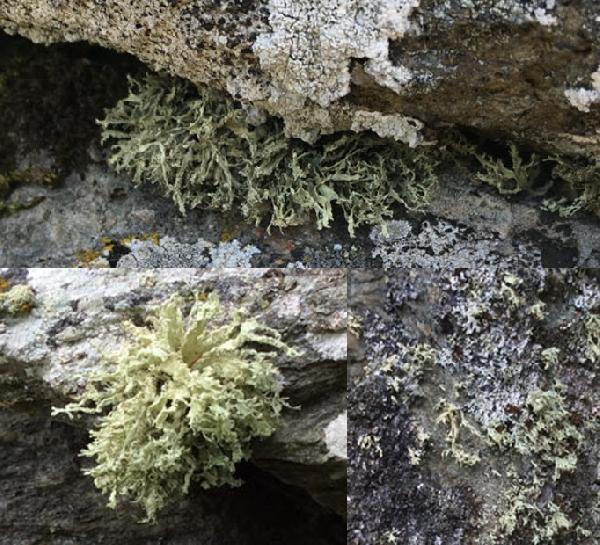
ԱրամԱրմենիա own work - Wikimedia Commons - Creative Commons CC0 1.0 Universal Public Domain Dedication.
Growth form: Fruticose
Photobiont: green algae other than Trentepohlia
Reproductive strategy: mainly asexual, by soredia, or soredia-like structures (e.g. blastidia)
In underhangs rarely wetted by rain
Commonnes-rarity: (info)
Alpine belt: absent
Subalpine belt: absent
Montane belt: very rare
Dry submediterranean belt: very rare
Humid submediterranean belt: very rare
Padanian area: absent
pH of the substrata:
| 1 | 2 | 3 | 4 | 5 |
Solar irradiation:
| 1 | 2 | 3 | 4 | 5 |
Aridity:
| 1 | 2 | 3 | 4 | 5 |
Eutrophication:
| 1 | 2 | 3 | 4 | 5 |
Poleotolerance:
| 0 | 1 | 2 | 3 |
Altitudinal distribution:
| 1 | 2 | 3 | 4 | 5 | 6 |
Rarity
absent
extremely rare
very rare
rare
rather rare
rather common
common
very common
extremely common
Loading data...
Occurrence data
Predictive map