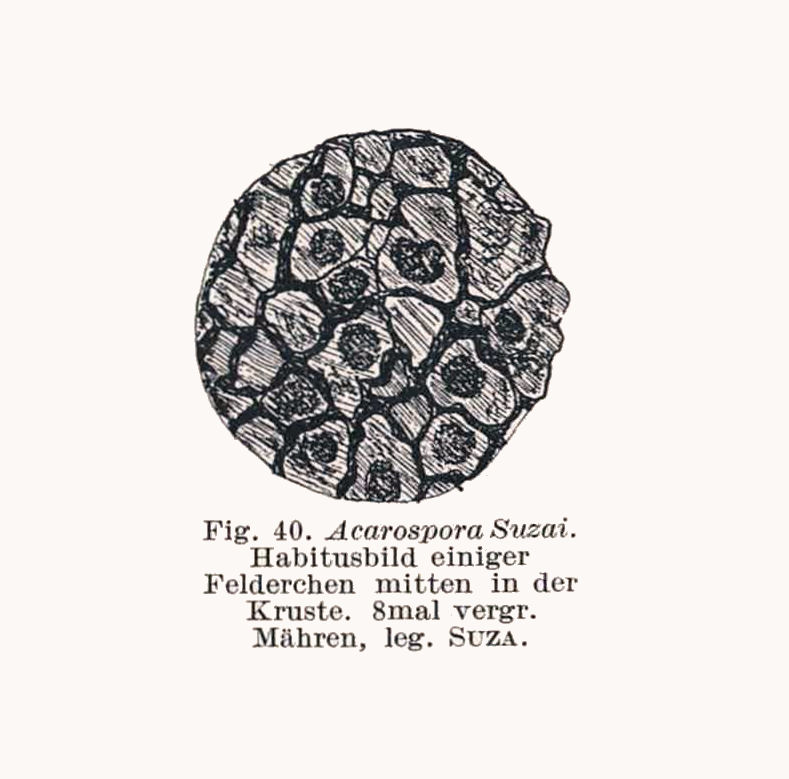
Acarospora suzae H. Magn.
Svensk bot. Tidskr., 18: 339, 1924
Synonyms: Acarospora nitrophila var. tiroliensis (H. Magn.) Clauzade & Cl. Roux; Acarospora suzae f. tyroliensis (H. Magn.) Zahlbr.; Acarospora suzae var. tyroliensis H. Magn.
Description: Thallus crustose, episubstratic, areolate, the areolae (developing on an endolithic hypothallus) contiguous, with an uneven surface, 0.5-1(-2) mm wide 0.4-0.5(-1.0) mm thick, irregular in shape, often angular, separated by deep and wide crevices, replicating by division, broadly attached, eventually becoming elevated by a mycelial base. Upper surface dark dull brown, rough, sometimes brownish-grey or white-pruinose; lower surface dark brown. Epicortex c. 10 µm thick; cortex 10-25 µm thick, of round, 3-5 µm wide cells, or with 2-5(-8) µm thick, vertically arranged hyphae, the upper layer consisting of a single layer of cells with reddish brown gel caps, the lower layer hyaline; algal layer continuous, not dense, 50-100 µm thick, most algal cells 10-14 µm wide; medulla snow-white, eventually forming a mycelial base of intricate, thin-walled, 2-5(-8) µm thick hyphae. Apothecia numerous, usually solitary, 0.4-0.6(-1) mm across, immersed or with a slightly elevated parathecial crown, the disc dull brown or black, rough. Proper exciple up to 25 µm wide; epithecium c. 10 µm high, usually lighter brown than the adjoining cortex; hymenium 80-100(-110) µm high, the hymenial gel euamyloid, I+ persistently dark blue; paraphyses c. 2 µm thick, the apices in gel caps, up to 3.5 µm wide, the epithecial gel I+ dark blue turning red (hemiamyloid); subhymenium c. 20 µm high, I+ blue; hypothecium 15-20 µm high. Asci multispored, 45-80 x 14-19 µm. Ascospores 1-celled, hyaline, ellipsoid, 3-5 x 1.5-2(-2.5) µm. Photobiont chlorococcoid. Spot tests: cortex and medulla K-, C-, KC-, P-. Chemistry: unknown, probably without lichen substances.
Growth form: Crustose
Substrata: rocks
Photobiont: green algae other than Trentepohlia
Reproductive strategy: mainly sexual
Subcontinental: restricted to areas with a dry-subcontinental climate (e.g. dry Alpine valleys, parts of Mediterranean Italy)
Commonnes-rarity: (info)
Alpine belt: absent
Subalpine belt: absent
Montane belt: extremely rare
Dry submediterranean belt: extremely rare
Humid submediterranean belt: absent
Padanian area: absent
pH of the substrata:
1 2 3 4 5

Solar irradiation:
1 2 3 4 5
Aridity:
1 2 3 4 5
Eutrophication:
1 2 3 4 5
Poleotolerance:
0 1 2 3
Altitudinal distribution:
1 2 3 4 5 6
Rarity
absent
extremely rare
very rare
rare
rather rare
rather common
common
very common
extremely common
Loading data...
Occurrence data
Predictive map
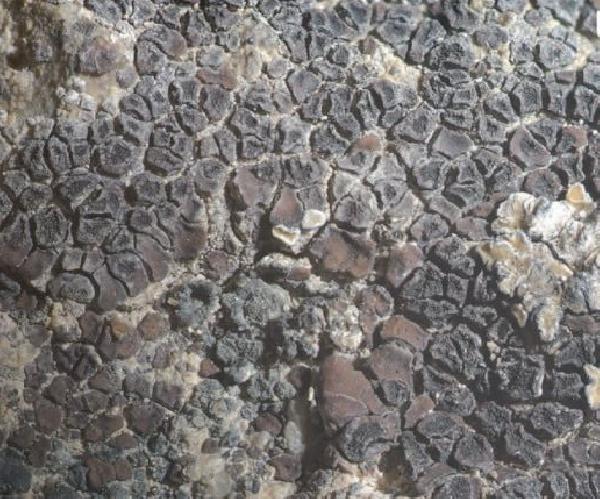
Source: Knudsen K. & Kocourková J. (2017) Bryologist 120(2): 125-129 What is Acarospora nitrophila (Acarosporaceae) ?
E. Foriss s.n. ( ´ UPS) bar¼2 mm.
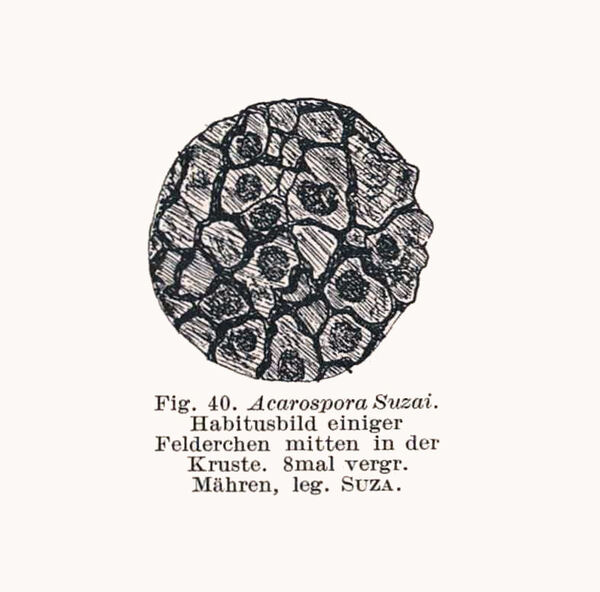
Magnusson A. H. (1935) Acarosporaceae, Thelocarpaceae. - In: Rabenhorst G. L.: Kryptogamen-Flora von Deutschland, Österreich, und der Schweiz-. 2nd- IX. Die Flechten. Abt. 5- 1. Gebr. Borntraeger. Leipzig, pp. 1-318. – Public Domain
Growth form: Crustose
Substrata: rocks
Photobiont: green algae other than Trentepohlia
Reproductive strategy: mainly sexual
Subcontinental: restricted to areas with a dry-subcontinental climate (e.g. dry Alpine valleys, parts of Mediterranean Italy)
Commonnes-rarity: (info)
Alpine belt: absent
Subalpine belt: absent
Montane belt: extremely rare
Dry submediterranean belt: extremely rare
Humid submediterranean belt: absent
Padanian area: absent
pH of the substrata:
| 1 | 2 | 3 | 4 | 5 |
Solar irradiation:
| 1 | 2 | 3 | 4 | 5 |
Aridity:
| 1 | 2 | 3 | 4 | 5 |
Eutrophication:
| 1 | 2 | 3 | 4 | 5 |
Poleotolerance:
| 0 | 1 | 2 | 3 |
Altitudinal distribution:
| 1 | 2 | 3 | 4 | 5 | 6 |
Rarity
absent
extremely rare
very rare
rare
rather rare
rather common
common
very common
extremely common
Loading data...
Occurrence data
Predictive map

Source: Knudsen K. & Kocourková J. (2017) Bryologist 120(2): 125-129 What is Acarospora nitrophila (Acarosporaceae) ?
E. Foriss s.n. ( ´ UPS) bar¼2 mm.