Metamelanea umbonata Henssen
Lichenologist, 21: 105, 1989
Synonyms:
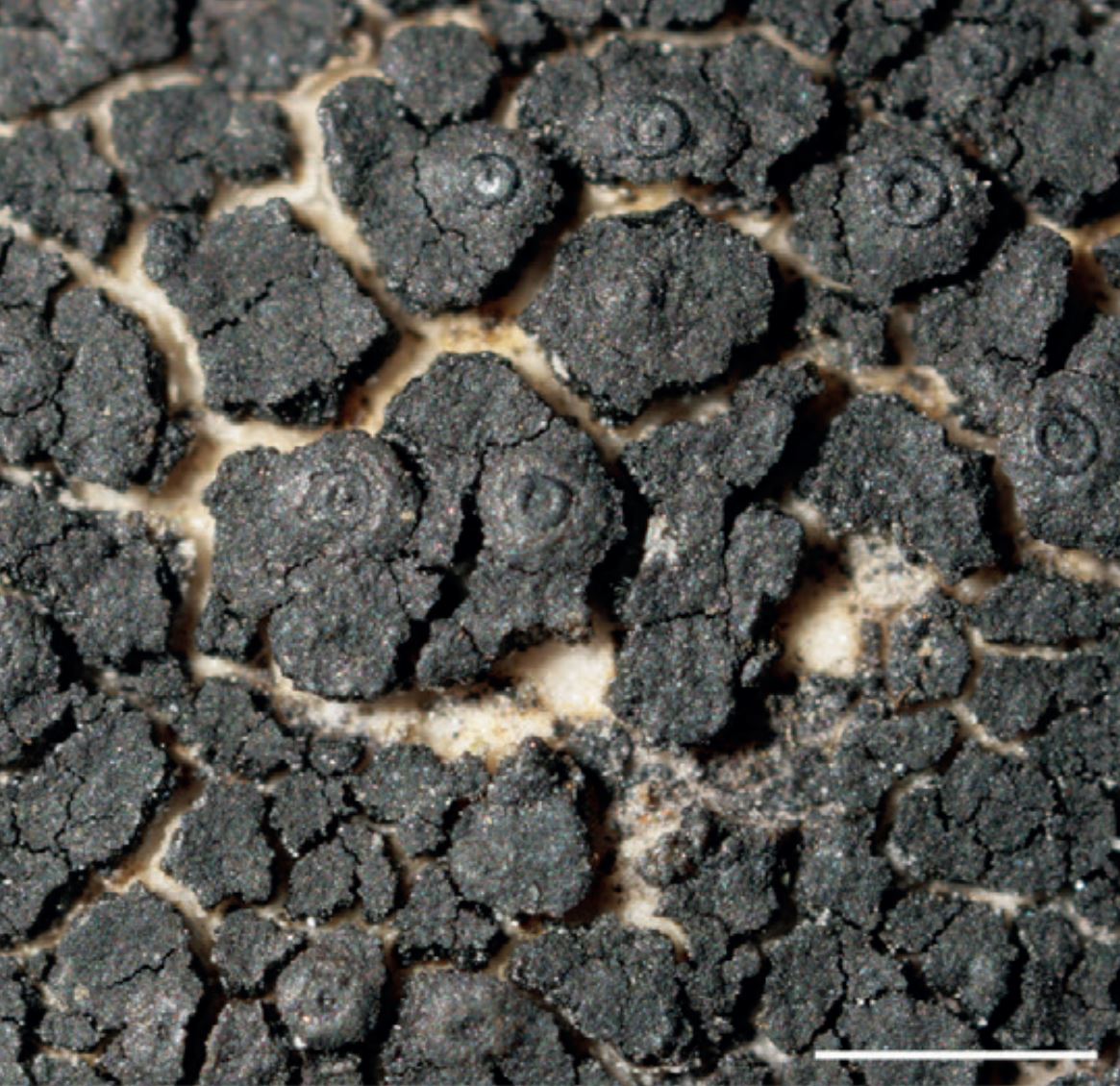
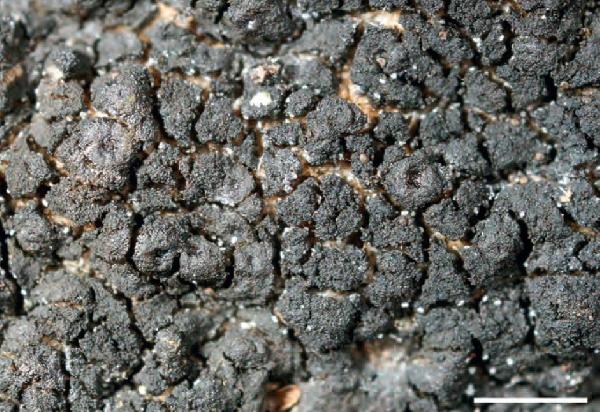
Description: Thallus crustose, homoiomerous, gelatinous when wet, episubstratic, brown-black to very dark greenish black or dark olive brown, somewhat glossy, areolate, forming up to 5 cm wide patches, the areoles 0.2-0.6 mm wide, c. 0.3 mm thick, more or less angular, obtusely wedge-shaped in section, the surface with numerous, densely aggregated, erect, 12-35 µm wide, lobule-like outgrowths containing the densely packed photobiont cells surrounded by a loose network of hyphae. Apothecia adnate, 1-7 per areole, up to 0.6 mm across, with a blackish, umbonate to gyrose disc, the umbo up to 120 µm broad and 70 µm high, a dark reddish brown proper margin, and a well-developed, entire, coronate, persistent thalline margin, proper and thalline margin often separated by a thin fissure. Thalline exciple up to 200 µm wide; proper exciple up to 20 µm wide apically, up to 10 µm wide basally, dark brown in upper part, paler in lower part; epithecium brown; hymenium colourless to brownish in upper part, 90-150 um high, K/I+ blue; paraphyses septate, sparingly branched and anastomosing, the apical cells slightly swollen; hypothecium colourless to pale brown, K/I+ blue. Asci 8-spored, long-cylindrical-clavate, thin-walled, without internal amyloid structures. Ascospores 1-celled, hyaline, broadly ellipsoid, 11-13.5 x 8-9.5 µm, thin walled. Pycnidia laminal, immersed, 110-140 µm high, 40-65 µm across, with a colourless wall. Conidia bacilliform, 2-3.5 x 1-1.5 µm. Photobiont cyanobacterial, chroococcoid, the cells surrounded by brownish gelatinous sheaths, densely aggregated in vertical columns. Spot tests: all negative. Chemistry: without lichen substances.
Growth form: Crustose
Substrata: rocks
Photobiont: cyanobacteria, coccaceous (e.g. Gloeocapsa)
Reproductive strategy: mainly sexual
On otherwise dry surfaces with short periods of water seepage after rain
Commonnes-rarity: (info)
Alpine belt: absent
Subalpine belt: extremely rare
Montane belt: extremely rare
Dry submediterranean belt: absent
Humid submediterranean belt: absent
Padanian area: absent
pH of the substrata:
1 2 3 4 5

Solar irradiation:
1 2 3 4 5
Aridity:
1 2 3 4 5
Eutrophication:
1 2 3 4 5
Poleotolerance:
0 1 2 3
Altitudinal distribution:
1 2 3 4 5 6
Rarity
absent
extremely rare
very rare
rare
rather rare
rather common
common
very common
extremely common
Loading data...
Occurrence data
Predictive map
Source: Prieto M., Westberg M, Schultz M. Herzogia 28 (1), 2015: 142–152
Westberg SL48, S
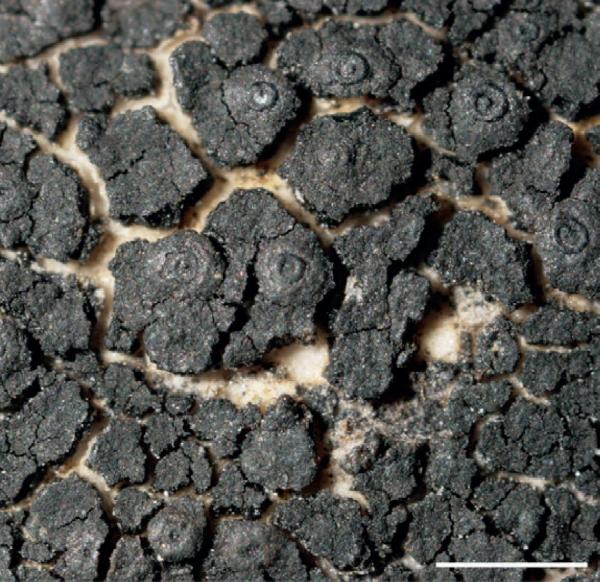
Source: Prieto M., Wedin M., Schultz M. 2024. Phylogeny, evolution and a re-classification of the Lichinomycetes. Studies in Mycology, 109: 595-655. - CC BY-NC-ND
Metamelanea umbonata, crustose, areoles angulate, thick with blackish, umbonate
apothecia (Orange 15053) Scale bar: 1 mm
Growth form: Crustose
Substrata: rocks
Photobiont: cyanobacteria, coccaceous (e.g. Gloeocapsa)
Reproductive strategy: mainly sexual
On otherwise dry surfaces with short periods of water seepage after rain
Commonnes-rarity: (info)
Alpine belt: absent
Subalpine belt: extremely rare
Montane belt: extremely rare
Dry submediterranean belt: absent
Humid submediterranean belt: absent
Padanian area: absent
pH of the substrata:
| 1 | 2 | 3 | 4 | 5 |
Solar irradiation:
| 1 | 2 | 3 | 4 | 5 |
Aridity:
| 1 | 2 | 3 | 4 | 5 |
Eutrophication:
| 1 | 2 | 3 | 4 | 5 |
Poleotolerance:
| 0 | 1 | 2 | 3 |
Altitudinal distribution:
| 1 | 2 | 3 | 4 | 5 | 6 |
Rarity
absent
extremely rare
very rare
rare
rather rare
rather common
common
very common
extremely common
Loading data...
Occurrence data
Predictive map
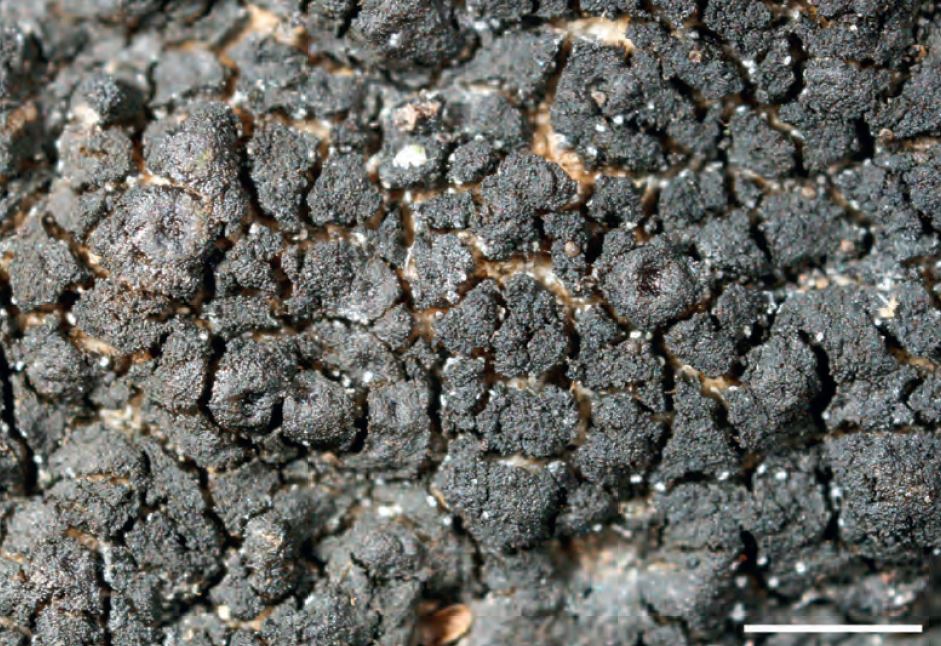
Source: Prieto M., Westberg M, Schultz M. Herzogia 28 (1), 2015: 142–152
Westberg SL48, S