Thalloidima squamatum (Hoffm.) M. Westb. & Timdal
in Westberg & al. , Plant and Fungal Systematics, 68, 2: 358, 2023. Basionym: Psora squamata Hoffm. - Deutschl. Fl., 2: 161, 1796 (1795)
Synonyms:
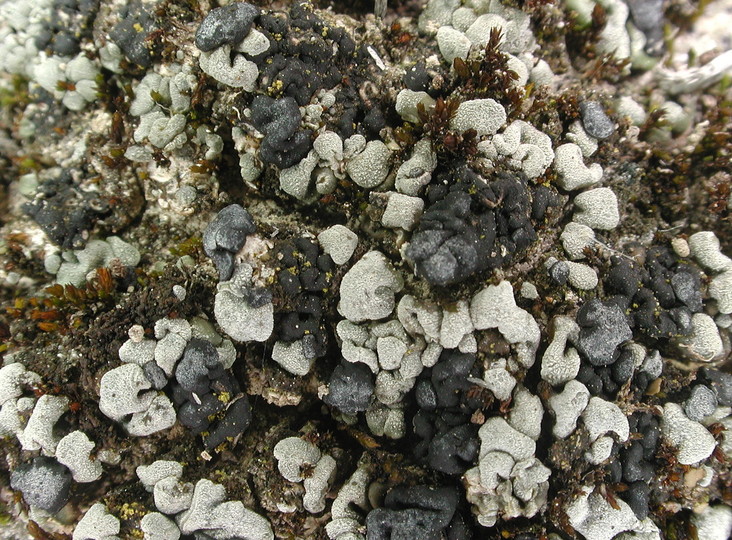
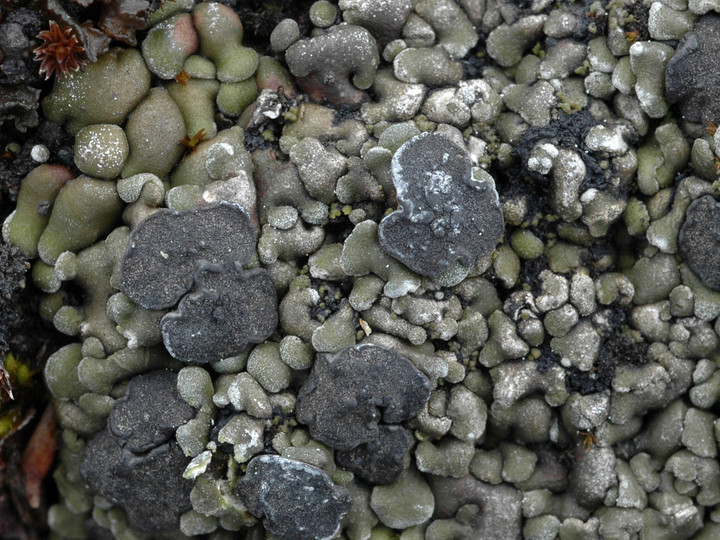
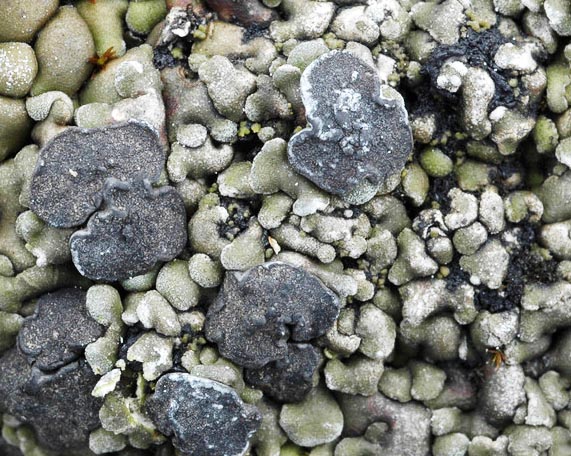
Description: Thallus squamulose, often forming compact, up to 8 cm wide patches, the squamules up to 6 mm long, contiguous to sometimes imbricate, bullate from the beginning, rounded to finally irregularly lobed, rarely short-columnar, the larger ones sometimes horizontally flattened. Upper surface pale brown, greenish brown or dark green, smooth, usually partly covered with a white, farinose pruina, but sometimes epruinose to densely white-pruinose, without pseudocyphellae; lower side pale brown to whitish. Upper cortex 20-40 μm thick, including an up to 15 μm thick epinecral layer, often containing or covered by crystals of calcium oxalates, of thick-walled, irregularly to mainly anticlinally arranged hyphae with rounded to elongated cells; medulla white to pale yellow, lacking crystals, consisting of a spongy tissue of thin-walled hyphae; algal layer continuous; lower cortex resembling the upper one, but thinner. Apothecia lecideine, at first rounded, then strongly irregular in outline, up to 4 mm across, black, epruinose or rarely entirely pruinose, finally immarginate. Proper exciple colourless to pale golden brown in outer part, darker golden brown within; epithecium grey, often with a faint violet tone, K+ and N+ purple; hymenium colourless, 65-80 μm high; paraphyses simple, stout, c. 3 μm thick at mid-level, the apical cells subcylindrical to clavate, up to 6 μm wide; hypothecium golden brown to red-brown. Asci 8-spored, narrowly clavate, surrounded by a gelatinous I+ blue coat, with a well-developed I+ blue tholus, a I+ darker blue tube and a well-developed ocular chamber, Bacidia-type. Ascospores 1-septate, hyaline, fusiform or with one end rounded, 12-20 x 3-4 μm. Photobiont chlorococcoid. Spot tests: cortex and medulla K-, C-, KC-, P-, UV-. Chemistry; thallus without lichen substances: epithecium with the Sedifolia-grey pigment.
Growth form: Squamulose
Photobiont: green algae other than Trentepohlia
Reproductive strategy: mainly sexual
Commonnes-rarity: (info)
Alpine belt: very rare
Subalpine belt: rare
Montane belt: rare
Dry submediterranean belt: very rare
Humid submediterranean belt: very rare
Padanian area: absent
pH of the substrata:
1 2 3 4 5

Solar irradiation:
1 2 3 4 5
Aridity:
1 2 3 4 5
Eutrophication:
1 2 3 4 5
Poleotolerance:
0 1 2 3
Altitudinal distribution:
1 2 3 4 5 6
Rarity
absent
extremely rare
very rare
rare
rather rare
rather common
common
very common
extremely common
Loading data...
Occurrence data
Predictive map
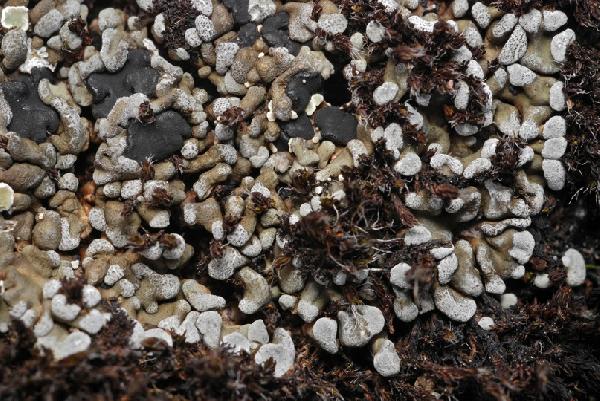
photo Leif Stridvall, courtesy of Anita Stridvall
Sweden
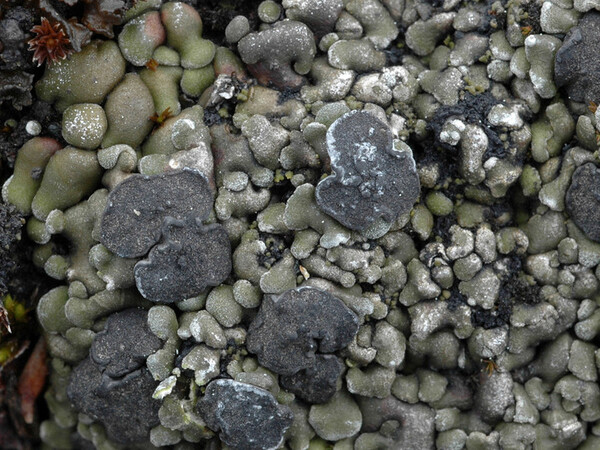
Leif Stridvall - Source: http://www.stridvall.se/la/galleries.php (Courtesy: Anita Stridvall)
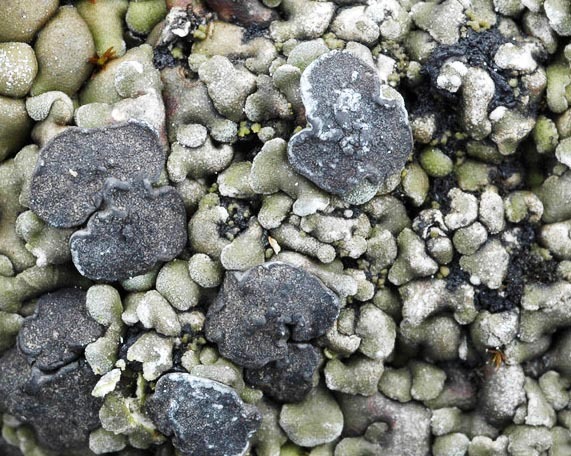
Leif Stridvall http://www.stridvall.se/la/galleries.php (Courtesy: Anita Stridvall)
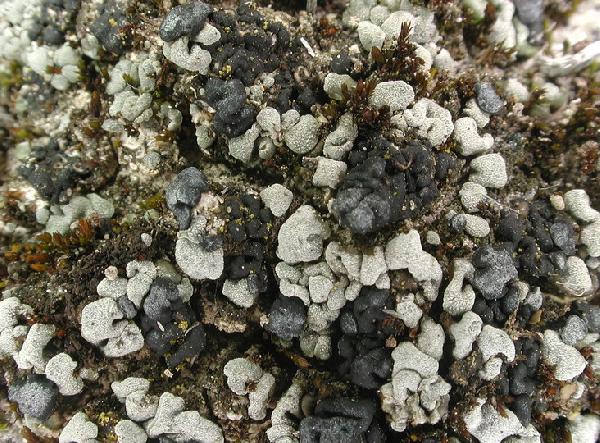
photo Leif Stridvall, courtesy of Anita Stridvall
Sweden
Growth form: Squamulose
Photobiont: green algae other than Trentepohlia
Reproductive strategy: mainly sexual
Commonnes-rarity: (info)
Alpine belt: very rare
Subalpine belt: rare
Montane belt: rare
Dry submediterranean belt: very rare
Humid submediterranean belt: very rare
Padanian area: absent
pH of the substrata:
| 1 | 2 | 3 | 4 | 5 |
Solar irradiation:
| 1 | 2 | 3 | 4 | 5 |
Aridity:
| 1 | 2 | 3 | 4 | 5 |
Eutrophication:
| 1 | 2 | 3 | 4 | 5 |
Poleotolerance:
| 0 | 1 | 2 | 3 |
Altitudinal distribution:
| 1 | 2 | 3 | 4 | 5 | 6 |
Rarity
absent
extremely rare
very rare
rare
rather rare
rather common
common
very common
extremely common
Loading data...
Occurrence data
Predictive map
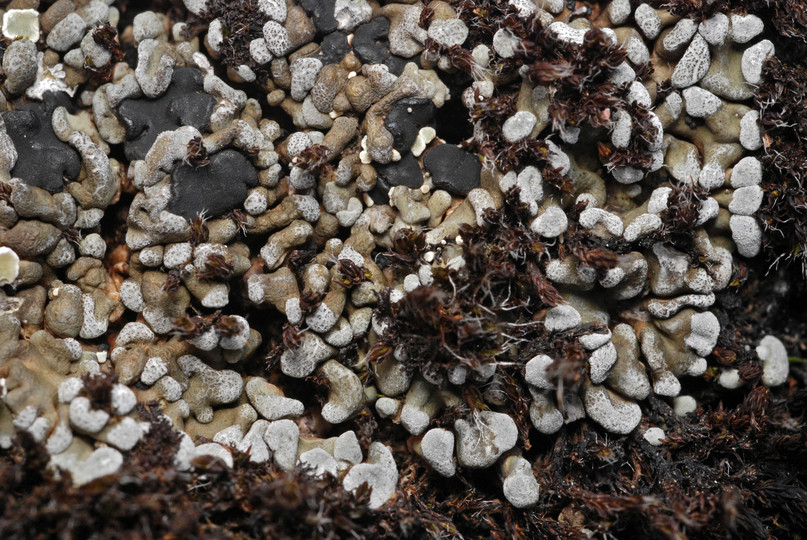
photo Leif Stridvall, courtesy of Anita Stridvall
Sweden
Leif Stridvall - Source: http://www.stridvall.se/la/galleries.php (Courtesy: Anita Stridvall)
Leif Stridvall http://www.stridvall.se/la/galleries.php (Courtesy: Anita Stridvall)