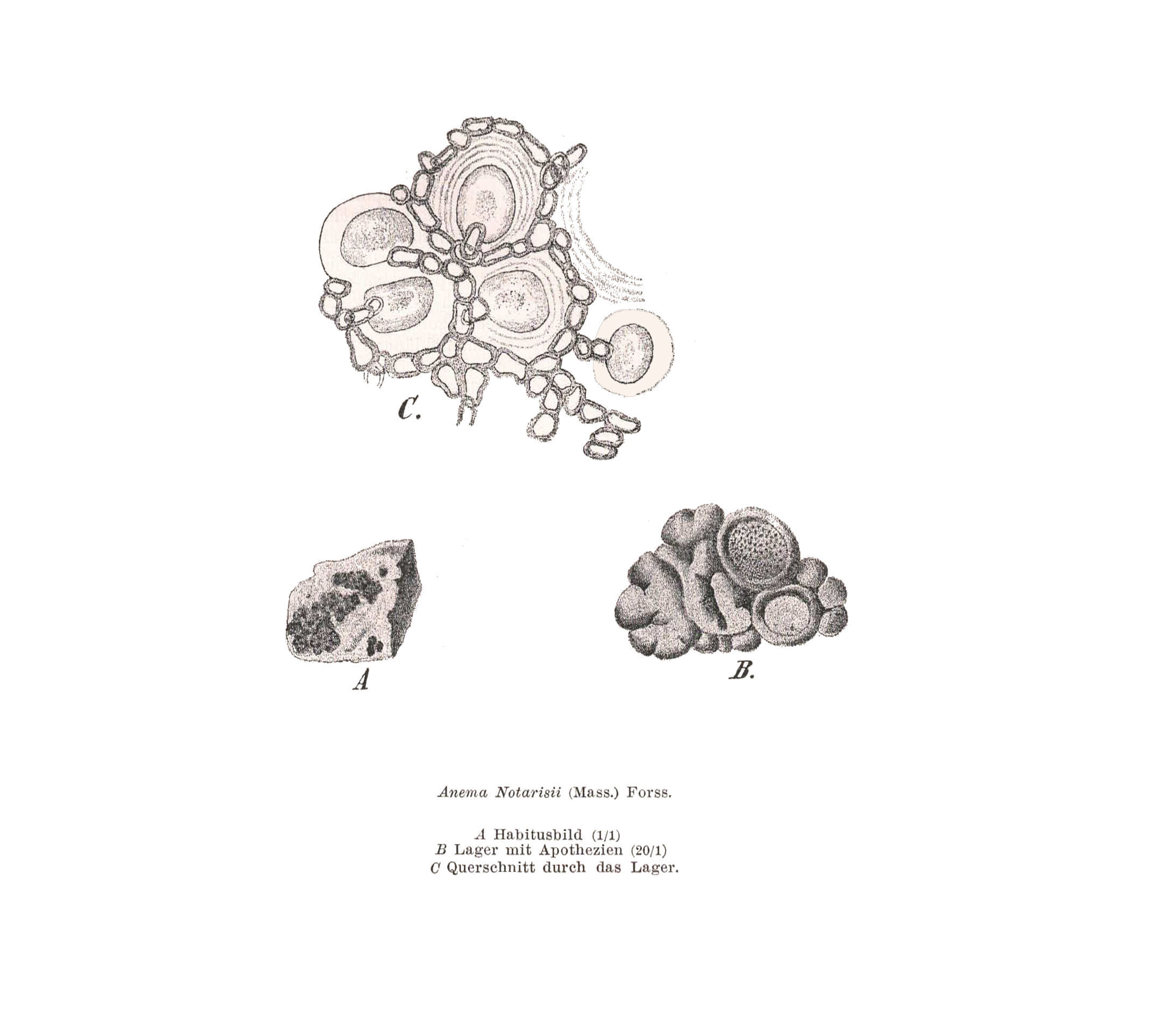
Anema nummularium var. notarisii (A. Massal.) Zanfr.
Atti Soc. natural. mat. Modena, ser. 4, 8: 32, 1906.. Basionym: Omphalaria notarisii A. Massal. - Framm. Lichenogr.: 13, 1855.
Synonyms: Anema nummulariellum Nyl.
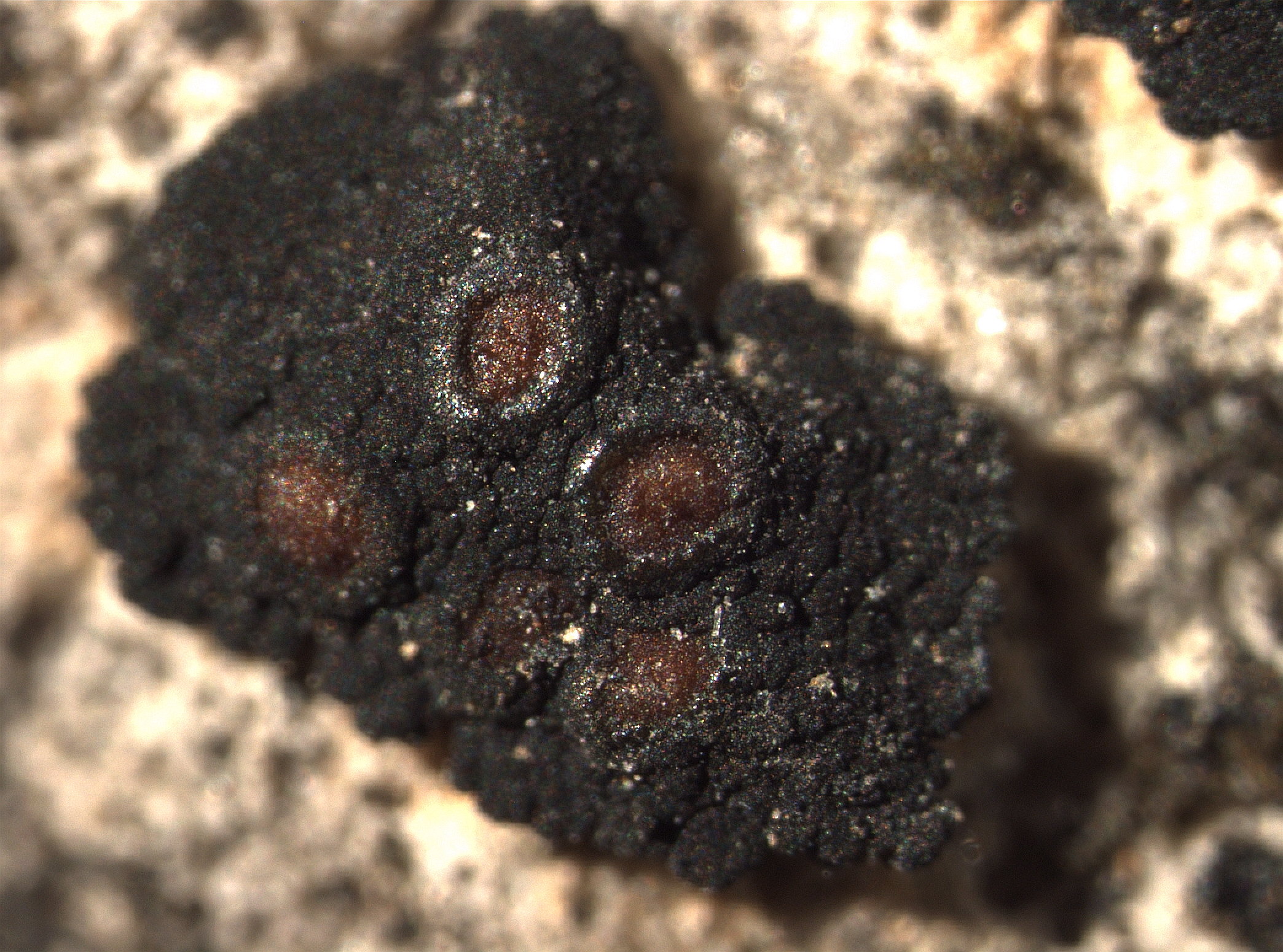
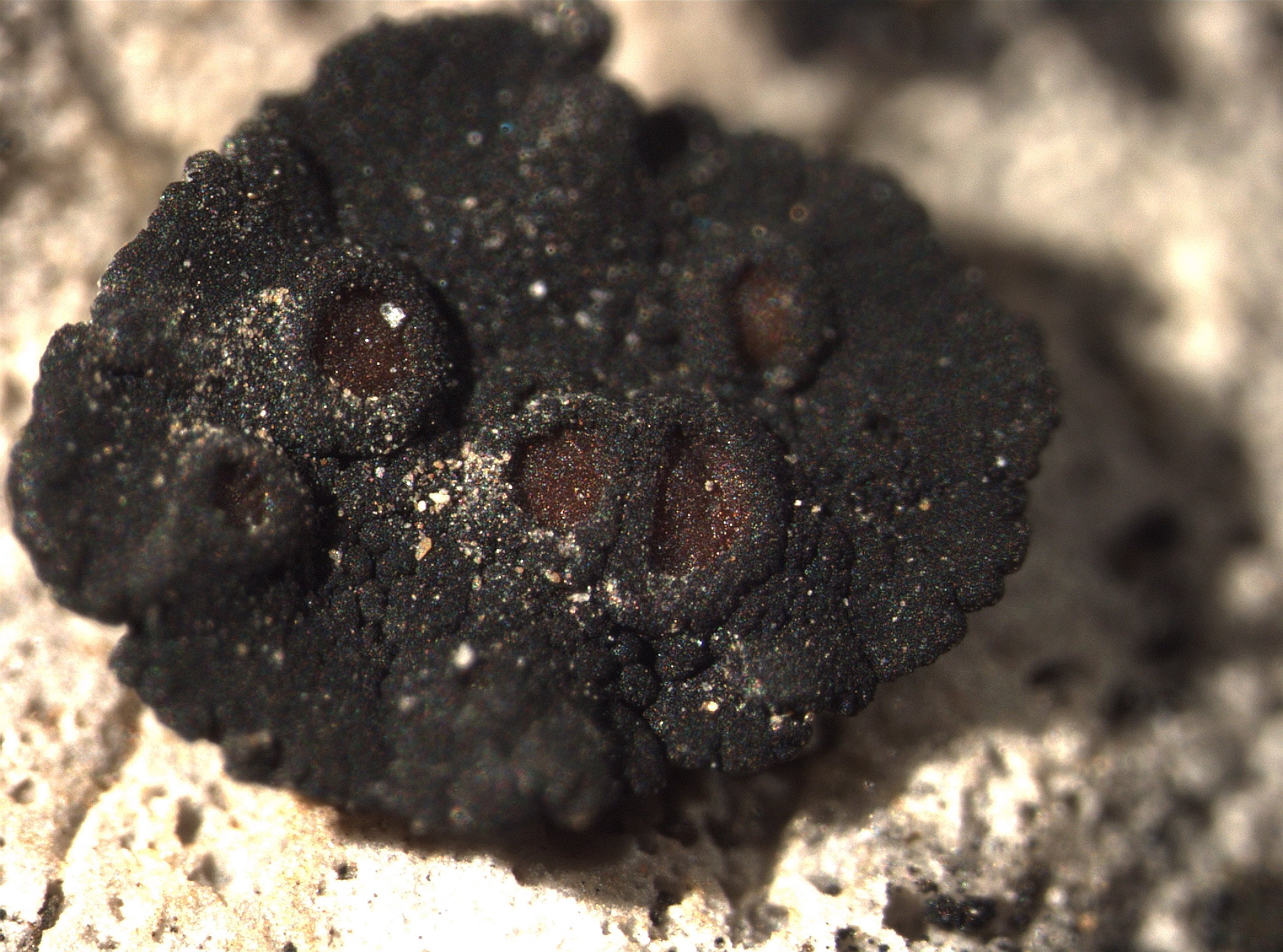
Description: Thallus squamulose-umbilicate, homoiomerous, slightly gelatinous when wet, 0.2-0.4 mm thick, in section with a loosely reticulate network of thin hyphae enclosing groups of cyanobacterial cells. Squamules black, epruinose, dispersed to crowded, closely attached, 3-6 mm wide, button-like, epruinose, not isidiate, attached by a central, compact bundle of rhizohyphae, with an indistinctly lobulate margin, the lobules short, contiguous, smooth, slightly convex, rounded at apex. Apothecia pycnoascocarps, 2-3 per squamule, at first immersed and urceolate but soon expanded and clearly lecanorine, 0.3-1(-1.5) mm across, with a dark reddish brown, concave to flat disc, and a thick, usually smooth thalline margin. Proper exciple poorly developed; epithecium brownish orange; hymenium colourless, the hymenial gel I+ blue, paraphyses moniliform, the upper cell clearly swollen; hypothecium yellowish. Asci 8-spored, broadly clavate, thin-walled, with a distinct amyloid outer cap, but no apical dome, Peccania-type. Ascospores 1-celled, hyaline broadly ellipsoid to ellipsoid, 7-15 x 4-10(-12) µm, the wall 1-2 µm thick. Pycnidia immersed, globose, unilocular. Conidia hyaline, ellipsoid, 3-4 x 0.5-1.5 µm. Photobiont cyanobacterial, chroococcoid, of a few 8-13 µm wide cells often penetrated by haustoria and surrounded by a gelatinous sheath which is colourless in inner parts, yellowish brown near the thallus surface. Spot tests: all negative. Chemistry: without lichen substances.
Growth form: Squamulose
Substrata: rocks
Photobiont: cyanobacteria, coccaceous (e.g. Gloeocapsa)
Reproductive strategy: mainly sexual
On otherwise dry surfaces with short periods of water seepage after rain
Commonnes-rarity: (info)
Alpine belt: absent
Subalpine belt: absent
Montane belt: absent
Dry submediterranean belt: rare
Humid submediterranean belt: rare
Padanian area: absent
pH of the substrata:
1 2 3 4 5

Solar irradiation:
1 2 3 4 5
Aridity:
1 2 3 4 5
Eutrophication:
1 2 3 4 5
Poleotolerance:
0 1 2 3
Altitudinal distribution:
1 2 3 4 5 6
Rarity
absent
extremely rare
very rare
rare
rather rare
rather common
common
very common
extremely common
Loading data...
Occurrence data
Predictive map
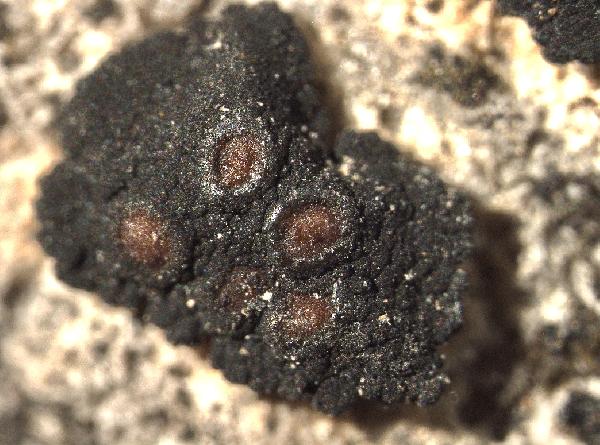
Pier Luigi Nimis - Department of Life Sciences, University of Trieste - CC BY-SA 4.0
TsB 18654
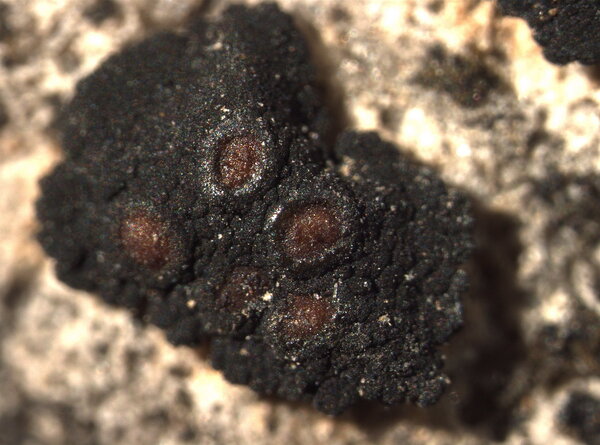
Pier Luigi Nimis - Department of Life Sciences, University of Trieste - CC BY-SA 4.0
TSB 18654
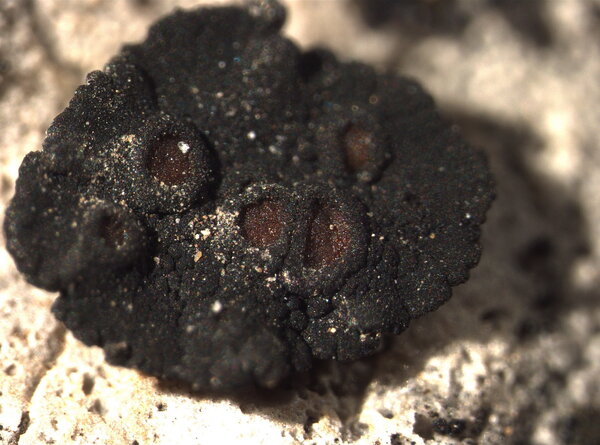
Pier Luigi Nimis - Department of Life Sciences, University of Trieste - CC BY-SA 4.0
TSB 18654
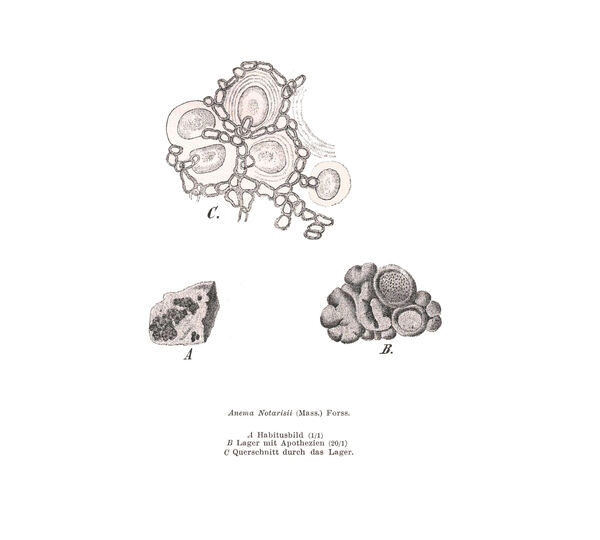
Zahlbruckner A. 1926. Lichenes (Flechten). In: Engler A. (ed.): Die natürlichen Pflanzenfamilien. 2nd ed., vol 8, W. Engelmann, Leipzig, 270 pp.
Growth form: Squamulose
Substrata: rocks
Photobiont: cyanobacteria, coccaceous (e.g. Gloeocapsa)
Reproductive strategy: mainly sexual
On otherwise dry surfaces with short periods of water seepage after rain
Commonnes-rarity: (info)
Alpine belt: absent
Subalpine belt: absent
Montane belt: absent
Dry submediterranean belt: rare
Humid submediterranean belt: rare
Padanian area: absent
pH of the substrata:
| 1 | 2 | 3 | 4 | 5 |
Solar irradiation:
| 1 | 2 | 3 | 4 | 5 |
Aridity:
| 1 | 2 | 3 | 4 | 5 |
Eutrophication:
| 1 | 2 | 3 | 4 | 5 |
Poleotolerance:
| 0 | 1 | 2 | 3 |
Altitudinal distribution:
| 1 | 2 | 3 | 4 | 5 | 6 |
Rarity
absent
extremely rare
very rare
rare
rather rare
rather common
common
very common
extremely common
Loading data...
Occurrence data
Predictive map

Pier Luigi Nimis - Department of Life Sciences, University of Trieste - CC BY-SA 4.0
TsB 18654
Pier Luigi Nimis - Department of Life Sciences, University of Trieste - CC BY-SA 4.0
TSB 18654
Pier Luigi Nimis - Department of Life Sciences, University of Trieste - CC BY-SA 4.0
TSB 18654