Verrucaria hakulinenii Pykälä & Myllys
in Pykälä & al., Lichenologist, 56, 5: 264, 2024.
Synonyms:
Description: Thallus crustose, thinly episubstratic, c. 0.05-0.1 mm thick, continuous, rimose to cracked-areolate, pale to medium green, sometimes with a brownish hue, turning pale brownish grey in the herbarium, the areoles, when developed, 0.2-0.8 mm wide; prothallus absent or very thin, brown. Cortex poorly developed, 10-30 μm thick, the cortical cells pale or brown; medulla not differentiated, the algal cells distributed throughout. Perithecia c. 110–200 per cm2, 0.13-0.26 mm across, half to 3/4 immersed, not leaving pits in the rock, often with a thin thalline cover except at the apex, the ostiole tiny, pale to dark, flat or depressed, c. 10-30 μm wide. Involucrellum reaching to base-level, c. 25-70 μm thick, appressed to the exciple or slightly diverging in lower part; exciple c. 0.15-0.24 mm across, the wall pale to medium brown, c. 22-25 μm thick; periphysoids branched, c. 17-25 x 1-2 μm, interascal filaments absent. Asci 8-spored, clavate, I-, fissitunicate, the wall thickened above, with an ocular chamber, dehiscent by extrusion of an endotunica to form a delicate rostrum, Verrucaria-type. Ascospores (17-)18-22(-25) x (6.5-)7.5-9.5(-11) μm. Photobiont chlorococcoid. Spot tests: K-, C-, KC-, P-, UV-. Chemistry: without lichen substances
Growth form: Crustose
Substrata: rocks
Photobiont: green algae other than Trentepohlia
Reproductive strategy: mainly sexual
Pioneer species
Commonnes-rarity: (info)
Alpine belt: rare
Subalpine belt: very rare
Montane belt: extremely rare
Dry submediterranean belt: absent
Humid submediterranean belt: absent
Padanian area: absent
pH of the substrata:
1 2 3 4 5

Solar irradiation:
1 2 3 4 5
Aridity:
1 2 3 4 5
Eutrophication:
1 2 3 4 5
Poleotolerance:
0 1 2 3
Altitudinal distribution:
1 2 3 4 5 6
Rarity
absent
extremely rare
very rare
rare
rather rare
rather common
common
very common
extremely common
Loading data...
Occurrence data
Predictive map
Source: Pykälä J, Kantelinen A, Myllys L. Seven new species of Verrucaria from calcareous and siliceous rocks of Finland. The Lichenologist. 2024;56(5):259-272. doi:10.1017/S002428292400029X - CC BY-NC 4.0
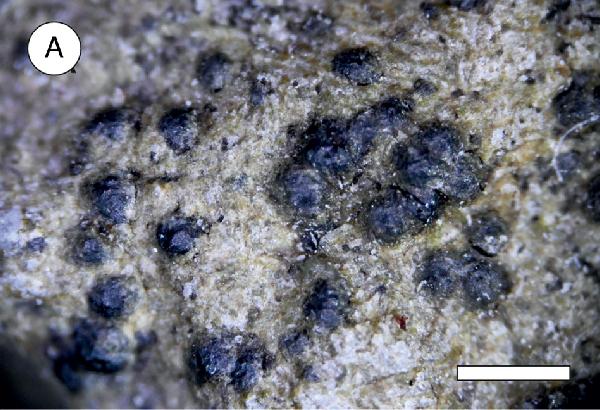
Verrucaria hakulinenii (holotype). Scale bar: 0.5 mm
Source: Pykälä J, Kantelinen A, Myllys L. Seven new species of Verrucaria from calcareous and siliceous rocks of Finland. The Lichenologist. 2024;56(5):259-272. doi:10.1017/S002428292400029X - CC BY 4.0
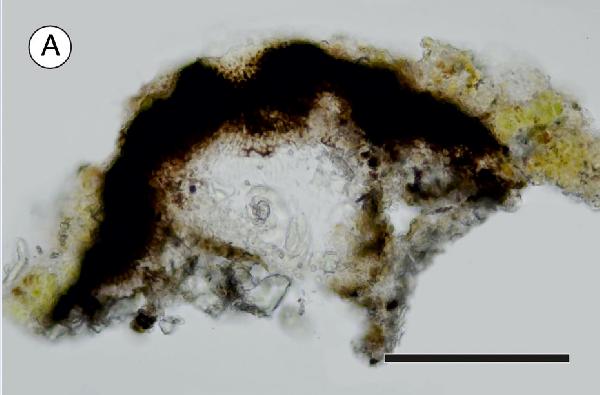
holotype - Scale: 0.1 mm
Growth form: Crustose
Substrata: rocks
Photobiont: green algae other than Trentepohlia
Reproductive strategy: mainly sexual
Pioneer species
Commonnes-rarity: (info)
Alpine belt: rare
Subalpine belt: very rare
Montane belt: extremely rare
Dry submediterranean belt: absent
Humid submediterranean belt: absent
Padanian area: absent
pH of the substrata:
| 1 | 2 | 3 | 4 | 5 |
Solar irradiation:
| 1 | 2 | 3 | 4 | 5 |
Aridity:
| 1 | 2 | 3 | 4 | 5 |
Eutrophication:
| 1 | 2 | 3 | 4 | 5 |
Poleotolerance:
| 0 | 1 | 2 | 3 |
Altitudinal distribution:
| 1 | 2 | 3 | 4 | 5 | 6 |
Rarity
absent
extremely rare
very rare
rare
rather rare
rather common
common
very common
extremely common
Loading data...
Occurrence data
Predictive map

Source: Pykälä J, Kantelinen A, Myllys L. Seven new species of Verrucaria from calcareous and siliceous rocks of Finland. The Lichenologist. 2024;56(5):259-272. doi:10.1017/S002428292400029X - CC BY-NC 4.0
Verrucaria hakulinenii (holotype). Scale bar: 0.5 mm